Healthcare service discovery has changed dramatically. AI-powered search is transforming how patients look for healthcare services. SEO strategies need to adapt quickly to this new reality.
Healthcare brands must adapt their SEO strategies. The digital world demands new approaches to SEO for healthcare services. Understanding emerging search patterns has become crucial. Local healthcare providers face new challenges as 70% of patients now consider using AI tools to research physicians.
These 9 essential patient search behaviors that will determine success in this AI-driven environment. You will learn how your practice can stay ahead of these changes and thrive.
9 Patient Search Patterns: SEO Tips for Healthcare Services
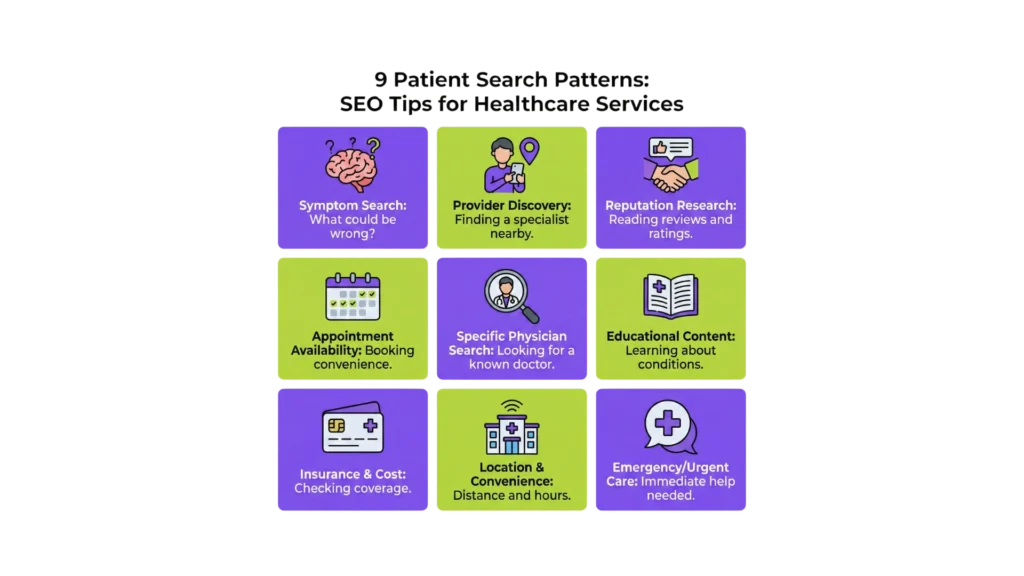
AI’s impact on search has changed how patients look for healthcare services online. Healthcare providers must understand these new behaviors to stay competitive in today’s digital world. Let’s look at the key search patterns that drive patient decisions and find practical SEO strategies to help your healthcare practice succeed.
1. Using Conversational Queries
Today’s patients don’t search like they used to. Instead of typing fragmented keywords like “cardiologist Chicago,” they’re asking complete questions: “Who’s the best cardiologist near me that accepts Blue Cross insurance?” This shift toward conversational search is driven by voice search technology and AI interfaces that understand natural language.
AI-powered search tools have accelerated this trend, encouraging patients to interact with search engines as they would with a human assistant. These tools are designed to understand context, intent, and nuance in ways traditional search algorithms couldn’t.
For healthcare services, optimizing for conversational queries requires a fundamental shift in SEO strategy:
- Create FAQ content that mirrors how patients actually ask questions. Develop comprehensive FAQ pages that address common patient questions in natural, conversational language. Group related questions together and provide thorough answers that anticipate follow-up questions.
- Optimize for long-tail keywords that reflect complete questions. Research and target phrases like “how to find a pediatrician who specializes in autism” rather than just “pediatrician autism.”
- Develop content that answers the “who, what, where, when, why, and how” of patient concerns. Create dedicated pages that address specific questions patients have about conditions, treatments, and your practice.
- Use schema markup to help AI better understand your content. Implement healthcare-specific structured data to clearly identify your services, specialties, conditions treated, and provider information.
Healthcare providers who adapt to conversational search patterns will find their content more likely to be featured in AI summaries and direct answers, significantly increasing visibility when patients search in this natural, conversational manner.
2. Searching for Specific Conditions and Symptoms
Patient searches often begin with symptoms or specific medical conditions. A headache might prompt a search for “sudden severe headache causes,” while a diagnosis might lead to queries about “best rheumatoid arthritis specialists near me.” These condition and symptom-specific searches represent crucial moments when patients are actively seeking medical guidance or providers.
AI search tools excel at identifying the most relevant and authoritative content for these specific medical queries. They prioritize content from sources that demonstrate expertise and provide comprehensive information on particular conditions.
To optimize for condition and symptom searches:
- Create condition-specific pages that thoroughly address each condition you treat. Develop dedicated pages for each major condition, procedure, or service you offer. Include information on symptoms, causes, diagnosis methods, treatment options, and recovery expectations.
- Use medical terminology alongside lay terminology. Include both technical terms physicians use and the everyday language patients use to describe their symptoms. For example, “elevated blood pressure” and “high blood pressure.”
- Include symptom checkers and self-assessment tools when appropriate. Interactive tools that help patients understand their symptoms can increase engagement while providing valuable information.
- Link related conditions and treatments to create comprehensive resource hubs. Connect related content to help patients explore relevant information and demonstrate the depth of your expertise to search engines.
Healthcare SEO services that prioritize condition-specific content see significant improvements in their ability to capture patients at crucial decision-making moments in their healthcare journey.
3. Trusting Verified Patient Reviews
Patient reviews have become a cornerstone of healthcare decision-making. Studies show that 71% of patients use online reviews as their first step in finding a new doctor, and 70% say a positive online reputation is the most important factor when choosing a provider.
What’s changed with AI-powered search is how these reviews are analyzed, summarized, and presented to patients. AI tools can now aggregate review sentiment across multiple platforms, identify common themes in patient feedback, and present this information in easy-to-digest summaries.
To leverage the power of patient reviews in your healthcare SEO strategy:
- Implement a systematic review generation strategy. Develop a consistent process for requesting reviews from satisfied patients across multiple platforms including Google Business Profile, Healthgrades, Vitals, and WebMD.
- Respond thoughtfully to all reviews, especially negative ones. When responding to negative reviews, show empathy, avoid defensive language, and offer to resolve concerns offline—all while maintaining HIPAA compliance.
- Highlight positive reviews on your website with proper consent. Feature testimonials from patients who have given permission to share their feedback, focusing on specific aspects of care that showcase your strengths.
- Use structured data markup for reviews on your website. Implement review schema to help search engines understand and potentially display your star ratings in search results.
- Monitor and analyze review patterns for service improvement. Use review feedback to identify trends and address operational issues that may be impacting patient satisfaction.
Healthcare brands that effectively manage their online reputation gain a significant advantage in AI-powered search results, as these systems increasingly factor authentic patient feedback into their ranking algorithms.
4. Relying on AI Summaries for Quick Answers
A growing number of patients now rely on AI-generated summaries to quickly access healthcare information without having to visit multiple websites. These summaries appear at the top of search results and pull information from various authoritative sources to provide concise answers to patient queries.

For healthcare providers, being included in these AI summaries is becoming as important as ranking highly in traditional search results. The challenge is creating content that AI systems deem worthy of inclusion in these prominent positions.
To optimize for inclusion in AI summaries:
- Structure content with clear headings and concise paragraphs. Organize information logically with descriptive headings, bullet points, and short paragraphs that can be easily scanned and understood by both humans and AI systems.
- Provide direct, factual answers to common questions. Begin sections with clear, straightforward answers before elaborating with details, examples, or context.
- Use data and statistics from reputable sources. Include relevant data points from respected medical journals, government health agencies, and professional medical associations.
- Ensure technical accuracy while maintaining readability. Have content reviewed by healthcare professionals for accuracy while keeping the language accessible to patients without medical backgrounds.
The best SEO services for healthcare providers now prioritize creating “AI-friendly” content that stands a higher chance of being featured in these influential summary positions.
5. Skipping AI Overviews for Traditional Sources
Despite the growing prominence of AI summaries, a significant segment of patients deliberately bypass these overviews in favor of traditional, authoritative healthcare sources. This behavior is particularly common for complex medical issues, serious diagnoses, or when patients are seeking in-depth information.
These patients value content from established medical institutions, academic medical centers, and recognized healthcare authorities. They’re looking for depth, expertise, and credibility rather than convenience.
To appeal to this patient segment:
- Signal expertise, authority, and trustworthiness in your content. Include author credentials, cite reputable medical sources, and showcase relevant institutional affiliations.
- Develop comprehensive, in-depth resources on topics within your specialties. Create detailed guides, explainer articles, and educational resources that go beyond surface-level information.
- Incorporate research findings and clinical data when appropriate. Reference peer-reviewed studies and explain how research influences your approach to treatment.
- Highlight professional credentials, academic appointments, and research contributions. Feature the qualifications of your providers prominently, including board certifications, hospital affiliations, and academic positions.
For healthcare local SEO services, building this authority requires both technical SEO expertise and high-quality medical content that demonstrates genuine expertise.
6. Asking for Doctor Recommendations in AI Tools
Patients are increasingly turning to AI assistants and chatbots to ask for doctor recommendations. Rather than simply searching “neurologist near me,” they might ask an AI assistant, “Which neurologist in Denver has the best reviews for migraine treatment?”
This interaction style changes how patients discover healthcare providers and what information influences their decisions. AI tools often prioritize different factors than traditional search engines when making these recommendations.
To optimize for AI-powered recommendations:
- Ensure complete and consistent NAP (Name, Address, Phone) information across all platforms. Verify that your business information is identical across your website, Google Business Profile, directory listings, and social media accounts.
- Develop specialty and sub-specialty-specific content. Create pages that highlight your expertise in specific conditions or treatments, as AI tools often match patient queries with highly specific provider capabilities.
- Build a robust Google Business Profile with regular updates. Keep your profile active with posts, updated hours, services, and responses to questions, as many AI tools pull heavily from this data.
- Create provider bio pages that highlight unique qualifications and approaches. Develop distinctive provider profiles that showcase not just credentials but also practice philosophy, special interests, and patient approach.
Healthcare local SEO services that optimize for these AI recommendation systems gain significant advantages in connecting with patients at the moment they’re actively seeking a provider.
7. Using Multiple Platforms to Cross-Check Info
Today’s patients rarely rely on a single source when making healthcare decisions. Instead, they cross-reference information across multiple platforms—comparing a provider’s website with their social media presence, online reviews, professional directories, and insurance network listings.
This cross-platform verification has become even more common in the age of AI, as patients seek to confirm the accuracy of AI-generated summaries and recommendations. Inconsistencies across platforms can quickly undermine patient trust.
To create a strong cross-platform presence:
- Audit and align all digital touchpoints for consistency. Ensure your messaging, services, and basic information are consistent across your website, social media, directory listings, and review platforms.
- Develop a unified content strategy across channels. Create content that works together across platforms, with each channel serving a distinct purpose while maintaining a consistent voice and message.
- Build profiles on healthcare-specific platforms. Maintain active profiles on healthcare directories like Healthgrades, Vitals, WebMD, and specialty-specific directories relevant to your practice.
- Implement a monitoring system for mentions across the web. Use tools to track when and where your practice is mentioned online, allowing you to address inaccuracies or respond to comments across platforms.
Healthcare brands SEO services increasingly focus on this multi-platform approach, recognizing that visibility across multiple channels is essential for building patient trust in an AI-driven search landscape.
8. Favoring Doctors with Strong Online Presence
Patients increasingly equate a strong online presence with practice quality and reliability. A comprehensive digital footprint that includes an informative website, active social media, educational content, and positive reviews signals to patients that a provider is established, transparent, and engaged.

AI search tools amplify this effect by aggregating information from across the web to create a more complete picture of healthcare providers. Those with minimal online presence become nearly invisible in this environment.
To build a robust online presence:
- Develop a content hub with educational resources. Create a regularly updated blog, resource center, or video library that addresses patient questions and showcases your expertise.
- Establish a thoughtful social media strategy. Focus on 2-3 platforms where your target patients are active, posting a mix of educational content, practice updates, and community engagement.
- Create video content featuring your providers. Develop short videos explaining common conditions, treatments, or answering frequently asked questions to humanize your practice.
- Participate in online health communities and discussions. Contribute to relevant online forums, webinars, or social media discussions where you can provide valuable expertise.
SEO services healthcare providers need today must go beyond traditional SEO tactics to help build this comprehensive online presence that both patients and AI search tools favor.
9. Searching Based on Insurance and Location
Practical considerations—particularly insurance coverage and location—remain primary filters in patient search behavior. Nearly 60% of patients consider insurance acceptance their top criterion when selecting a provider, while 58% prioritize proximity to home or work.
AI-powered search has made it easier for patients to filter providers based on these practical factors, with tools that can automatically match patient insurance information with in-network providers or calculate true drive times rather than simple distances.
To optimize for insurance and location-based searches:
- Clearly list accepted insurance plans in a prominent location. Create a dedicated insurance page that lists all accepted plans, with regular updates as network participation changes.
- Implement local SEO best practices for each practice location. Optimize for local search with location-specific pages, local keywords, and Google Business Profile optimization for each physical location.
- Use schema markup for location and insurance information. Implement structured data that clearly communicates your locations, service areas, and accepted insurance plans to search engines.
- Consider creating neighborhood-specific content. Develop content that addresses the specific needs of communities you serve, demonstrating your understanding of local health concerns.
- Highlight transportation options and accessibility information. Include details about parking, public transportation, and facility accessibility to help patients plan their visits.
Healthcare local SEO services that emphasize these practical factors help practices connect with patients specifically looking for providers that meet their insurance and location requirements.
Conclusion
AI-powered search is reshaping how patients look for healthcare information, and your practice needs to understand these nine vital search patterns to succeed online. Patient search behavior has evolved. They now use specific symptom queries, rely on verified reviews, and turn to AI tools for medical guidance. Traditional information sources remain popular, but AI-assisted healthcare decisions gain more traction every day.
Success demands more than simple website updates. You need an integrated approach that tackles all but one of these patient search behaviors at once. Successful practices will excel at showing their expertise, building trust online, and creating content that speaks to both people and AI systems.
Want to position your practice for success in this AI-driven search world? RankFast‘s healthcare SEO services can help you put these strategies to work and keep your practice visible to patients, whatever way search technology changes. Search methods evolve, but your core mission stays the same—connecting patients who need your expertise with your exceptional care.
FAQs
What role do patient reviews play in healthcare decision-making?
Patient reviews have become a critical factor in healthcare decision-making. Most patients read multiple reviews before choosing a doctor, and a significant percentage would avoid physicians with less than four stars. Healthcare providers need to prioritize review management as part of their SEO strategy to maintain a positive online reputation.
How important is a strong online presence for healthcare providers?
A strong online presence is now essential for healthcare providers. Patients favor doctors with comprehensive digital footprints, including professional websites, active social media channels, and consistent information across various online platforms. This digital presence serves as a critical differentiator in attracting new patients.
Are patients still relying on traditional sources for medical information?
Yes, many patients still prefer traditional sources for medical information. A significant percentage of people trust physicians as their most reliable source of health information. While AI tools are gaining popularity, many patients actively skip AI overviews in favor of information directly from healthcare professionals.
How do insurance and location affect patient search behavior?
Insurance coverage and location remain primary factors in patient decision-making. Many patients prioritize finding providers who accept their insurance and are conveniently located. Healthcare providers should clearly list accepted insurance plans and maintain accurate location information across all platforms to optimize for these search behaviors.