Most businesses that hesitate to hire an SEO agency have the same two questions. What will it actually cost? And what will we actually get back?
These are the right questions. The problem is that most SEO agencies answer them with traffic projections and keyword rankings. Neither of those is revenue. And in 2026, with AI reshaping search results and competition intensifying across almost every industry, vague metrics are a worse answer than ever.
This post gives you the real ROI breakdown: what professional SEO services cost at different tiers, what drives actual return on that investment, and how to figure out whether an SEO agency is worth the spend before you commit to anything.
Organic Search Still Drives More Revenue Than Any Other Channel
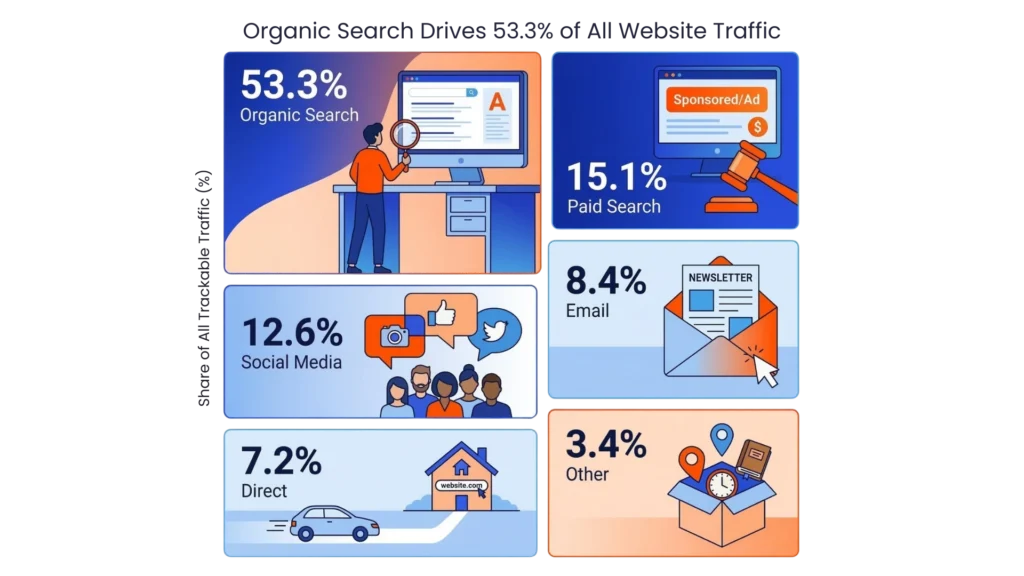
Before we get into pricing and ROI math, it’s worth grounding the conversation in one number. According to BrightEdge research, organic search drives 53.3% of all trackable website traffic: more than paid search, social, email, and display combined. For B2B companies specifically, organic search accounts for 44.6% of all revenue.
That’s the channel a professional SEO agency is optimising for. And despite what the headlines about AI Overviews suggest, that dominance hasn’t collapsed. BrightEdge’s 2025 analysis found that while AI search referral traffic is growing fast, it still accounts for less than 1% of referrals, while organic search remains the primary traffic driver and delivers the majority of conversions.
Why organic beats paid on a long enough timeline
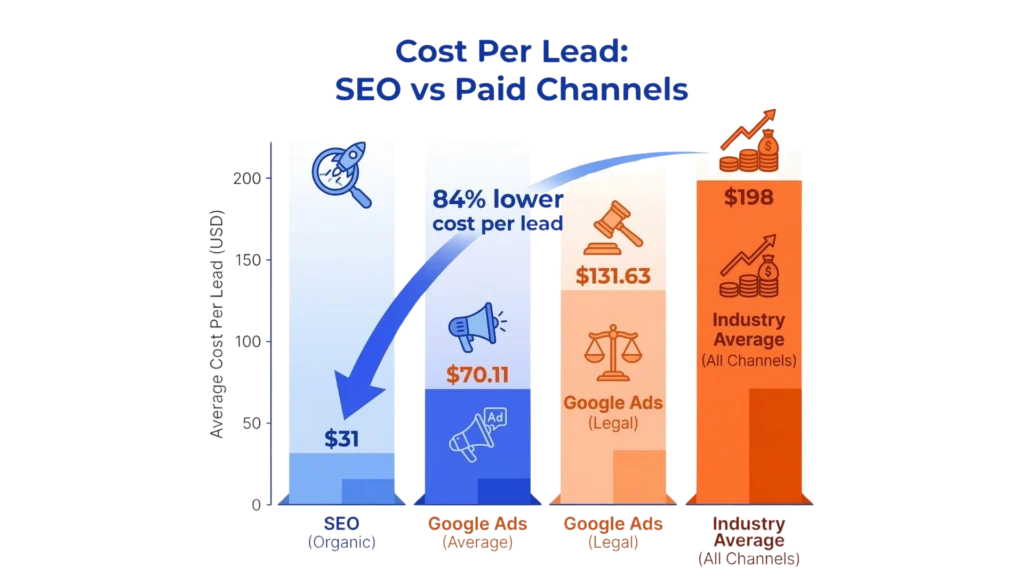
Paid search gives you immediate visibility. You pay per click, traffic stops the moment the budget runs out, and costs in competitive industries keep climbing. According to WordStream’s 2025 Google Ads benchmarks, the average cost per lead across Google Ads is now $70.11, up from $66.69 the year before. In high-value industries like legal services, the average hits $131.63 per lead.
SEO works differently. The investment is front-loaded, and results build over time, but traffic doesn’t stop when you stop paying. Research from SeoProfy SEO ROI Statistics 2025–26 puts the average cost per lead from SEO at $31, compared to a $198 industry average across other channels. That’s an 84% cost advantage once the channel reaches maturity.
The Core ROI Principle
Paid ads produce immediate but temporary traffic. SEO produces compounding, long-term traffic. The cost per lead from SEO drops over time as rankings hold. The cost per lead from paid ads either stays flat or rises.
What’s actually changed in 2026
AI Overviews have reduced click-through rates for informational queries; broad educational searches that were never the main conversion driver anyway. The queries that actually drive leads and sales (local searches, commercial comparisons, transactional searches) are largely unaffected. Businesses getting the best returns from SEO agencies in 2026 are targeting those queries, measuring against revenue outcomes, and treating local SEO as a separate workstream from broad organic SEO.
Agencies still selling a 2019 playbook (keyword rankings as the primary KPI, informational blog content as the main deliverable) are underperforming. That’s worth screening for before you hire an SEO agency.
What a Good SEO Agency Actually Does Each Month
The phrase “SEO services” gets used to cover a wide range of activities, some of which produce results and some of which produce reports. Before evaluating SEO agency pricing or deciding whether to hire, it’s worth understanding what professional work actually looks like in practice.
Technical SEO
Technical SEO addresses the infrastructure of your website: whether search engines can find, crawl, index, and understand your pages. It’s not glamorous, but it’s foundational. A site with strong content and weak technical health consistently underperforms a site with average content and solid technical structure.
- Crawlability and indexation: making sure search engines can access all important pages.
- Site speed: Core Web Vitals scores directly affect rankings and conversions. A one-second delay in mobile load time has been shown to reduce conversions by up to 20%.
- Site architecture: how pages link to each other and how authority is distributed across the site.
- Duplicate content: preventing your own pages from competing against each other in search results.
- Schema markup: structured data that helps Google understand and display content correctly, including rich results that capture 58% of clicks compared to 41% for non-rich results in equivalent positions.
On-page SEO
On-page SEO covers the optimisation of individual pages: titles, headings, content structure, internal linking, and keyword targeting. A professional SEO agency doesn’t just add keywords to existing pages. It restructures pages around how your target audience actually searches, with content depth that matches what Google needs to see to rank a page for competitive terms.
This includes content strategy: deciding which pages to build, which keywords to target on each page, and how to structure content so it serves both search intent and conversion goals. On-page work without a coherent strategy produces isolated page improvements rather than compounding authority.
Off-page SEO
Off-page SEO is primarily about link building: earning links from other websites that signal credibility and authority to Google. This is also where the industry has the most variation in quality. Agencies that buy links or use automated outreach to place links on irrelevant sites can trigger penalties that set rankings back by months.
Legitimate off-page work means earning editorial links through content that other sites genuinely want to reference, digital PR that generates coverage in industry publications, and partnerships that produce natural link placement. It compounds over time rather than carrying risk.
Local SEO
For businesses serving customers in specific geographic areas, local SEO is often the highest-return component of an SEO service package. According to AIOSEO SEO Statistics 2026, 46% of all monthly Google searches have local intent, and when a local search is performed on mobile, 18% lead to a sale within 24 hours.
Local searches with clear commercial intent: “plumber near me”, “accountant in [city]”, “best marketing agency [city]”, drive direct enquiries and often convert faster than broad organic traffic. Effective local SEO covers Google Business Profile optimisation, citation building, local page creation, and review strategy. Searching “seo services near me” is itself a local SEO query, and businesses that rank locally for their service keywords consistently see faster lead flow.
What SEO Agencies Charge in 2026 (and What You Get at Each Tier)
SEO agency pricing varies widely, and that variation isn’t always correlated with quality. The cheapest options often produce nothing measurable. The most expensive don’t always outperform mid-tier agencies. Here’s how the market is structured.
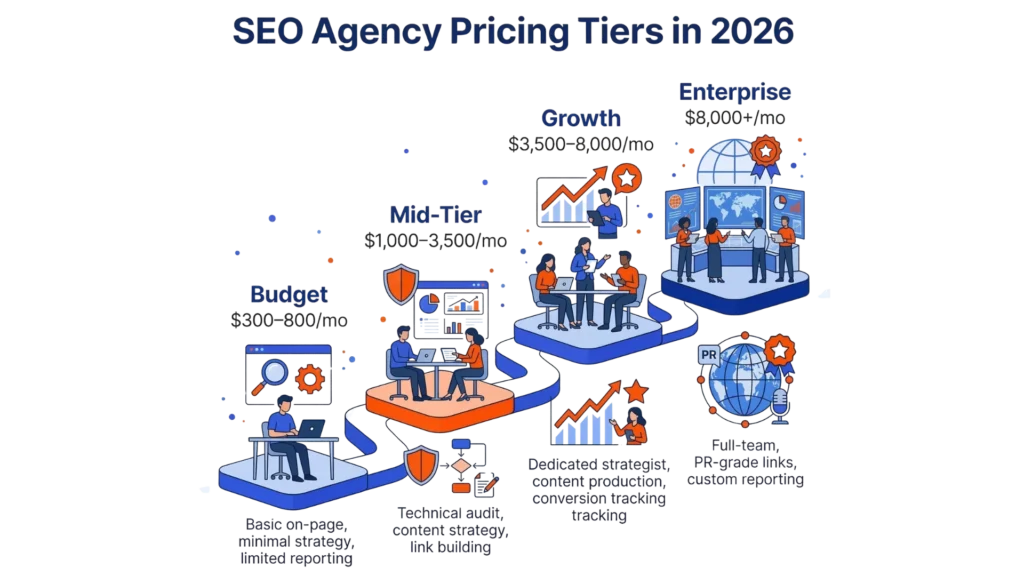
A note on budget-tier agencies: the cost of bad SEO is higher than the cost of no SEO. Agencies using black-hat link building or mass-producing thin content can trigger Google penalties that take 6–12 months to recover from. When you’re comparing SEO agency pricing, factor in risk alongside the monthly fee.
For context, SeoProfy’s 2026 statistics show that 74% of small businesses invest in SEO, with an average monthly spend of $497, which sits squarely in the budget tier and often reflects limited outcomes to match.
Pricing Red Flag
Any agency guaranteeing page one rankings within 30–60 days for a fixed monthly fee under $500 is either misleading you or using tactics that will hurt you. Legitimate SEO takes 4 to 6 months to show meaningful results in most markets.
Retainer vs. project-based pricing
Most SEO agencies work on monthly retainers because SEO is an ongoing discipline, not a one-time fix. Project-based pricing (a flat fee for an audit, a site migration, or a specific content build) makes sense for defined scopes but doesn’t cover the ongoing monitoring and iteration that keeps rankings stable over time.
If you’re evaluating a retainer, the right question isn’t just what the monthly fee is. It’s what work gets done each month and how that work connects to business outcomes, not just ranking reports.
The ROI Math: How to Work Out Whether SEO Is Worth It for Your Business
Here’s a practical ROI framework based on conservative assumptions. This isn’t best-case modelling. It’s what realistic results look like for mid-market businesses investing in professional services of SEO.
The inputs you need before running the numbers
- Average transaction value (or client lifetime value for service businesses
- Current close rate on inbound leads
- Target monthly search volume for your primary keywords (your SEO agency should provide this
- Expected click-through rate from page one rankings: roughly 3–5% for positions 4–10, and 15–25% for positions 1–3
- Monthly SEO agency retainer cost
Worked example: B2B SaaS company
Company: B2B SaaS product, average contract value $4,800/year, 20% close rate on demos, 400 organic visitors/month currently.
| Metric | Month 6 (Conservative) | Month 12 (Conservative) |
| Organic visitors/month | 1,200 | 2,800 |
| Demo requests (2.5% conversion) | 30 | 70 |
| New customers (20% close rate) | 6 | 14 |
| Monthly revenue from SEO | $2,400 | $5,600 |
| SEO agency monthly cost | $2,500 | $2,500 |
| Net monthly return | ≈ Break-even | +$3,100/mo |
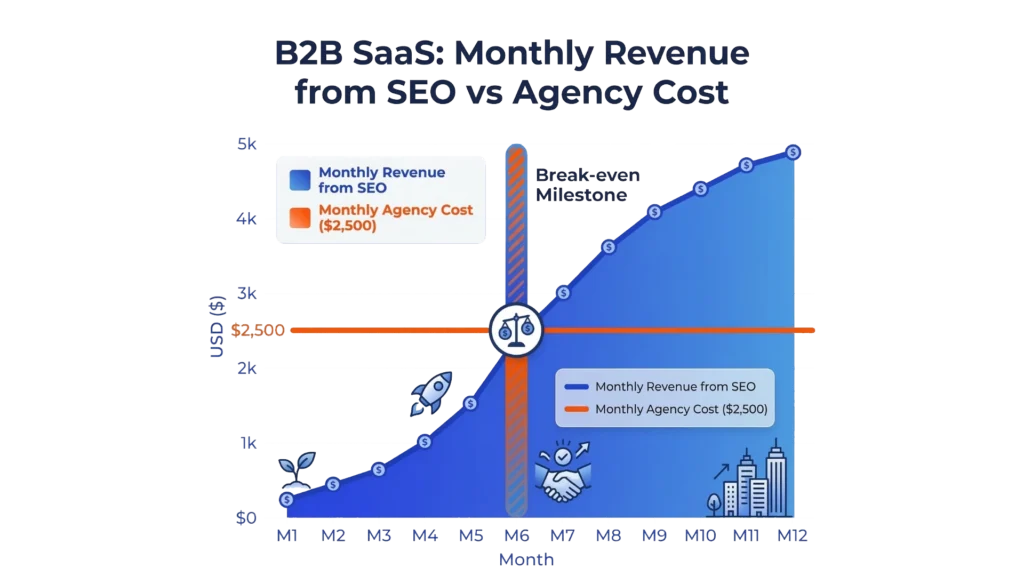
By month 12, the agency investment is generating $3,100 net above its cost each month. By month 18–24, that same $2,500 investment commonly produces $8,000–12,000 in monthly attributed revenue as rankings compound. This aligns with FirstPageSage SEO ROI Statistics 2026, which puts the average ROI of a thought leadership SEO campaign for B2B SaaS at 702% over a three-year period.
Worked example: local service business
Company: HVAC business, average job value $1,200, 40% close rate on inbound calls, currently ranking for a few long-tail terms but not competitive city-level keywords.
| Metric | Month 4 (Local SEO Focus) | Month 9 |
| Organic + local pack calls/month | 22 | 48 |
| Booked jobs (40% close rate) | 9 | 19 |
| Monthly revenue from SEO | $10,800 | $22,800 |
| SEO agency monthly cost | $1,500 | $1,500 |
| Net monthly return | +$9,300 | +$21,300 |
Local service businesses often see faster ROI timelines than B2B companies. Local pack rankings can improve in 2–4 months versus 5–8 months for broad organic rankings. The intent of searchers is higher, and the path from search to phone call is shorter. The investment is lower, and the return per conversion is often easier to attribute directly to SEO activity.
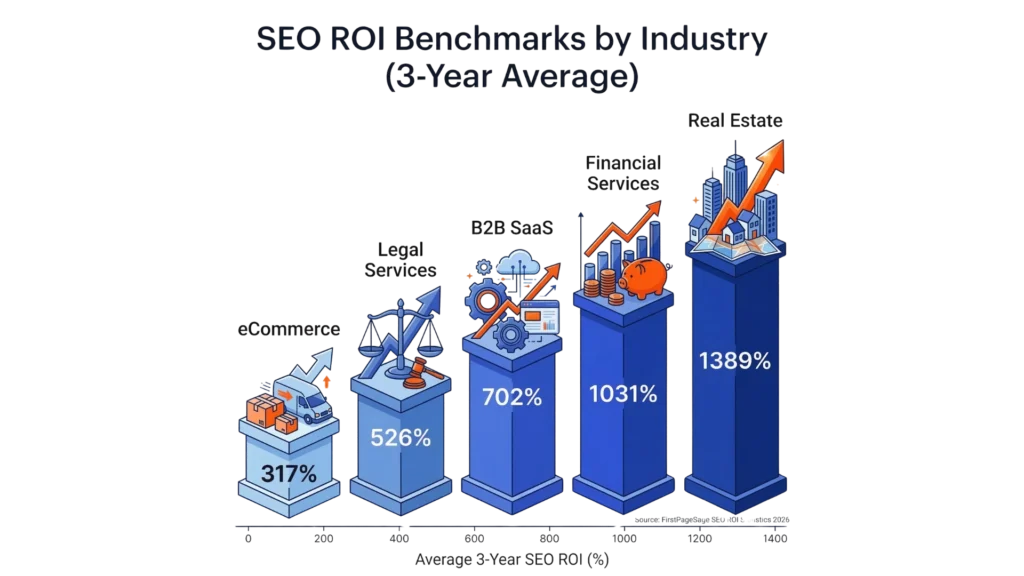
These are 3-year averages from thought leadership campaigns.
Hiring In-House vs. Working With an SEO Agency
Some businesses consider building an internal SEO capability instead of engaging an agency. This is worth thinking through honestly.
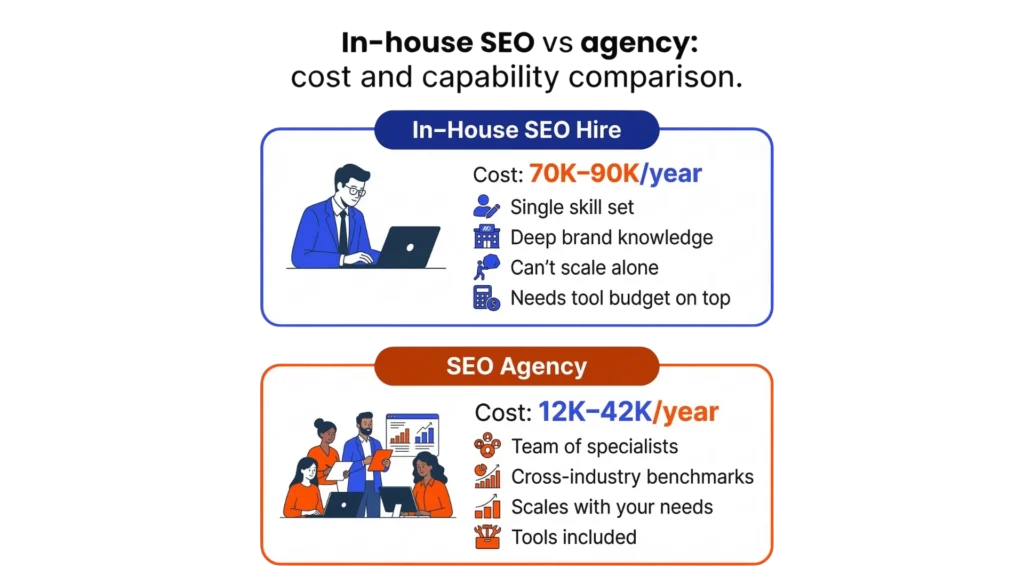
For most businesses under $10M in revenue, an SEO agency delivers more output per dollar than a single in-house hire. The average SEO specialist salary in the US is $86,000/year.
And that’s before tools, content budget, and the fact that one person can’t realistically execute technical SEO, content production, and link outreach at a meaningful scale at the same time.
How To Tell a Good SEO Agency From a Mediocre One
The actual benefits of SEO agency depend entirely on which agency you choose. Here’s what good looks like and what should make you walk away.
What good agencies do
- Start with a technical audit before proposing a strategy. No legitimate agency recommends tactics without first seeing your baseline.
- Define success in business metrics (leads generated, revenue attributed, cost per acquisition), not just rankings or traffic volume.
- Show examples of work done for businesses similar to yours, with results they can actually walk you through.
- Explain their link building approach specifically: what types of sites they target and how they approach outreach.
- Give you a realistic timeline. In most markets: 4–6 months for initial ranking movement, 6–12 months for meaningful ROI.
- Provide monthly reporting that connects activity to outcomes, not just a dashboard of impressions.
Red flags that should end the conversation
- Guaranteed rankings on specific keywords within 30–90 days
- Pricing so low it can’t support real human work (under $500/month for a full-service retainer)
- No clear answer on where links will come from or how content will actually be produced
- Reports that show impressions and traffic with no conversion or revenue context
- Deliverables and assets that belong to the agency, not to you, when the contract ends
- No client references or case studies from businesses in your industry or size range
The Right Question to Ask Every Agency
Ask: ‘What does success look like for my business in month 12, and what should we be seeing by month 3 to know we’re on track?’ A vague or defensive answer tells you everything.
Questions worth asking before you sign
- Who will actually work on my account day-to-day, and what’s their experience level?
- How do you approach industries or markets you haven’t worked in before?
- What happens to the content and links if we end the relationship?
- How do you adjust strategy if rankings haven’t moved after four months?
- How do you stay current with algorithm updates, and how does that affect what you do for active clients?
Conclusion
If you’re currently relying on paid ads, referrals, or word of mouth to grow, organic search is the channel that makes those results consistent and compounding. RankFast builds SEO strategies around your revenue goals, not vanity metrics.
Talk to our team about what a realistic SEO strategy looks like for your industry, your market, and your growth targets. No guaranteed rankings, no template strategies; just a clear picture of what the work involves and what it should return.
Frequently Asked Questions
What’s the difference between a cheap SEO agency and an expensive one?
The difference usually comes down to three things: where links come from, how content gets produced, and whether strategy is tailored or template-based. Budget agencies often use the same content frameworks and link tactics across all clients, regardless of industry. Higher-tier agencies invest time understanding your business, competitive landscape, and revenue model before building a strategy. That research is what the additional cost is paying for.
Should I invest in SEO or paid ads?
For most businesses, the answer is both, but sequenced correctly. Paid ads deliver immediate leads while SEO builds the organic foundation. As SEO compounds and organic traffic grow, you can reduce paid spend without losing lead volume. The mistake is treating them as alternatives. Businesses that rely entirely on paid ads end up dependent on a channel where costs only go up year on year.
What does a full-service SEO agency actually include?
A full-service SEO agency typically covers a technical audit and ongoing technical maintenance, keyword research and content strategy, on-page optimisation of existing pages, new content creation, link building, local SEO where relevant, and monthly performance reporting. Some agencies also include conversion rate optimisation, which is worth asking about because traffic that doesn’t convert produces no ROI regardless of volume.
How do I know if my current SEO agency is actually doing good work?
Three signals matter more than ranking reports. First, are the keywords you’re ranking for driving traffic that converts, not just impressions? Second, is the quality of links being built to your site improving (you can verify this in Ahrefs or Semrush)? Third, is your agency proactively adjusting strategy, or sending the same report every month regardless of results? According to Conductor research cited by SeoProfy 2026, 91% of marketers report that SEO had a positive impact on their website performance and marketing goals. If you’re not in that 91%, the problem is either the agency or the strategy, and it’s worth finding out which.