Here is a problem most dental practices share: the phone is not ringing as much as it should. The schedule has gaps. New patient numbers are flat or barely growing. Meanwhile, the practice down the street with no obvious clinical advantage seems consistently full.
The difference, in most cases, is not the quality of care. It is visibility. Specifically, it is local search visibility. When someone in your area searches for a dentist near me, an emergency dentist open Saturday, or a cosmetic dentist in your city, who appears first? If it is not you, it is your competition and that patient is booking their appointment with someone else.
This post breaks down exactly how dental SEO marketing works in 2026, what a real campaign produces in terms of new patient volume and revenue, and what separates practices with full schedules from those still relying on word of mouth and referrals alone. We will use a real DSO case study as the anchor throughout, and show the strategies, timelines, and ROI figures behind it.
If you are a practice owner weighing whether to invest in a dental SEO agency, or you are already spending on SEO and not seeing the results you expected, this is where to start.
The Scale of the Opportunity: Why Every Practice Needs to Be Found Online
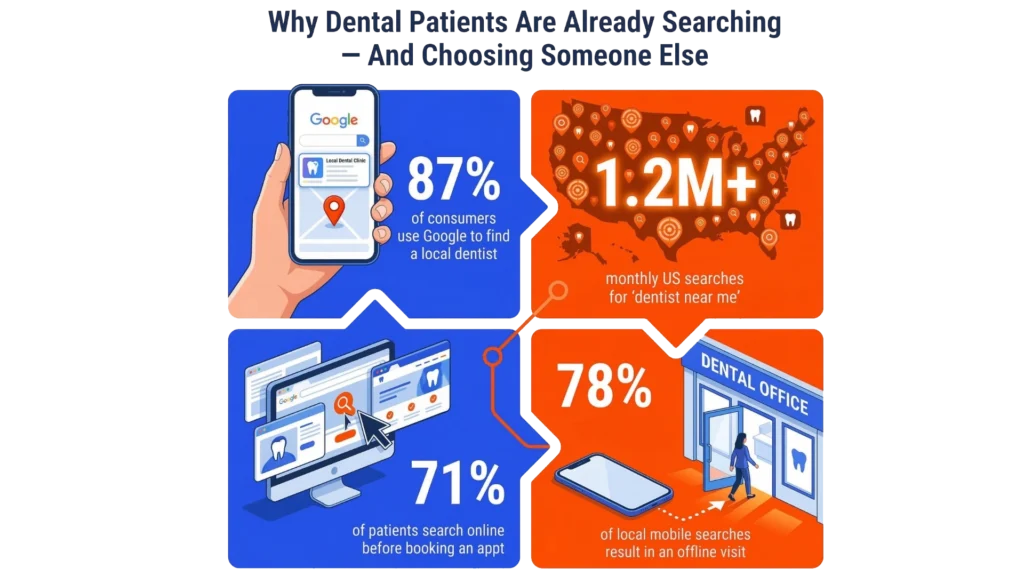
The U.S. dental services market is valued at $172.6 billion and projected to reach $254.7 billion by 2034. The patients driving that growth are already searching for dental care online. 87% of consumers use Google to find a local business, and there are more than 1.2 million monthly U.S. searches for the phrase dentist near me alone. Patients are not browsing passively. They are searching with urgency and intent.
Consider what happens at the moment of need. Someone wakes up with a toothache at 7 am and searches for an emergency dentist open now. That patient has already made their decision. They just need to choose who to call. Whichever practice appears first in the local pack captures that call. 78% of local mobile searches result in an offline visit within 24 hours, and 71% of patients run an online search before scheduling an appointment. This is one of the most direct and measurable patient acquisition pipelines in any service industry.
The visibility gap that most practices are missing
Most dental practices have a website. Most have claimed their Google Business Profile. Many have some reviews. But having these things and having them properly optimized are completely different situations. Research from My Social Practice shows that the top three positions in Google’s local pack generate 300% more enquiries than positions four through ten. If your practice is ranking fourth or fifth in your market, you are effectively invisible to the majority of patients actively searching.
The practices appearing at the top of local search are not there by accident. They have invested in dental practice SEO with a clear, sustained strategy built over months and compounded over years. The good news is that the gap is closeable. Practices that invest now consistently outperform those that wait, because search authority builds over time in a way that paid advertising simply does not.
The Real Financial Case: What a New Patient Is Actually Worth
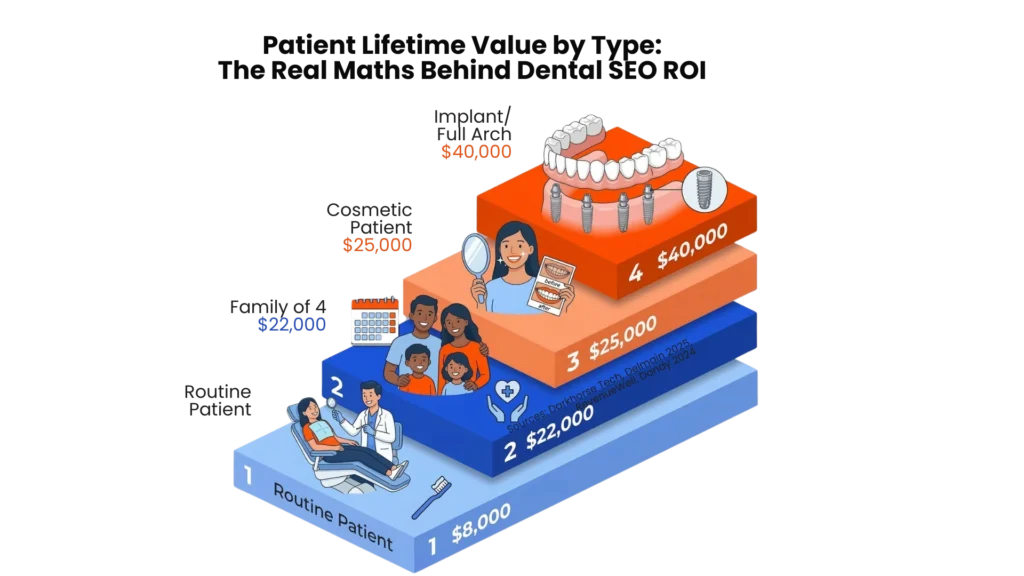
Before evaluating the cost of dental SEO services, it is essential to establish what you are paying for. Most dental marketing conversations center on the cost of a new patient visit. The far more relevant number is the lifetime value of that patient to your practice.
For a general dental practice, lifetime patient value ranges between $4,500 and $22,000 depending on treatment mix, retention, and referral behaviour, with $10,000 widely cited as a working average for planning purposes. For cosmetic and implant patients, the numbers are significantly higher. A practice consultant cited by Darkhorse Tech places the average lifetime value at $22,000, while True Dental Success estimates up to $45,000 over a 20-year relationship when high-value treatments are included.
A survey of nearly 13,000 dental practices found that gross production per patient averages around $4,200 annually. Assuming an average patient retention period of 8 to 12 years and an average attrition rate of 17% per year, a standard general dental patient represents between $8,000 and $22,000 in lifetime direct revenue before accounting for referrals.
The referral multiplier that changes the maths entirely
Every new patient acquired through SEO carries a referral value on top of their direct lifetime value. The formula from Dandy shows this clearly: if a patient has a $5,000 direct lifetime value and refers an average of three patients over their time with your practice, the total value including referrals rises to $20,000. For a practice with a higher average treatment mix, those referral chains are even more valuable.
Against a monthly dental SEO agency retainer of $1,500 to $2,500, a campaign needs to produce roughly one or two new patients per month to break even on immediate revenue alone. Most well-run dental SEO campaigns produce far more than that and because those patients stay for years and refer others, the compounding return over 12 to 36 months dwarfs the monthly spend.
The ROI Starting Point
If your SEO campaign generates 10 new patients per month at an average first-visit value of $800, that is $8,000 in immediate monthly revenue against a $2,000 retainer: a 300% return before lifetime value or referrals. Successful dental SEO campaigns typically achieve 3:1 to 5:1 returns in year one, compounding significantly into year two as domain authority accumulates.
Case Study: A DSO Goes From 15 to 38+ New Patients Per Location in Six Months
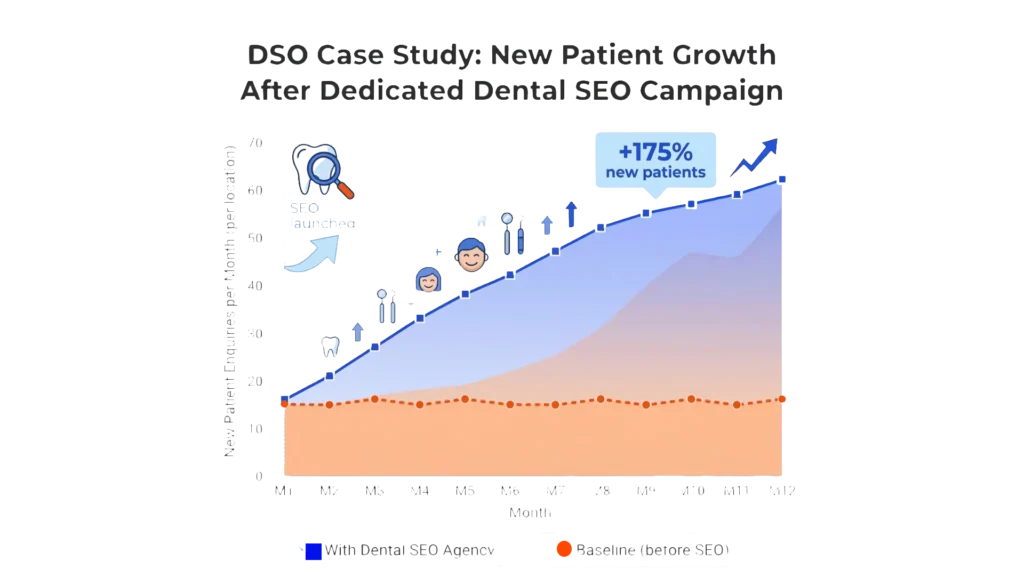
To make the strategy concrete, here is a breakdown of a real, published dental SEO case study: dental marketing services that achieved measurable, documented results worth examining closely.
The practice: stalled growth despite nine months of digital marketing spend
A multi-location dental marketing services had been working with a general digital marketing agency for nine months. New patient enquiries were averaging around 15 per month per location, well below the 40+ that their capacity could comfortably accommodate. The primary frustration: their agency was producing reports but not results. This mirrors the experience described in Arcane Marketing’s published dental DSO case study, where a practice with three locations and seven dentists found its performance stagnant for over nine months before switching agencies.
The goals were unambiguous: increase new patient volume enough to justify opening an additional location, shift the patient mix towards higher-value cosmetic and implant treatments, and build a sustainable organic channel that did not disappear the moment advertising spend paused.
Phase 1: Diagnosis before any strategy
The campaign began with a comprehensive audit of the existing digital presence. Not with content. Not with ad campaigns. The audit first. What it revealed was a familiar and fixable picture:
- Google Business Profiles across all locations were incomplete, with inconsistent categories and sparse photos
- Service pages existed but were templated, generic, and carried no location-specific content or targeted keywords
- NAP data (name, address, phone) was inconsistent across more than 50 online directories, actively suppressing local pack visibility
- The site had failing Core Web Vitals scores: mobile load times above 5 seconds, failing the 3-second threshold that Google now uses as a ranking signal
- Zero dedicated pages targeting emergency or cosmetic treatment queries, despite these having the highest conversion rates
- The review response rate was under 20%, and no systematic process existed for generating new reviews consistently
This diagnostic phase is what most practices skip, and it is why most dental SEO campaigns underperform. Without knowing precisely what is broken, you optimize in the wrong direction.
Phase 2: Technical and GBP foundation (months 1–3)
Technical fixes came first. Core Web Vitals issues were corrected, bringing mobile load time from over 5 seconds to under 2.5 seconds. NAP data was normalized across all major directories. Google Business Profiles at all locations were rebuilt: correct primary category set to Dentist, all relevant secondary categories added (Cosmetic Dentist, Emergency Dental Service, Pediatric Dentist, where applicable), services section completed with specific treatment names, current photos uploaded, including treatment rooms and staff, and Q&A populated with high-intent patient questions that patients actually search.
LocalBusiness and Dentist schema markup was implemented across all location pages. This structured data makes the site content machine-readable for both Google’s ranking systems and the AI tools that increasingly surface local recommendations directly in search results.
The result of the GBP rebuild alone: Google Business Profile views increased by over 60% within six weeks, and call volume from the map pack started rising before a single new page of content was published. Technical fixes produce returns quickly because they unlock the potential of all existing content that was previously underperforming.
Phase 3: Service pages and keyword targeting (months 2–5)
The content strategy opened with the highest-value service pages: dental implants, Invisalign and clear aligners, emergency dentistry, cosmetic dentistry, and teeth whitening. Each page targeted a specific treatment with both informational and commercial-intent keyword variants, and dedicated local versions were created for each area served.
Emergency dental pages were treated as a priority category. High-intent searches like emergency dentist near me convert at 89% higher rates than general dental terms because they represent a patient in active need, making an immediate decision. Yet most dental practices either lack an emergency page entirely or have a generic one that fails to rank locally. Creating dedicated, well-optimized emergency service pages is consistently one of the highest-ROI individual SEO investments a dental practice can make.
Location-specific content was developed for each practice area; not thin placeholder pages, but genuinely useful local content addressing specific patient concerns, local treatment pricing context, and neighbourhood-relevant information. The logic is straightforward: someone searching for a dentist in a specific suburb converts faster than someone searching in a broader city area, because local intent is higher and competition is lower.
Phase 4: Review strategy and authority building (months 3–6)
Reviews in dental SEO are not just a patient trust signal. They are an active ranking factor. Research confirms that practices with 4+ star ratings receive three times more calls than lower-rated competitors, and Google’s algorithm specifically rewards practices that generate reviews consistently rather than in bursts. Review velocity (the rate at which fresh reviews arrive) carries more algorithmic weight than total review count.
The review strategy deployed here had two components. First, systematic generation: automated SMS and email review requests sent within 24 to 48 hours of positive appointments, verbal prompts trained into the front desk checkout routine, and QR codes in the reception area linking directly to the review page. Second, professional response management: every review is responded to within 24 hours, positive and negative alike. Review responses are indexed by Google and function as additional local content; they are not just customer service, they are SEO.
Over the six-month campaign, the practice went from a 3.6-star average across 35 reviews to 4.5 stars across 160 reviews. Link building ran concurrently, focusing on local citations, dental association directories, and community-relevant content that earned genuine editorial links.
The results at month 6 and beyond
Within six months of the campaign launch, the DSO achieved a +175% increase in new patients per location, jumping from 15 monthly enquiries to 38, exceeding industry benchmarks for practices of their size and market position. The conversion rate optimization work done alongside SEO, redesigned booking flow, trust signals, and before/after galleries produced a 180% increase in appointment booking conversions from website traffic.
| Metric | Before Campaign | Month 6 |
| New patient enquiries/month (per location) | ~15 | 38+ |
| GBP profile views (monthly, per location) | ~900 | 2,600+ |
| Average star rating | 3.6 (35 reviews) | 4.5 (160 reviews) |
| Appointment booking conversion rate | Baseline | +180% |
| Keywords ranking in the top 3 (local) | 4 | 31+ |
| Estimated monthly SEO ROI | N/A | +175% patient volume |
What the Numbers Actually Mean
38 new patients per month per location × 3 locations = 114 new patients monthly across the DSO. At an average first-visit value of $800, that is $91,200 in immediate monthly revenue. Against a comprehensive SEO investment, the ROI is well into five figures per month, before any lifetime value is accounted for.
The 5 Pillars of Dental SEO Marketing That Fill Schedules
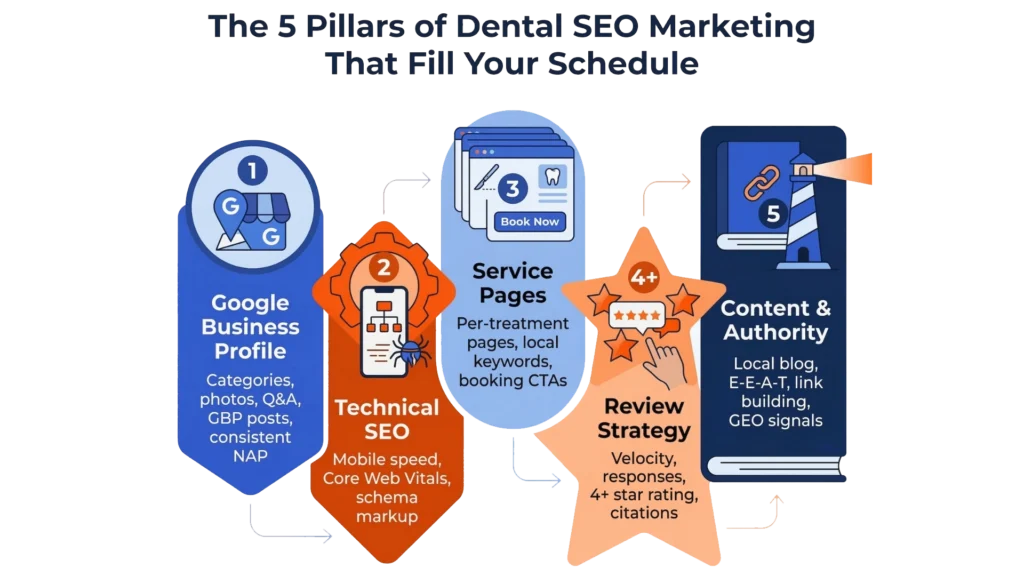
The results above were not produced by a single tactic. They came from five interconnected systems working simultaneously. Here is what each pillar does and why it cannot be skipped.
Pillar 1: Google Business Profile
Your Google Business Profile determines whether you appear in the local pack — the three map results that sit above all organic listings for most dental queries. For most searches involving dentist near me or emergency dentist, the local pack captures the majority of clicks, and most patients call directly from the listing without ever visiting your website. The GBP is not a supporting element of dental SEO. For many practices, it is the primary patient acquisition asset.
Getting the GBP right means: setting Dentist as the primary category (not Dental Clinic or Health Clinic), adding every relevant secondary category that accurately matches your services, uploading a consistent stream of real photos including treatment rooms, staff headshots, and equipment, populating the Q&A section proactively with the questions patients actually search, publishing GBP posts with service updates and seasonal offers, and responding to every review within 24 hours.
Businesses with complete, optimized GBP profiles are 94% more likely to be viewed as reputable by patients.
Pillar 2: Technical SEO
Over 60% of dental searches happen on mobile devices. Google uses mobile-first indexing, meaning your mobile site performance, not your desktop experience, determines your rankings. A dental website that loads slowly on mobile, fails Core Web Vitals benchmarks, or does not display correctly on a 6-inch screen is losing patients before a single word of content is read. The 3-second rule matters: mobile pages loading in under 3 seconds convert at dramatically higher rates, yet the average dental website takes over 7 seconds to fully load on mobile.
Technical dental SEO covers: page load time under 3 seconds, HTTPS security, DentalClinic and LocalBusiness schema markup, clean site architecture with no broken links or duplicated pages, Core Web Vitals in the Good range across all page templates, and click-to-call functionality prominently placed for mobile users, especially on emergency pages where the patient’s next action is calling you, not browsing.
Pillar 3: Service-specific landing pages
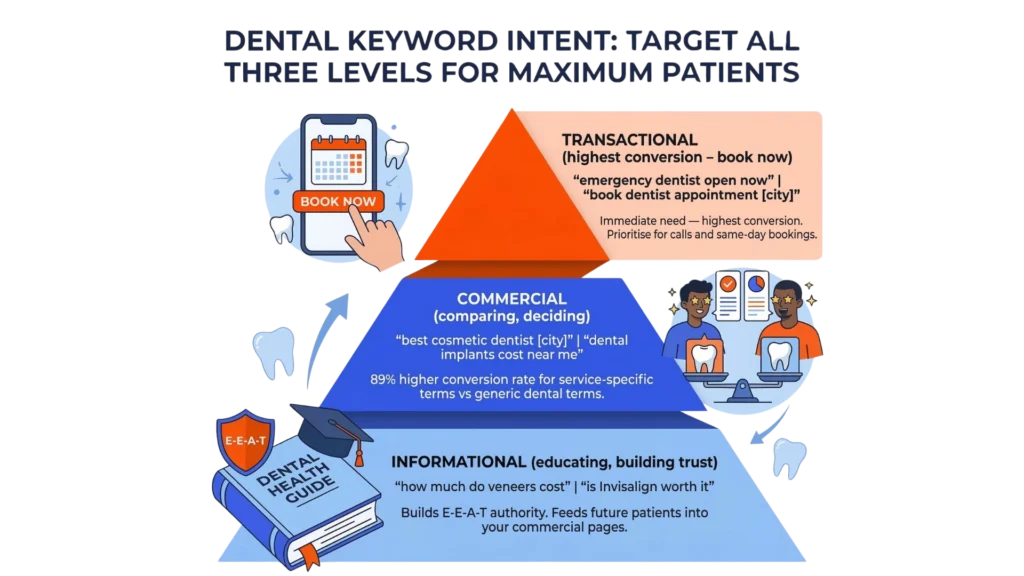
The most common content mistake in dental marketing is a single Services page that lists every treatment in bullet points. Google cannot rank one page for dental implants in your city, Invisalign near me, and emergency dentist open Saturday simultaneously; the page is too diffuse to be authoritative for any single query. Every major treatment category needs its own dedicated, properly structured page.
Each service page should serve both the informational and commercial intent stages of the patient journey. A patient searching how much do dental implants cost is earlier in their decision process than someone searching for a dental implant consultation booking. Your page needs content that speaks to both without confusing either, answering the education question while making the booking call to action impossible to miss.
The highest-priority service pages for most practices, ordered by conversion value: emergency dentistry, dental implants, Invisalign or clear aligners, cosmetic dentistry, teeth whitening, and pediatric dentistry, where applicable. Each page should include a treatment overview written for patients, an FAQ section targeting common queries, transparent pricing or financing information, staff credentials, and a prominent, friction-free booking call to action.
Pillar 4: Review strategy
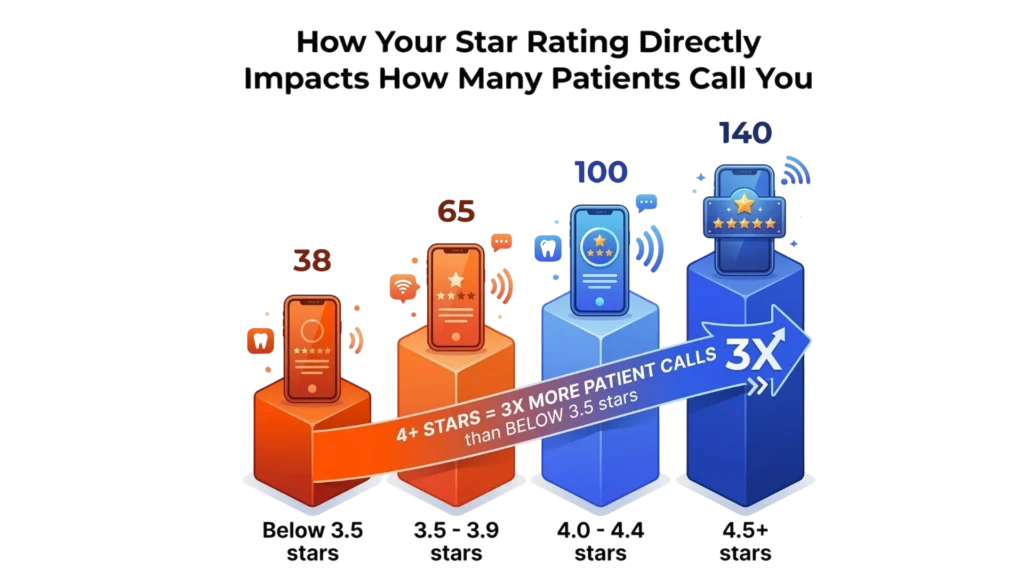
92% of dental patients trust online reviews as much as personal recommendations when choosing a dentist. But reviews in dental SEO are not just a conversion mechanism. They are a direct ranking signal. Google’s local search algorithm analyzes review velocity, response rates, and the presence of service and location keywords in review text when determining local pack positions.
The review strategy for dental practices requires two components operating simultaneously. Systematic generation: automated SMS and email review requests sent within 24 to 48 hours of positive appointments, trained verbal prompts at checkout, and QR codes in the reception area that link directly to the Google review page. And professional response management: responding to every review (positive and negative) within 24 hours. Review responses are indexed by Google and function as additional local SEO content. Practices that respond within 24 hours consistently outrank those with higher ratings but poor response rates.
A practical minimum target before investing heavily in other SEO channels: 4.0 stars with at least 50 reviews. Below this threshold, even strong rankings will convert poorly because patients will simply scroll to a higher-rated alternative. The reputation foundation has to precede the visibility investment.
Pillar 5: Content marketing and E-E-A-T authority
In 2026, Google classifies dental content as YMYL (Your Money or Your Life), meaning health-related content that can directly affect patient well-being. This classification subjects dental websites to a higher standard of scrutiny through Google’s E-E-A-T framework:
Experience, Expertise, Authoritativeness, and Trustworthiness. Dental content that does not demonstrate genuine clinical knowledge and real-world credibility will struggle to rank regardless of technical optimization.
In practice, this means blog content needs to be written to healthcare accuracy standards, authored or reviewed by a named dentist, and structured around genuine patient questions. The content that produces the most SEO value targets informational queries that feed into commercial service pages through internal links.
A post about what to expect at a dental implant consultation creates link equity to your implant service page, captures patients earlier in the decision process, and signals to Google that your site carries genuine topical authority.
Content volume also matters. B2B companies publishing more than 9 posts per month see 35.8% higher year-over-year organic traffic growth than those publishing 1 to 4 times monthly. For dental practices, a consistent publishing cadence of 2 to 4 substantive posts per month, combined with regular GBP posts and service page updates, builds the compounding authority that sustains rankings over time.
What Dental SEO Services Cost in 2026 and What You Get at Each Level
Dental SEO pricing varies by market competitiveness, the scope of work, and whether you are optimising a single location or a multi-site group. Here is an honest breakdown of what each investment level delivers.
| Tier | Monthly Investment | What Is Included | Best For |
| GBP & Listings Management | $300–$600 | GBP optimization, citation cleanup, review monitoring, basic reporting | New practices, very low competition markets, DIY-plus situations |
| Single-Location SEO | $800–$1,500 | Technical audit, GBP, 3–5 service pages, review strategy, local link building, monthly reporting | Single-location general dentistry in mid-competition markets |
| Growth Campaign | $1,500–$3,000 | Full technical SEO, full service page build, content programme, advanced review strategy, conversion optimization | Competitive markets; practices targeting cosmetic, implant or ortho patients |
| Multi-Location / DSO | $3,000–$8,000+ | All of the above across multiple locations, programmatic local pages, digital PR, and custom reporting | DSOs, practices with 2+ locations, highly competitive metro markets |
At the single-location growth campaign level, a well-run dental SEO campaign should aim for 8 to 15 new patients per month, specifically from organic search, based on industry benchmarks for mid-sized US cities. At the conservative end of that range, the maths on a $1,500/month retainer are clear: 8 new patients at $800 average first-visit value generate $6,400 in immediate monthly revenue. Before lifetime value. Before referrals.
Pricing Reality Check
Any dental SEO agency offering full-service optimization for under $300 per month is almost certainly using automated tools, templated content, or link-building tactics that will not produce rankings in a competitive local market. The cost of poor dental SEO is not just wasted budget; it is the opportunity cost of every patient acquired by a competitor while your site sits unoptimized.
How to evaluate dental SEO agencies before hiring
| Signs of a Strong Dental SEO Agency | Red Flags to Walk Away From |
| Proposes a technical and GBP audit in the first month before recommending any content | Immediately proposes a content calendar or blog posts without reviewing the site |
| Measures success in new patient calls and bookings, not just rankings or traffic | Reports primarily on impressions and organic sessions with no conversion attribution |
| Has case studies from dental practices specifically, with measurable patient acquisition results | Has generic case studies from multiple unrelated industries |
| Explains their review generation strategy, GBP process, and E-E-A-T approach clearly | Vague about monthly deliverables beyond SEO services and a report |
| Understands YMYL content standards and healthcare-specific E-E-A-T requirements | Has never heard of YMYL or cannot explain what schema markup does for dental sites |
| Provides a realistic timeline: 3–6 months for initial traction, 6–12 months for compounding results | Guarantees page one rankings within 30 to 60 days |
SEO vs Paid Advertising: Why Organic Search Wins the Long Game

Most dental practices run some form of paid advertising, Google Ads for high-intent keywords, Meta ads for cosmetic patient awareness, or both. Paid channels produce results immediately and have a legitimate role in a balanced acquisition strategy. But they have a fundamental structural weakness: the moment you stop paying, the results stop.
SEO operates on a fundamentally different compounding model. Domain authority, review count, citation consistency, and content depth all accumulate over time and continue working whether or not you are actively spending. A study of dental practices comparing SEO and PPC over 12 months found that dental SEO campaigns achieved 2.1x return on investment in the first four months, and that, unlike paid ads, the organic traffic and patient leads continued growing after the SEO investment period ended.
The optimal strategy for most dental practices is to run both channels in parallel, sequenced correctly. Paid ads provide immediate visibility for high-intent keywords while the SEO foundation is being built. As organic rankings solidify (typically months 4 through 8), paid spend on those keywords can be reduced without losing patient volume. By month 12 to 18, a well-run SEO campaign typically produces significantly more new patients per pound or dollar invested than paid advertising on the same keywords.
What happens to the practices that stay on paid alone
Dental PPC costs are rising. Average cost per click for dental keywords increased substantially between 2022 and 2025 as more practices shifted budget to paid channels and competition intensified. Practices that depend entirely on paid advertising face a compounding problem: every year, the same patient acquisition result costs more. There is no accumulated equity. When the budget pauses, the pipeline dries up within days.
The practices with the most stable, predictable new patient flow in 2026 are those that built their organic search presence during the years when it was less competitive than it is today. The second-best time to start is now.
Dental SEO in 2026: Three Shifts Practices Need to Know About
Generative Engine Optimization (GEO) and AI search
Google’s AI Overviews now appear for a significant proportion of dental queries. Patients are increasingly asking questions like what is the best family dentist in my area and receiving an AI-generated answer rather than a list of links.
Appearing in these AI answers requires the same foundation as traditional local SEO (strong GBP, consistent citations, structured data, quality content), but with additional emphasis on FAQ content, question-driven copy, and schema markup that makes pages machine-readable. Dental practices that invest in this foundation now are building visibility across both traditional search results and AI-generated recommendations simultaneously.
Mobile-first patient behaviour
68% of patients now research dental services on mobile devices, and that proportion continues rising. Patients are not sitting at desks, carefully evaluating dental websites. They are searching urgently on their phones, often at the moment of need. A dental practice website that has not been explicitly optimized for mobile performance, including fast load times, touch-friendly booking forms, and click-to-call functionality, is losing the majority of its potential new patient traffic before a single impression is made.
Review content and AI recommendations
AI tools like ChatGPT, Gemini, and Perplexity increasingly surface dental practice recommendations based on the same signals that drive traditional local SEO: GBP completeness, review quality and consistency, citation accuracy, and structured content. Practices that maintain a strong, consistent local SEO presence are being recommended in AI-generated answers not as a separate initiative, but as a direct byproduct of good local SEO practice. Optimising for one channel now increasingly means being visible across all of them.
Conclusion
If your appointment schedule has availability and your phone is not ringing at the rate your practice deserves, the problem is almost certainly local search visibility. Patients in your area are searching for exactly what you offer right now. Whether they find you or a competitor comes down to how your practice appears in the map pack, in organic results, and increasingly in AI-generated recommendations.
RankFast builds dental SEO strategies around patient acquisition, not ranking reports or vanity traffic numbers. We start with a clear-eyed technical and visibility audit of what is suppressing your local search presence, build the GBP, technical, and content foundations that produce rankings, and measure success in new patients and revenue, not impressions.
Talk to our team about what a realistic dental SEO marketing strategy looks like for your market and your practice.
Frequently Asked Questions
What makes SEO for dentists different from general local SEO?
Google classifies dental websites as YMYL (Your Money or Your Life), meaning health-related content is subject to elevated E-E-A-T standards. Dental content must be written to healthcare accuracy standards, ideally authored or reviewed by a named dentist. Patient privacy considerations (HIPAA in the US) affect how reviews can be responded to and what patient information can be referenced. And dental search intent (the urgency behind emergency and treatment queries) requires a keyword strategy that a general local SEO framework will miss. Agencies that work across unrelated industries without healthcare-specific experience consistently underperform in dental SEO.
How many new patients can I realistically expect from SEO?
In a mid-sized US city with moderate competition, a well-run dental SEO campaign should generate 8 to 15 new patients per month, specifically from organic search and GBP. In highly competitive markets or for practices specifically targeting cosmetic or implant patients, the number for a full-service campaign can be significantly higher. The published DSO case study referenced throughout this post reached 38+ new patients per location per month within six months.
Should I run SEO and paid ads at the same time?
Most practices benefit from running both, sequenced intentionally. Paid ads deliver immediate new patient volume while the SEO foundation is being built. As organic rankings solidify, paid spend on those keywords can be reduced without losing new patient flow. The practices with the most stable acquisition pipelines use paid channels for immediate results and SEO for compounding long-term growth. Relying entirely on paid advertising means accepting rising costs with no accumulating equity, and a pipeline that stops the moment the budget pauses.
What should I actually measure to know if SEO for dentists is working?
Rankings and traffic trends are useful health indicators, but are not the business metric. The metrics that matter are: new patient calls attributed to Google Business Profile and organic search, new patient appointments booked and traced to online discovery, the organic share of your total new patient volume month over month, and cost per acquired patient from organic versus paid channels. Your practice management software should be attributing new patient sources; if it cannot, fixing that tracking is the first priority before evaluating any marketing investment.
Is dental SEO still effective now that AI is changing how people search?
Yes, and the foundation is the same. AI Overviews and tools like ChatGPT and Gemini surface dental recommendations based on the same signals that drive traditional local SEO: GBP completeness, review consistency, citation accuracy, and structured content. Local pack results for dentist near me queries are largely unaffected by AI Overviews; they remain the dominant click destination for high-intent dental searches. Practices that build strong local SEO foundations today are building visibility across both traditional search and AI-generated discovery at the same time.