The SaaS acquisition environment in 2026 is unforgiving. Median CAC payback has stretched to 20 months. The average company is spending $2.00 in sales and marketing to generate $1.00 of new ARR. Paid acquisition costs are rising quarter over quarter while efficiency deteriorates. In this environment, organic search is not a nice-to-have channel. It is the growth lever that separates companies compounding efficiently from those burning capital to stay flat.
The numbers justify the attention. B2B SaaS companies achieve an average 702% ROI from SEO over one to three years, with a break-even point of just seven months. Organic search generates 44.6% of all B2B revenue, more than paid search, social, and outbound combined. SEO delivers 3.3 times better unit economics than paid channels. And unlike PPC, it compounds: every month of compounding authority makes the next month more efficient.
The problem is that most SaaS companies either hire a generic SEO agency that does not understand the SaaS buyer journey, or they hire based on the wrong criteria entirely: domain authority, pricing, or an impressive-looking proposal. This guide explains what SaaS SEO actually requires, why it is categorically different from standard content marketing, and how to evaluate an agency against the criteria that actually predict whether they will move your MRR.
Why Generic SEO Agencies Fail SaaS Companies
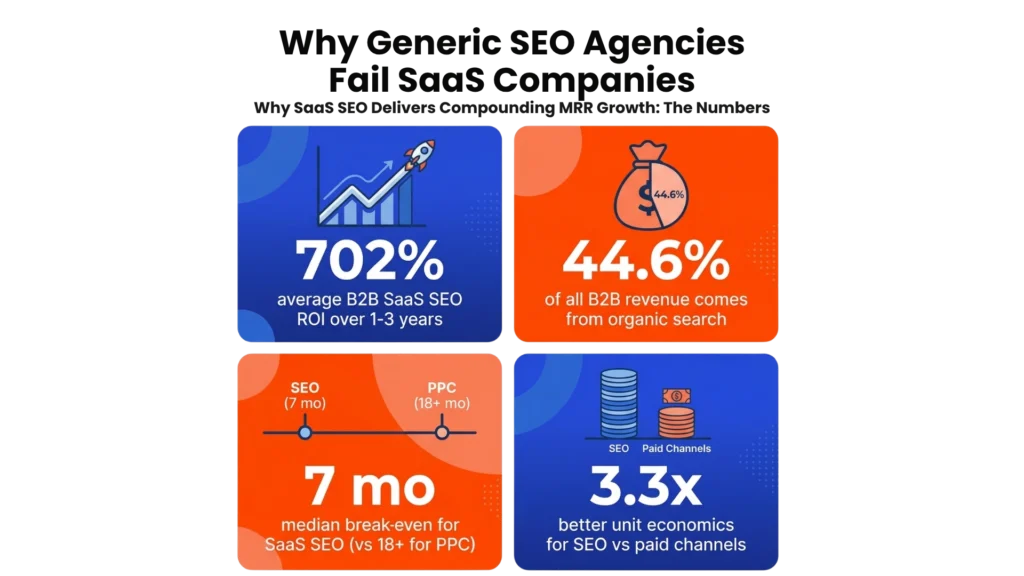
SaaS SEO looks superficially similar to other forms of content marketing. You research keywords, produce content, build links, and track rankings. But the underlying logic is completely different, and agencies that do not understand that difference consistently underperform.
In traditional local or e-commerce SEO, the goal is to drive a transaction. The funnel is short, the decision is simple, and the intent behind search queries is relatively easy to map. In SaaS, the decision cycle is long, involves multiple stakeholders, and is shaped by a complex interplay of educational content, feature comparisons, pricing research, and social proof.
A search query like “customer success software” might come from a procurement manager building a shortlist, a VP of Customer Success evaluating vendors, or a founder who just lost a churned customer. The same traffic, very different needs.
Agencies that miss this produce content that ranks but does not convert. They write informational blog posts targeting high-volume keywords that attract top-of-funnel visitors with no buying intent. They build links that lift domain authority without improving the pipeline. They report on traffic growth while trial signups and demo requests remain flat.
As Robin Waite’s 2026 SaaS agency guide notes, agencies that speak the language of business outcomes (MRR contribution, CAC payback, pipeline impact) tend to produce strategies aligned with those outcomes. Agencies that speak only in rankings and domain authority tend to produce results aligned with those metrics: rankings and domain authority, rather than revenue.
The Core Distinction
Standard SEO optimizes for traffic. SaaS SEO optimizes for a qualified pipeline. The keyword strategy, content architecture, conversion paths, and reporting framework all need to be built around how your ICP discovers, evaluates, and buys software, not how any generic buyer finds any generic website.
The Financial Case: What SaaS SEO Actually Does to Your CAC
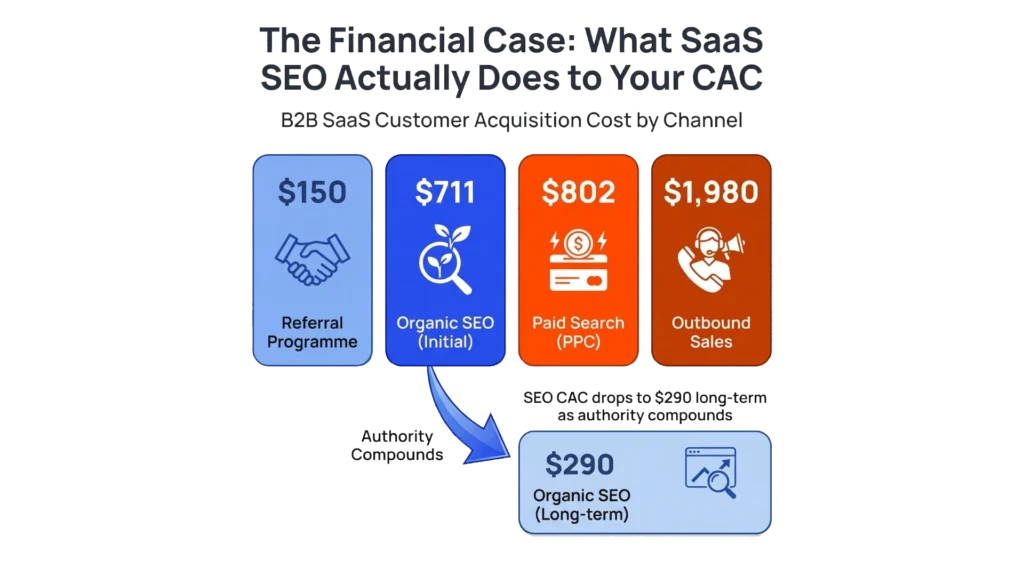
The most compelling argument for SaaS SEO investment is not the ROI percentage — it is the CAC comparison by channel. Organic SEO has a median B2B SaaS CAC of $480 to $942, dropping to $290 as domain authority compounds over time. Compare this to paid search at $802, outbound sales at $1,980, and median CAC across all channels sitting at a point where companies are spending $2.00 to generate $1.00 of new ARR.
One SaaS startup case study illustrates the opportunity precisely: a company whose CAC payback period had crept past 20 months shifted 30% of its budget from paid ads to organic SEO and strategic partnerships. They reduced CAC payback to just over 12 months within two quarters.
The structural reason is straightforward: paid acquisition is a perpetual cost. Organic search is a compounding asset. Every piece of content that ranks continues generating a pipeline without incremental cost. Every new month of domain authority makes future content rank faster.
Websites publishing 9 or more blog posts per month achieve a 41.5% year-over-year increase in organic traffic, compared to just 21.3% for those publishing 1 to 4 times monthly. And SaaS websites offering free tools such as ROI or TCO calculators show a 33% increase in top-10 keyword rankings, with 28.2% referring domain growth, creating link equity and pipeline simultaneously.
What Genuine SaaS SEO Services Actually Cover
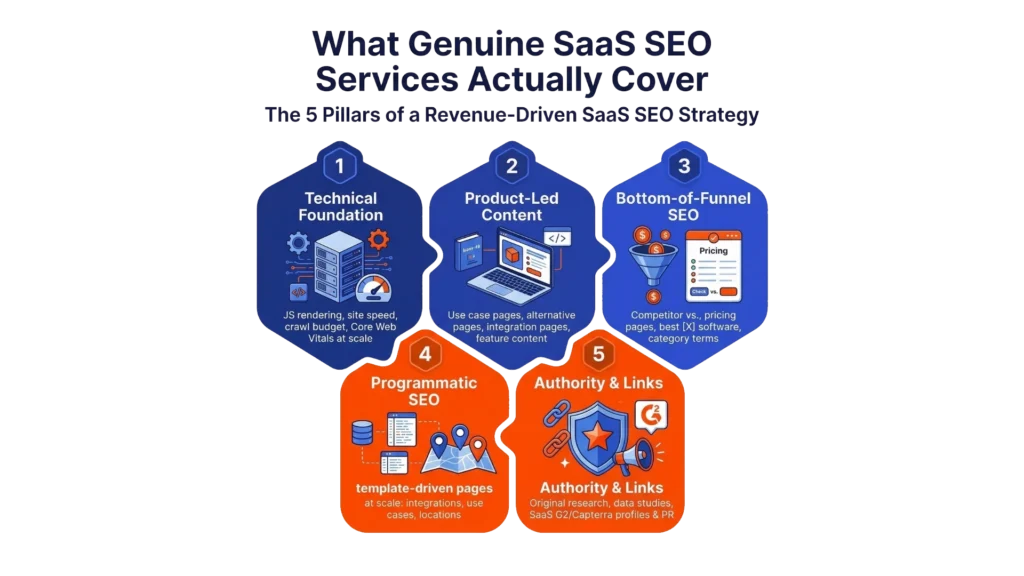
A SaaS SEO agency that limits itself to technical audits and blog posts is missing the majority of the value. Here are the five pillars that distinguish a genuine SaaS SEO programme from a content marketing retainer with an SEO label.
Pillar 1: Technical SEO for SaaS architecture
Most SaaS products are built on JavaScript-heavy frameworks: React, Next.js, Vue, and Angular. These are powerful for product development and problematic for search visibility if not handled correctly. Googlebot does not render JavaScript the same way a browser does, and significant portions of a SaaS website can be effectively invisible to search engines if JavaScript rendering is not explicitly addressed.
Beyond JavaScript, SaaS sites have specific technical challenges: large paginated documentation sets that can cause crawl budget waste, staging environments that occasionally get indexed, multi-region sites with hreflang complexity, and login-gated content that creates thin-page signals across the public site. A SaaS SEO agency must be able to address each of these at the architecture level.
Pillar 2: Product-led content that maps to ICP and funnel stage
The content architecture for services for SaaS is fundamentally different from general content marketing. Rather than building around high-volume generic keywords, it builds around the problems, use cases, and job-to-be-done of the specific buyer persona.
This means dedicated pages for each primary use case (how your product solves a specific problem for a specific vertical), integration pages targeting queries like “[your product] + [popular integration tool]”, feature-specific content that captures users researching individual capabilities, and job-title-specific content targeting the VP of Sales versus the RevOps manager versus the CFO.
The impact of audience segmentation in SaaS content strategy is significant. Websites that segment their audience saw a 43.4% increase in top-10 organic ranking keywords, compared to a 37.6% decline for those that did not segment. Segmented sites also achieved 158.5% growth in referring domains: a 5.1x higher rate than unsegmented sites. Content specificity is not a nice editorial touch. It is a measurable structural advantage.
Pillar 3: Bottom-of-funnel SEO, the highest-converting content type
Most agencies over-invest in top-of-funnel informational content and under-invest in bottom-of-funnel pages where buyer intent is highest. For SaaS, the highest-converting page types are those targeting users who are already comparing vendors and are close to making a decision.
These include: competitor alternative pages (best [competitor] alternatives), direct comparison pages ([your product] vs [competitor]), pricing-intent content (how much does [product category] cost), category leader pages (best CRM for small businesses), and use-case-specific landing pages that address the exact job a buyer is trying to accomplish.
These pages have lower search volume than generic informational content, but significantly higher conversion rates because the visitor is further down the funnel. A SaaS-fluent agency knows to weight the content strategy towards the bottom and middle of the funnel, not the top.
Pillar 4: Programmatic SEO at scale
Programmatic SEO is one of the most powerful and underutilized growth levers for SaaS companies with structured data to work with. It involves building templates for pages that follow a consistent pattern, then generating them at scale from a database: every integration your product supports (“[Your Product] + Salesforce integration”), every use case across every vertical, location-specific pages for multi-market products, and comparison pages covering every major competitor.
Companies like HubSpot, Zapier, and G2 built significant portions of their organic traffic on programmatic strategies. Zapier’s integration pages alone account for enormous volumes of bottom-of-funnel traffic from users searching for specific workflow solutions.
The technical requirement is a database of structured content and a template system that produces pages meeting Google’s quality standards. An agency that has done this before will approach it systematically. One that has not will either avoid proposing it or execute it poorly.
Pillar 5: Authority building for SaaS ecosystems
Link building for SaaS is not the same as link building for local businesses or e-commerce. The sites that carry authority in the SaaS ecosystem are specific: G2, Capterra, TrustRadius, and Product Hunt for category presence; industry publications like TechCrunch, The Hustle, and SaaStr for editorial coverage; integration partner pages; and original data studies that earn natural links from the publications your ICP actually reads.
SaaS websites that produce original research see 29.7% organic traffic increases versus 9.3% for those without. Data-driven content is both an authority signal and a link acquisition strategy simultaneously.
How SaaS SEO Compounds Into MRR Over Time

The compounding argument for SaaS SEO is not theoretical; it is mechanical. Each month of investment builds on the previous month in ways that paid channels structurally cannot. Here is how the compounding effect accumulates:
- Month 1–3: Technical foundations are corrected, product pages and bottom-of-funnel content are built. No significant ranking movement yet, but the asset base is being constructed.
- Month 3–6: Initial rankings appear for long-tail and bottom-of-funnel queries. Trial signups from organic search begin to register. Domain authority starts building as links and citations accumulate.
- Month 6–9: The break-even point for most SaaS SEO services. Organic pipeline contribution exceeds the monthly retainer cost. Middle-of-funnel content begins ranking for more competitive terms.
- Month 12+: Compounding returns accelerate. High-intent comparison and alternative pages rank in positions that capture users at the final evaluation stage. CAC from organic search is declining as traffic scales without proportional cost increases.
- Month 18–24: The channel is self-reinforcing. Strong domain authority means new pages rank faster and for more competitive terms. Organic SEO becomes the lowest-CAC acquisition channel in the stack by a significant margin.
The companies that benefit most from this compounding effect are those that start early and sustain consistently. The SaaS companies with the most efficient organic pipelines in 2026 started their SEO investment in 2022 or 2023. The ones starting now will be those same companies in 2028.
What to Look for When Evaluating a SaaS SEO Agency
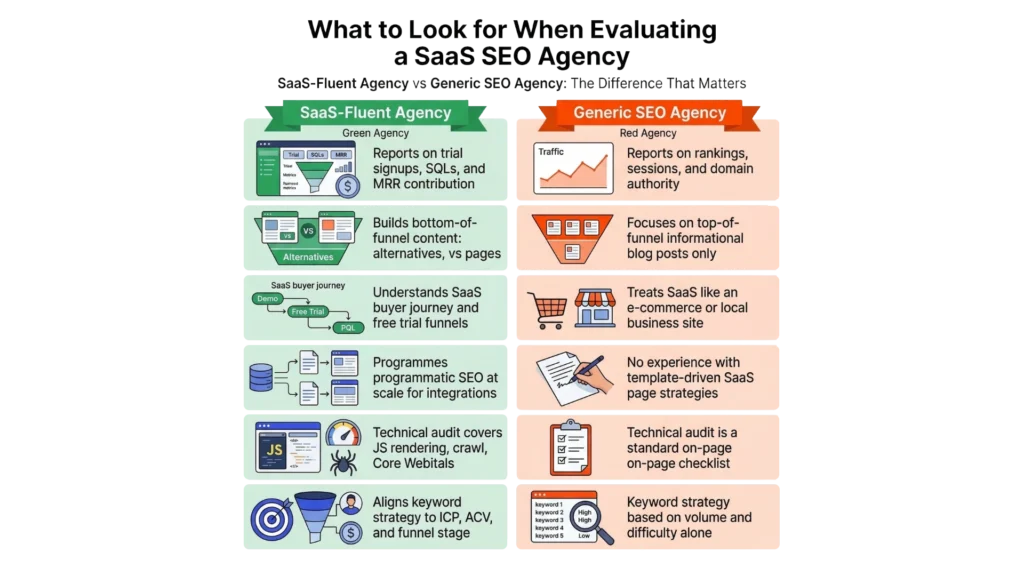
Most SaaS SEO services present credibly in a first meeting. The questions that reveal genuine SaaS depth are specific.
Commercial fluency: Do they speak MRR or rankings?
The single clearest differentiator between a SaaS-fluent agency and a generic one is whether they frame success in business metrics or SEO metrics. Ask any prospective agency: how do you measure the success of a SaaS SEO campaign?
The answer should include trial signups, demo requests, organic MRR contribution, and SQL volume from organic, not domain authority growth and keyword rankings in isolation. As Robin Waite’s evaluation framework notes, agencies that speak the language of business outcomes produce strategies aligned with those outcomes. Agencies that speak only in SEO metrics produce strategies aligned with SEO metrics.
Funnel architecture: Do they build BOFU content or just blog posts?
Ask the agency to describe their content strategy for a SaaS company in your category. A genuinely SaaS-fluent answer will prioritize bottom-of-funnel content (comparison pages, alternative pages, pricing-intent content) alongside top-of-funnel educational content.
An agency that leads with blog topics and keyword clusters, with no mention of competitor alternatives or use-case landing pages, is applying a content marketing framework that was not designed for SaaS conversion.
Technical depth: Have they actually solved SaaS-specific technical problems?
Ask specifically about JavaScript SEO, crawl budget management for large SaaS apps, and how they handle the indexation of product documentation versus marketing pages. If the technical part of their answer is vague or limited to standard on-page factors, their technical SEO capability is probably limited to the same. SaaS sites have specific and recurring technical challenges that a generic technical SEO audit will consistently miss.
Programmatic experience: Have they scaled SaaS pages at volume?
Ask whether they have built programmatic SEO programmes for SaaS clients, and if so, for what page types and at what scale. Ask what quality controls they apply to prevent Google from classifying programmatically-generated pages as thin or low-value content.
An agency that has done this work has specific answers. One that has not will give you a broad description of the concept without the implementation detail that reveals genuine experience.
SaaS case studies: results expressed in pipeline, not traffic
Request case studies from SaaS companies of comparable size and business model. The results should be expressed in terms that matter to a SaaS business: trial signups increased by X%, organic MQL volume grew by Y% over Z months, organic channel now contributes W% of the total pipeline.
If every case study talks about traffic growth and keyword rankings without a revenue metric in sight, the agency does not operate with SaaS revenue outcomes as its primary objective.
SaaS SEO Pricing: What Each Investment Level Actually Delivers
| Tier | Monthly Range | What Is Included | Best For |
| Early-Stage SaaS | $2,000–$4,000 | Technical audit, core product and use-case pages, foundational BOFU content, initial link building, and monthly reporting tied to trial signups | Seed to Series A companies establishing organic presence; 10K–50K monthly sessions |
| Growth SaaS | $4,000–$8,000 | All of the above + programmatic SEO for integrations and use cases, competitor alternative pages, content programme with ICP segmentation, conversion tracking | Series A–B companies scaling pipeline; existing SEO presence but underperforming conversion |
| Scale / Enterprise SaaS | $8,000–$20,000+ | Full dedicated team, international SEO, full BOFU and MOFU content architecture, digital PR and data studies, executive MRR reporting | Series B+ and enterprise SaaS with competitive markets, multiple ICPs, or international expansion |
SaaS SEO pricing is typically higher than general local SEO because the content complexity, technical depth, and conversion architecture are significantly more demanding. For a SaaS company where a single new enterprise customer is worth $50,000–$100,000 in ARR, even a modest incremental improvement in organic pipeline return represents multiples of the monthly agency investment.
The Selection Shortcut
Ask any prospective SaaS SEO agency to walk you through the organic strategy they would build for a company in your category without telling them what you currently have. A genuinely SaaS-fluent agency will describe BOFU content, programmatic integration pages, and competitor alternative pages within the first few minutes. One that leads with blog frequency and keyword difficulty scores is not thinking in SaaS commercial terms.
Conclusion
If your organic search channel is not contributing meaningfully to the pipeline, or if you have been investing in SEO without seeing the trial signups and MQL volume that should follow, the starting point is an honest assessment of what is actually limiting your organic performance.
RankFast works with SaaS companies to build SEO programmes grounded in commercial outcomes: bottom-of-funnel content architecture, technical foundations that handle SaaS site complexity, programmatic strategies at scale, and reporting that connects organic search to MRR. No generic content calendars. No vanity traffic targets.
Talk to our team about what a SaaS-specific SEO strategy looks like for your product, your ICP, and your current growth stage.
Frequently Asked Questions
How long does B2B SaaS SEO take to impact MRR?
Initial signals appear within 3 to 5 months: bottom-of-funnel pages begin ranking, trial signup attribution from organic search starts to register. Meaningful pipeline contribution is typically measurable at months 6 to 9. The break-even point, where organic pipeline contribution exceeds the monthly SEO investment, averages around 7 months for B2B SaaS SEO. Compounding returns build significantly from month 12 onwards as domain authority accumulates and content assets mature.
What metrics should a SaaS SEO agency report on?
The right metrics for SaaS SEO reporting are: organic trial signups and demo requests (by month), organic MQL and SQL volume, organic channel’s contribution to total pipeline percentage, CAC from organic versus paid, keyword rankings for BOFU terms specifically, and organic revenue attribution. Secondary metrics include organic sessions to high-intent pages, click-through rate trends for product and comparison pages, and referring domain growth. Any agency that reports primarily on total organic traffic and domain rating is not measuring the right things for a SaaS business.
What size SaaS company needs a specialist SaaS SEO agency?
Any SaaS company generating $1M ARR or above, with a defined ICP and a meaningful CAC payback pressure, should be working with an agency that understands SaaS commercial mechanics. Earlier than that, a competent content marketing hire with SEO knowledge may deliver more value per dollar. Beyond $5M ARR with a competitive market, the organic channel becomes strategically important enough to warrant dedicated specialist investment. Enterprise SaaS companies at $50M ARR and above typically need a full dedicated team, either in-house or through a comprehensive agency programme.
Should a SaaS company run paid ads and SEO simultaneously?
Yes, with intentional sequencing. Paid ads capture demand immediately while the SEO foundation is being built. As organic rankings solidify (typically months 6 to 9) paid spend on those terms can be reduced without losing pipeline volume. The most capital-efficient SaaS marketing stacks in 2026 use paid channels for immediate demand capture and net-new pipeline, while organic SEO handles the compounding long-term volume. Companies that rely entirely on paid acquisition accept permanent cost escalation and no accumulated equity. Companies that invest in SEO early build the channel with the best long-term unit economics in their stack.