Every moving company knows what peak season feels like when it goes right: phones ringing before 9 am, trucks rolling back-to-back, and a schedule booked three weeks out. They also know what it feels like when it goes wrong: watching competitors stay busy while your own calendar has gaps you cannot explain.
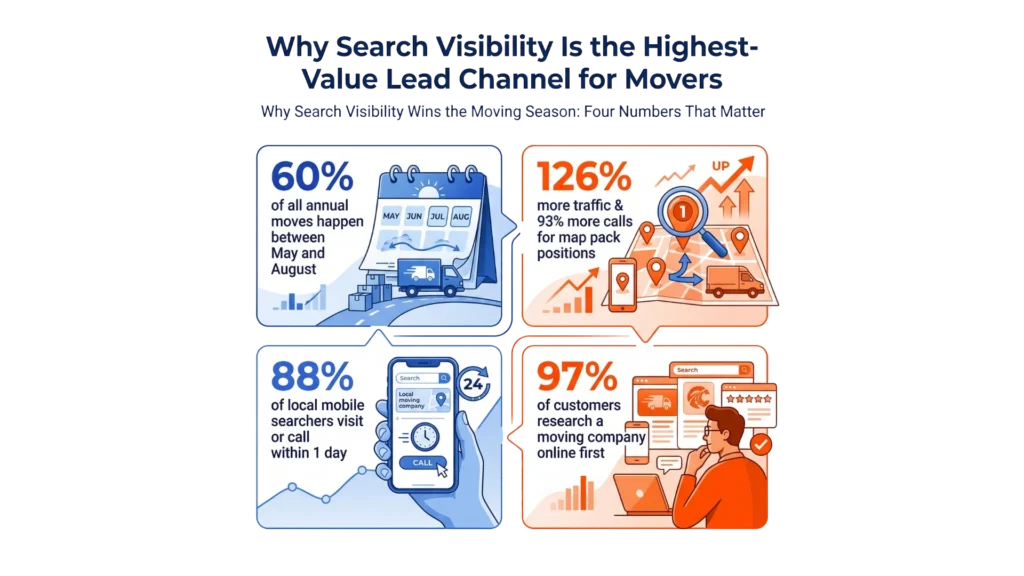
The difference, in most cases, is not crew quality or truck capacity. It is visibility. Nearly 60% of all annual moves happen between May and August. The customers booking those moves search for a moving company online, and 97% of them research a moving company on the internet before calling anyone. If your company is not in the top positions when those searches happen, those leads are going to a competitor who is.
The strategic reality of moving company SEO is that peak season rankings are not built in peak season. They are built in the months before. Companies with fully booked summer schedules began investing in SEO for moving companies in the autumn and winter.
The Moving Industry’s Seasonal Window and the SEO Problem It Creates

The seasonal concentration of the moving industry creates a specific and underappreciated SEO challenge. In 2025, 45% of all US moves occurred between May and August, with June alone accounting for 12.1% of all annual relocations; the single busiest moving month of the year. Summer searches for moving-related terms now exceed winter searches by 31%, and the gap continues to widen.
Here is the problem: SEO for moving companies does not respond immediately. It is not a tap you turn on in May and see results in June. Rankings are built over months through consistent technical work, content creation, and authority signals. For a moving company to dominate search results during peak season, the SEO foundation needs to be in place by February or March at the latest, which means the work begins in earnest from October or November.
The companies that understand this timing advantage consistently outperform those that only invest in marketing when demand spikes. As per Supermove 2025, moving companies that increase marketing spend in February and March to capture early spring planners secure significantly better peak-season positioning than those that wait until demand is already high and competition has intensified.
The Timing Rule
Peak season rankings are built in the off-season. The SEO services for movers started in May will see meaningful results in October or November, too late to impact that summer’s revenue. A company that starts in October will have compounding rankings in place by March, ready to capture the spring ramp and dominate the summer.
Why Search Visibility Is the Highest-Value Lead Channel for Movers
Moving companies have historically relied on a mix of lead marketplaces, pay-per-click advertising, and word of mouth. Each has its role, but none compounds the way organic search does, and none matches the intent quality of a customer who searched for a mover, found your business at the top of Google, and called you directly.
The data on local search behaviour makes the opportunity precise. 88% of consumers who conduct a local search on their smartphone visit or call a business within one day. Businesses listed in Google’s Map Pack (the three results that appear above organic listings for local queries) receive 126% more traffic and 93% more actions (calls, direction requests, website clicks) than those ranked 4th through 10th.
For a moving company, the difference between appearing in the top three map results and appearing fourth is the difference between a phone that rings constantly and one that does not ring enough.
The modern moving customer also touches 8 to 12 digital touchpoints before calling a moving company. They research on Google, read reviews, check pricing, visit service pages, compare competitors, and make a decision before picking up the phone. A moving company that appears consistently across these touchpoints (in the map pack, in organic results, in review platforms, and in answer to specific questions like ‘how much does it cost to move a 2-bedroom apartment?’) wins a disproportionate share of those decisions.
The lead marketplace problem
Many moving companies spend a significant budget on lead marketplaces; platforms that sell the same lead to three or more competing movers simultaneously. The economics of shared leads are structurally unfavourable: high cost per lead, low close rates because the customer is fielding multiple calls, and zero brand equity built from the transaction.
SmartMoving’s marketing data shows movers spending over $6,000 per month on Google Ads to achieve 50% close rates on those paid leads. Meanwhile, a customer who found your company through organic search, read your reviews, visited your service pages, and then called you arrives with significantly higher trust and a higher close rate because they chose you before the conversation began.
Local SEO is one of the few lead channels with a genuinely free marginal cost per lead once rankings are achieved. As SmartMoving’s slow-season lead strategy guide frames it, local SEO is one of the few lead channels that’s still free at the point of delivery; send Google the right signals consistently, and you start capturing high-intent leads in your area without paying per click.
The 5 Pillars of SEO for Movers
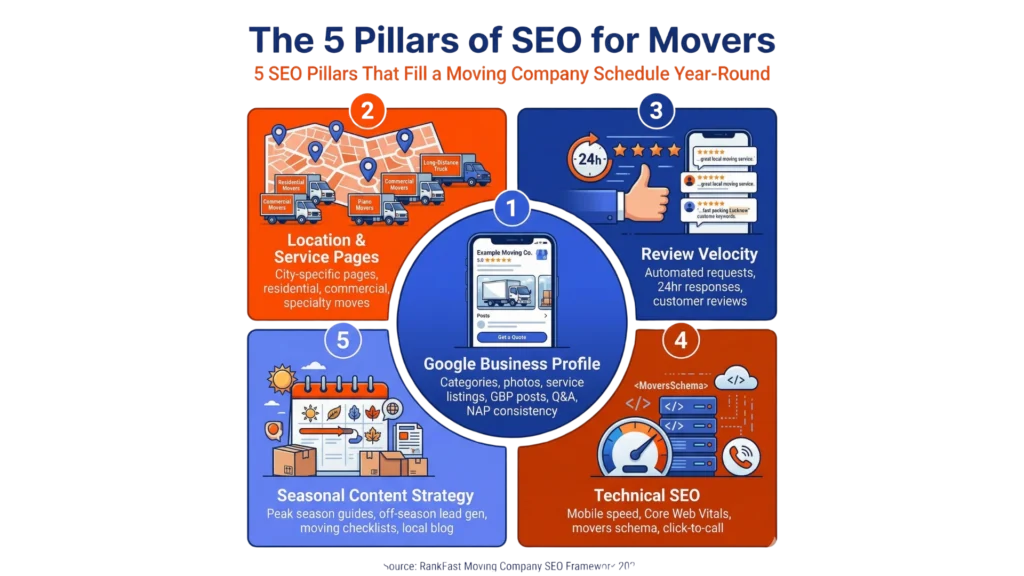
Effective SEO for movers is not a single tactic. It is five interconnected systems working simultaneously, each reinforcing the others. Here is what each requires and why it cannot be skipped.
Pillar 1: Google Business Profile
Most calls for a moving company originate directly from Google Maps. Not from your website. Not from a review platform. From the map listing that appears when someone searches for movers in their city. This makes the Google Business Profile the most important single asset in moving company SEO and the one most consistently under-optimized.
A properly optimized moving company GBP means: setting the correct primary category (Moving Company, not just Moving and Storage Service), adding every relevant secondary category, completing the services section with every service you offer including residential moving, commercial moving, long-distance, packing, furniture assembly, and specialty item handling, uploading authentic photos from real jobs consistently rather than stock images, populating Q&A with the questions customers actually search, and posting GBP updates weekly during peak season. Google rewards profiles with fresh, consistent engagement with higher map pack prominence.
Customers are 2.7 times more likely to trust a business with a complete, verified Google Business Profile. A verified, complete profile also receives around 200 clicks and interactions per month on average. For a moving company where one job is worth $1,500 to $3,000, those 200 monthly interactions represent significant revenue potential from a zero-cost asset.
Pillar 2: Location and service pages that capture every query type
A single generic ‘Services’ page cannot rank for the full breadth of queries your customers are searching. Someone searching for ‘apartment movers [city]’ has a different intent from someone searching for ‘long-distance moving company [city]’ or ‘office relocation services [city].’ Each of these requires its own dedicated, properly optimized page to compete for that specific query. As Bellhop Atlanta’s VP of Market Operations explains in the SmartMoving 2025 guide, local landing pages for every city served, with genuinely local content rather than templates with a different city name substituted in.
For moving companies serving multiple cities or suburbs, this means a network of location pages, each with unique content addressing that area’s specific moving considerations, local landmarks that signal geographic relevance to Google, and service-specific information relevant to that market. A company serving a metro area might build pages for every major suburb, every service type, and combinations of the two.
Service-specific pages to prioritize, in order of search volume and conversion rate: residential moving, apartment moving, long-distance moving, office and commercial relocation, packing and unpacking services, furniture assembly and disassembly, specialty moving (pianos, safes, artwork), and storage solutions where offered.
Pillar 3: Review Velocity
Reviews matter for moving companies in two distinct ways that most operators underestimate. First, they are an active Google ranking factor: review velocity, recency, and response rate all influence map pack position. Google prioritizes recent reviews from the last 90 days, meaning a burst of reviews followed by silence gradually loses its ranking value. Consistent, ongoing review generation is required.
Second, 68% of consumers will not use a business with a rating below 4 stars, meaning that even a strong map pack position converts poorly if the rating is marginal. The review system for a moving company needs to be embedded in operations, not bolted on as an afterthought. Automated SMS or email review requests sent within 24 hours of move completion, with a direct link to the Google review page, consistently produce 3 to 5 times more reviews than passive methods.

Front-line crew training on how to prompt satisfied customers verbally at job completion adds another layer. And a professional, specific response to every review (positive and negative) within 24 hours signals active engagement to both Google and prospective customers.
For a moving company, negative review responses deserve particular care.
A dissatisfied customer who sees a professional, solution-focused response from management is frequently reassured. A prospective customer reading that exchange is often more impressed by how the company handled a complaint than they would have been by a flawless 5-star record.
Pillar 4: Technical SEO
Technical SEO for moving companies focuses on the factors that determine whether Google can find, crawl, and rank your pages. For most moving company websites, the critical technical issues are: mobile performance (over 62% of global web traffic is now mobile, if your site loads slowly on a phone, you are losing leads before they ever read your content), Core Web Vitals compliance in the Good range, NAP consistency across all directories and platforms, and click-to-call functionality prominently placed on every page, especially on mobile.
NAP (Name, Address, Phone) consistency deserves emphasis. Google cross-references your business information across directories, review platforms, and your own site. Inconsistencies between how your business name or address appears on Yelp, the Better Business Bureau, moving.com, Yellow Pages, and your GBP actively suppress local rankings.
A citation audit and cleanup is often one of the fastest-returning technical SEO investments a moving company can make, because fixing existing inconsistencies can produce ranking improvements within weeks.
Pillar 5: Seasonal content strategy
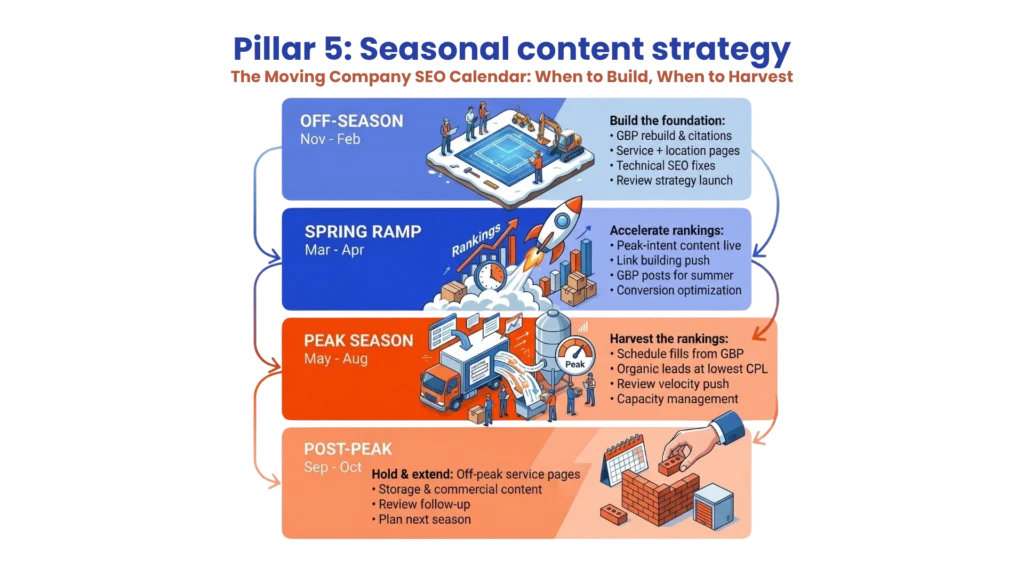
Content for moving companies works when it is strategically timed to the search calendar. The highest-value content targets customers at various stages of the moving decision process: early planners researching how much a move will cost (searches begin 45 to 60 days before a planned move), customers in active comparison mode evaluating specific companies, and customers with immediate need searching for same-day or next-week availability.
Blog content that earns rankings and builds local authority includes: moving cost guides broken down by apartment size and service type for your specific city, neighbourhood guides for the areas your customers are moving to or from, moving checklists and timelines that position your company as a helpful resource, and seasonal content timed to publish 6 to 8 weeks before the relevant search volume spike. A guide to summer moving tips published in March ranks by May. A guide published in June does not rank until late summer.
Off-season content serves a dual purpose: it builds the authority that lifts all your rankings heading into peak season, and it captures the smaller but still significant lead volume that exists year-round. Corporate relocation, college student moves, seniors downsizing, and apartment turnovers happen every month.
The Cost Per Lead Reality: SEO vs Paid vs Marketplaces
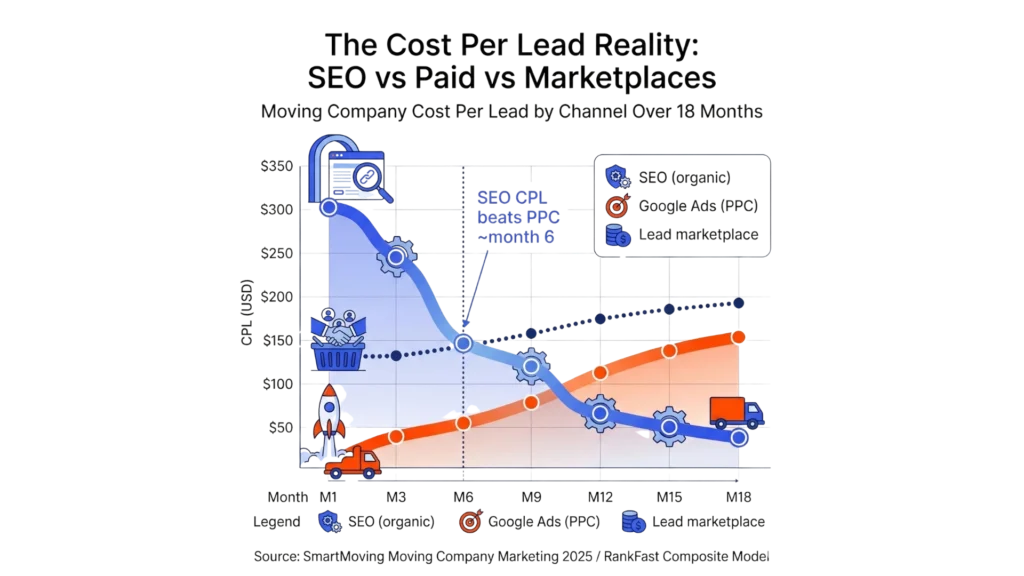
Understanding the cost per lead economics of each channel is essential for making the right investment decision. Moving business marketing has three primary paid lead channels: Google Ads, lead marketplaces, and organic SEO, and they have very different long-term economics.
| Channel | Initial CPL (M1-3) | Mature CPL (M12-18) |
| Organic SEO | $300–$420 | $78–$120 (declining) |
| Google Ads (PPC) | $130–$160 | $220–$265 (rising) |
| Lead marketplace (shared) | $280–$300 | $320–$340 (rising) |
| Word of mouth/referral | $0 | $0 (build with reviews) |
The CPL comparison makes the investment case for SEO clear, with one important caveat: the initial months of an SEO campaign are not cost-efficient. During months one through five, you are paying for the foundation (the audit, the technical fixes, the content build, the citation cleanup) while rankings are still being established.
This is why a target of 3x ROI on a moving company SEO investment is a reasonable planning benchmark, achieved over a 12-month window rather than assessed month by month. A $30,000 annual SEO investment that generates $90,000 in traceable revenue represents a strong return that compounds into the following year as rankings mature.
The 75% of local businesses that report local SEO generating more leads than paid advertising are experiencing this dynamic precisely: the channel that requires patience in months one through six delivers significantly better unit economics than paid channels from month six onwards, with a cost structure that improves rather than deteriorates over time.
AI Search and 2026: What’s Changing for Moving Company Visibility
The search landscape for moving companies is evolving in 2026 in ways that reward the same investments as traditional local SEO, while introducing new visibility surfaces worth understanding.
AI Overviews and GEO signals
Google’s AI Overviews now trigger for 40.16% of local business queries, and that proportion continues rising. For moving company searches, this means an increasing share of searchers are receiving AI-generated summaries that recommend specific companies before they see traditional organic results.
Appearing in these summaries requires the same signals that drive traditional local SEO: complete GBP, consistent citations, strong review signals, and structured schema markup but with additional emphasis on FAQ content and question-structured copy that AI systems can parse and cite.
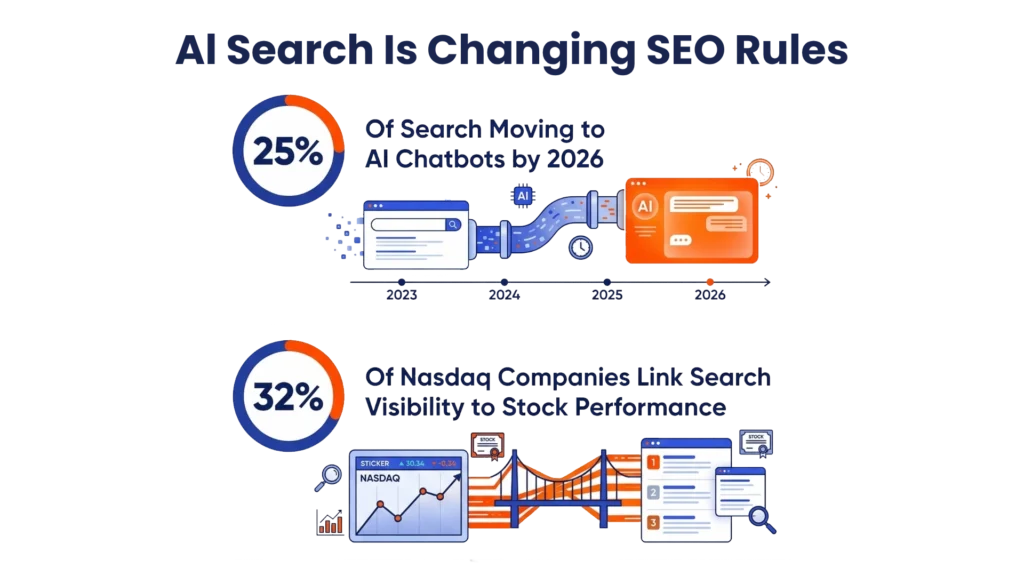
AI assistants like ChatGPT, Perplexity, and Google’s “Ask for Me” feature are also increasingly handling moving-related queries. A customer asking ChatGPT for reliable movers in their city receives a recommendation based on the same trust signals Google uses: completeness, consistency, reviews, and structured data. Moving companies that invest in traditional local SEO in 2026 are simultaneously building their visibility across all of these AI-driven discovery channels.
Voice search and micro-local intent
Google’s ranking algorithm has become significantly more sophisticated at understanding micro-local intent. A search for “movers” at 3 pm on a Tuesday from a specific location signals a same-day or next-day need from a user within 15 miles. Moving companies that have location-specific content, strong GBP proximity signals, and recent review activity are far better positioned to capture these ultra-high-intent searches than those with a single generic site page.
Conclusion
If your schedule has availability when it should not, or if your competitors seem to be capturing leads that should be coming to you, the answer is almost always a visibility gap. The customers moving in your area are searching right now: the question is whether your company is the one they find.
RankFast builds SEO programmes for moving companies grounded in seasonal strategy and local market knowledge. We start with a clear audit of what is suppressing your visibility, build the GBP, technical, and content foundations that produce rankings before peak season arrives, and measure success in booked jobs and trackable revenue, not just rankings and traffic reports.
Talk to our moving company SEO experts about what a realistic strategy looks like for your market, capacity, and peak-season goals.
Frequently Asked Questions
What keywords should a moving company target?
Moving company SEO targets three layers of keyword intent simultaneously. Transactional (highest conversion: “movers near me,” “moving company [city],” “same day movers [city].” Commercial) comparing options: “best moving companies [city],” “cheap movers [city],” “local moving company.” Informational, building trust: “how much does it cost to move a 2-bedroom apartment,” “what to look for in a moving company.” The highest commercial priority should be service-specific and location-specific combinations: “apartment movers [city],” “long-distance moving company [city],” “commercial movers [city].”
Should a moving company invest in SEO or Google Ads?
Both have a role, but they serve different time horizons. Google Ads deliver immediate leads while SEO builds. As the SEO foundation matures (typically months 6 to 12), paid spend on overlapping keywords can be reduced without losing lead volume. The most efficient marketing for moving companies stacks paid ads to fill immediate capacity during the first year of SEO investment, then reduces PPC as organic rankings take over. Running both indefinitely is rarely optimal; the goal is to transition the majority of lead generation to the lower-cost organic channel over time.
What is the ROI of moving company SEO?
A 3x ROI target over 12 months is a realistic benchmark for a well-run moving company SEO campaign. The first 3 to 5 months yield below-break-even returns as the foundation is being built. Months 6 to 12 typically produce positive ROI as rankings compound. Years 2 and 3 see significantly better returns as domain authority accumulates and rankings stabilize in competitive positions, with no proportional increase in cost.
How important are reviews for moving company SEO?
Critical, more so than in most other service industries. Moving involves significant trust: customers are handing over their possessions and home access to a company they often have not used before. 68% of consumers will not engage with a business rated below 4 stars, and Google actively uses review velocity, recency, and response rate as local ranking factors. A moving company with 4.5 stars and 150 recent reviews will consistently outrank a competitor with 4.8 stars and 40 older reviews, because the fresher signal is algorithmically weighted more heavily. Building a systematic review generation process is one of the most direct and fastest-returning investments in moving company SEO experts.