Managing SEO for a large-scale website is fundamentally different from managing it for a small or mid-sized business. The tactics that work for a 50-page site actively fail at 100,000 pages. Crawl budget becomes critical. Duplicate content compounds. Architecture decisions affect thousands of pages simultaneously. A single template error can suppress rankings for an entire product category.
This is why an enterprise SEO company operates as a different discipline entirely, not a scaled-up version of standard SEO. It requires automated systems, cross-team governance, specialist tools, and deep technical expertise in problems that small-site practitioners simply never encounter.
This guide covers exactly what large-scale SEO involves, the unique challenges of enterprise website SEO, how corporate SEO services are priced in 2026, and what separates agencies that can genuinely operate at enterprise scale from those that cannot.
The Enterprise SEO Market: Why the Stakes Have Never Been Higher
The global SEO software market reached $74.6 billion in 2024, with enterprises making up 56% of the total SEO software market share. That concentration reflects how central organic search has become to enterprise revenue.
For large organizations, the data makes the business case unambiguous:
- Organic search drives 53.3% of all website traffic, making it the largest single acquisition channel for most enterprise sites.
- 49% of marketers identify organic search as the top ROI-driving digital channel, consistently outperforming paid, email, and social.
- The median SEO ROI reaches 748%, with organizations realizing $22 in returns for every $1 invested.
- 55% of enterprises invest more than $20,000 per month in SEO
- 91% of organizations report that SEO positively impacts website performance and marketing goals.
Enterprise SEO has evolved from a technical marketing function into a board-level priority. The enterprise SEO platforms market is projected to grow from $4.38 billion in 2024 to $12.5 billion by 2032, growing at 14% CAGR. The organizations leading that investment treat organic search as core infrastructure, not a marketing expense.
Enterprise SEO vs Standard SEO: The Scale Difference
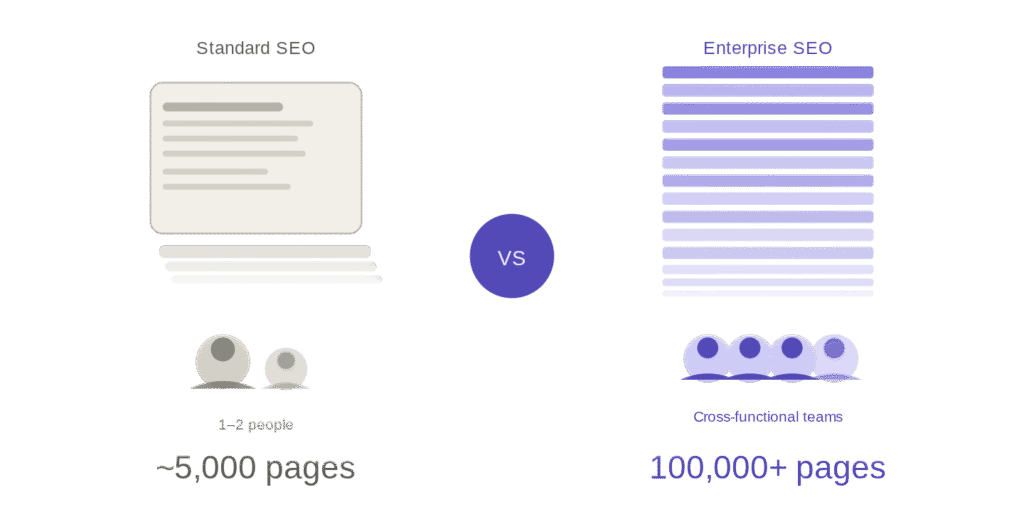
Enterprise website SEO and standard SEO share the same foundational principles but require completely different execution frameworks. Understanding that difference is critical before evaluating any enterprise SEO agency.
| Dimension | Standard SEO | Enterprise Website SEO |
| Site size | 50 to 5,000 pages | 100,000 to 10+ million pages |
| Optimization method | Page-by-page manual work | Template-driven automated systems |
| Crawl budget | Rarely relevant | Mission-critical resource to manage daily |
| Duplicate content | Occasional issue | Structural challenge across thousands of URLs |
| Team structure | One or two practitioners | Cross-functional: SEO + Dev + Content + IT + Legal |
| Tools required | Standard tools ($100-$500/month) | Enterprise platforms: BrightEdge, Conductor, Botify ($5,000-$30,000/month) |
| Monthly investment | $1,500-$5,000 | $7,000-$100,000+ |
| Core challenge | Building authority and rankings | Systems engineering for crawl efficiency |
Google draws the line at 10,000 pages as the point where crawl budget becomes relevant, with sites of one million or more requiring dedicated crawl management as a permanent operational function.
The practical consequence: 40% of B2B companies lack internal expertise to manage technical SEO at scale, and enterprises using mismatched tools waste up to 40% of their SEO budget on inefficient monitoring.
The Critical Challenge: Crawl Budget Management at Scale
Crawl budget is one of the least understood and most consequential aspects of SEO for big websites. Google allocates a finite number of crawls to each site per day. For small sites, this allocation is sufficient. For sites with 100,000+ pages, it becomes a strategic resource that determines which pages get ranked and which are effectively invisible.
Since May 2025, Google has implemented dynamic crawl budgeting, meaning your daily crawl allocation fluctuates based on server response times, content freshness, and technical health. The average well-optimized site now receives approximately 253 crawls per day, ten times higher than two years prior. AI crawlers like GPTBot have simultaneously expanded from 5% to 30% of total crawler traffic.
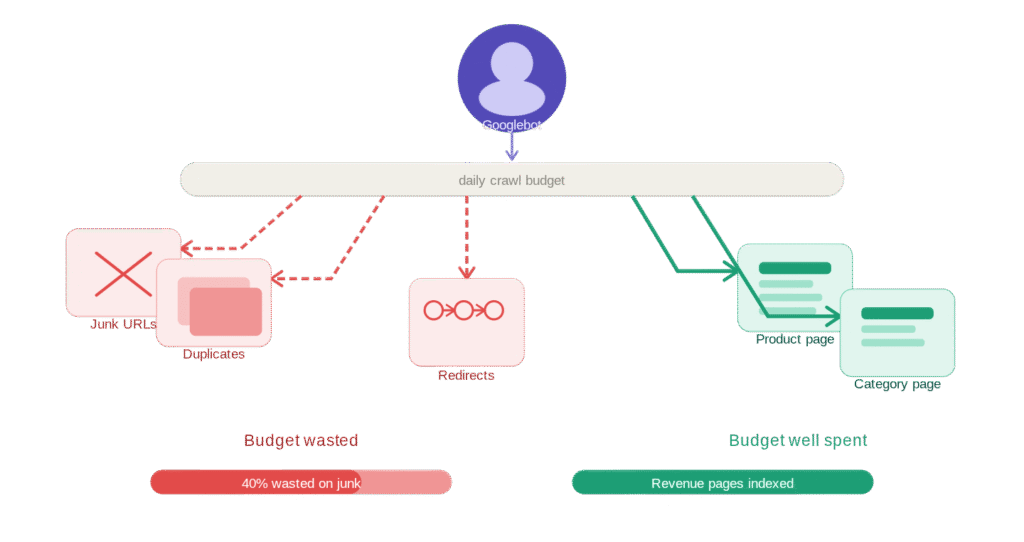
Where Large-Scale Sites Waste Crawl Budget
- URL parameter combinations: Faceted navigation with multiple filter layers can generate millions of unnecessary URL variants that consume crawl budget while contributing nothing to rankings.
- Duplicate content at scale: The same content appearing across multiple URLs dilutes ranking signals and wastes crawler resources simultaneously.
- Redirect chains: Multi-hop redirects force Googlebot to follow multiple requests for a single destination, multiplying crawl cost.
- Thin and outdated pages: Legacy press releases, archived pages, and internal search results consume crawl allocation that should go to revenue-generating pages.
- JavaScript rendering lag: Enterprise sites built on JS-heavy frameworks often have pages requiring multiple crawl attempts before Google successfully renders and indexes them.
A documented case: an enterprise e-commerce client with 5 million+ pages had JavaScript rendering issues suppressing mobile rankings. After migrating to a scalable infrastructure, crawl efficiency increased by 300% within months.
A Canadian manufacturing client with 2 million pages had 40% redundant pages, diluting authority. A 301 redirect migration recovered link equity and spiked organic traffic by 45%.
Enterprises often dismiss crawl budget issues as IT problems. They are SEO problems. If Googlebot cannot efficiently reach your product pages, category pages, and landing pages, no amount of content quality or link building will compensate. Technical SEO is the prerequisite for everything else in large-scale SEO.
Programmatic SEO: How Enterprise Sites Build Scale
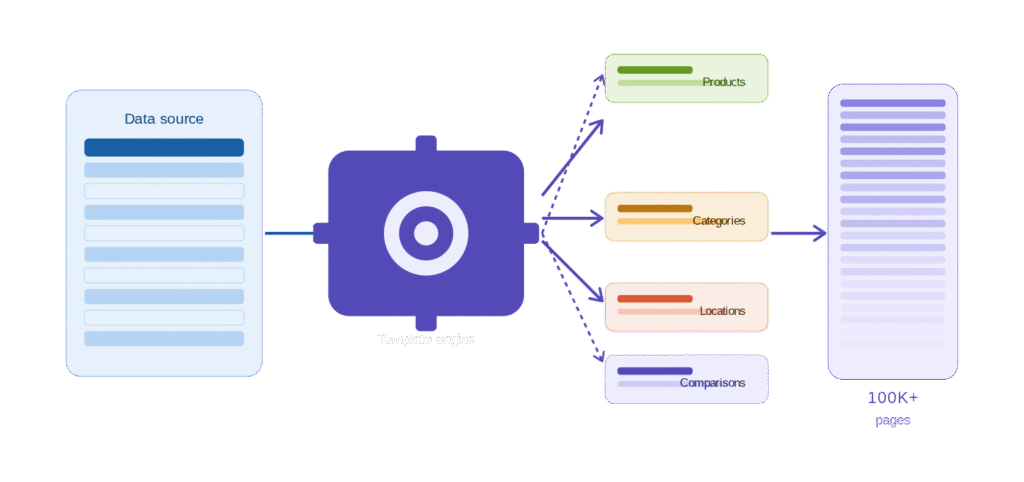
When a site has 100,000+ pages to optimize, manual page-by-page work is not just inefficient. It is mathematically impossible at a meaningful scale. Programmatic SEO solves this by building template-driven systems that generate, optimize, and update pages automatically from structured data.
The Most Powerful Programmatic Page Types
- Product pages: E-commerce enterprises like Amazon generate pages for tens of millions of products, each optimized with unique title tags, descriptions, and structured data.
- Category and subcategory pages: Hierarchical product taxonomy pages capturing mid-funnel commercial intent across thousands of keyword variations.
- Location pages: Multi-location businesses generate city, state, and neighbourhood-level pages capturing high-conversion local intent at scale.
- Comparison and alternative pages: SaaS and enterprise software companies rank for every relevant [Product A] vs [Product B] query by templating comparison content from product data.
- Integration and use-case pages: Zapier’s integration pages account for enormous bottom-of-funnel traffic from users searching for specific workflow solutions.
The critical distinction in 2026: fewer, stronger pages with clearer signals outperform fragmented clusters of low-quality URLs. Google’s algorithms are increasingly effective at identifying thin or low-value templated content. The goal is systematic coverage of commercially valuable keyword space with genuinely useful content.
Enterprise SEO in the AI Search Era
AI Overviews now appear in 31% of search results, and zero-click searches have risen to 58.5% of all searches in 2026. On queries where AI Overviews trigger, clicks to external websites drop by an average of 34.5%.
However, the picture is not uniformly negative. 63% of respondents report that AI Overviews positively impacted organic traffic, visibility, or rankings since rollout. AI search visitors who click through are 4.4 times more valuable than regular organic visitors, indicating significantly higher intent and conversion rates.
What enterprise sites must do for AI search visibility
- Structured data at scale: Schema markup helps Google and AI systems understand content. LLMs grounded in knowledge graphs achieve 300% higher accuracy in content extraction.
- E-E-A-T and entity building: Named author credentials, SameAs schema linking to Wikidata and LinkedIn, and Knowledge Graph presence make enterprise sites safe to cite for AI systems
- AI-readable content formatting: Short answers, tables, and structured lists enable AI systems to extract and cite information more reliably
- FAQ content targeting: Question-structured content captures both traditional featured snippets and AI Overview inclusions for informational queries
Position one rankings generate 39.8% of clicks, while the top three positions control 68.7% of all search result clicks. For enterprises, this concentration of value at the top makes ranking authority more commercially significant than ever.
Enterprise SEO Company Pricing in 2026
Enterprise SEO pricing reflects the scale of resources required. Most programs require 80 to 240+ hours of specialist work per month at an average blended rate of approximately $90.70/hour, though senior enterprise consultants charge $250 to $400+ per hour.
| Tier | Monthly Range | Hours | What’s Included | Best For |
| Entry Enterprise | $7,000-$15,000 | 80-120 hrs | Technical audits at scale, crawl budget strategy, on-page templates, basic programmatic SEO | Large sites new to enterprise SEO; established brands in moderate competition |
| Growth Enterprise | $15,000-$30,000 | 120-180 hrs | All above + full programmatic SEO build, content production team, link acquisition, CRO | Competitive markets, e-commerce, and SaaS companies with national or global ambitions |
| Large Enterprise | $30,000-$60,000 | 180-240 hrs | All above + international SEO, digital PR, dedicated strategy team, advanced analytics | Multinational operations; highly competitive verticals (finance, healthcare, legal, SaaS) |
| Global / DSO | $60,000-$100,000+ | 240+ hrs | All above + full automation, multi-domain management, board-level revenue reporting, AI search optimization | Fortune 500, global enterprises, companies where organic is a direct revenue infrastructure |
In-House vs Outsourcing: The Cost Comparison
- In-house enterprise SEO team: $200,000-$400,000+ per year in salaries alone (senior SEO lead $100K-$180K, specialists $60K-$90K each), plus tools, training, and management overhead
- Outsourcing to an enterprise SEO company: $5,000-$25,000+ per month for a full specialist team without the fixed overhead of full-time employment
Most large enterprises use a hybrid model: a small internal SEO function for governance and stakeholder management, partnered with a specialist agency for technical execution, content production, and link acquisition.
What Genuine Enterprise SEO Services Include
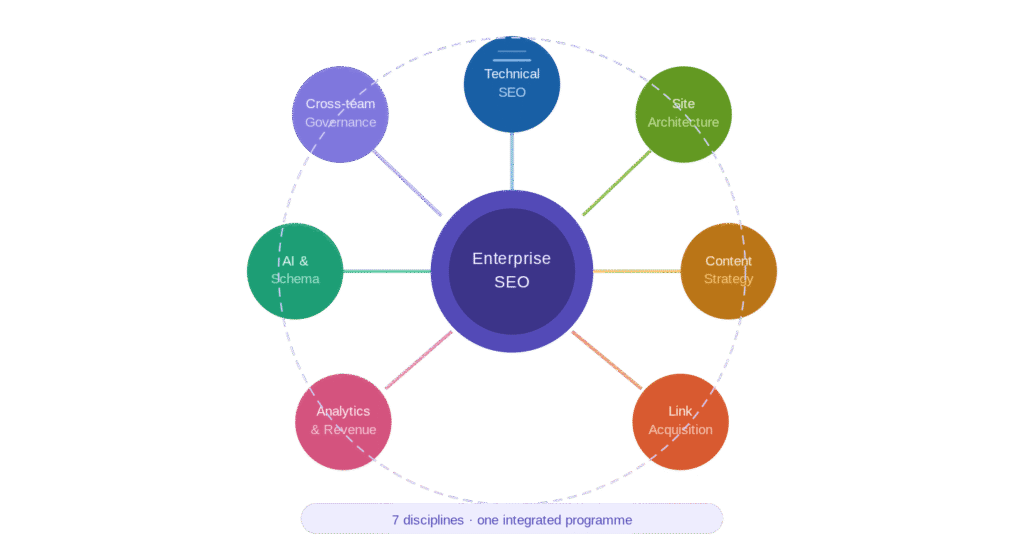
A full enterprise SEO programme covers seven interconnected disciplines. Evaluating any enterprise SEO company means verifying coverage across all seven.
1. Enterprise Technical SEO
Site speed optimization across CDN-distributed infrastructure, Core Web Vitals compliance at the page template level, JavaScript rendering management, log file analysis, crawl budget optimization, and hreflang management for multinational sites. Technical work at enterprise scale requires pattern-level analysis, not URL-by-URL inspection.
2. Site Architecture and Information Architecture
Hierarchical taxonomy development that can scale with content growth, faceted navigation systems that avoid duplicate content while supporting user discovery, URL naming conventions serving both SEO and usability, and internal linking strategies that distribute PageRank efficiently across priority pages at scale.
3. Programmatic and Template-Based Content
Building content templates for product, category, location, and comparison pages that produce unique, search-relevant content at scale. This includes structured data implementation across all template types and the content governance processes that maintain quality as volume grows.
4. Enterprise Link Acquisition
Large enterprises competing on high-value terms need domain authority that matches their competitors. This means digital PR campaigns targeting editorial coverage in major publications, data studies, and original research that earn natural links, and link acquisition from industry-specific authoritative sources.
5. AI Overview and Structured Data Optimization
Schema markup at scale covering product, service, organization, FAQ, and breadcrumb data across all relevant page templates. Entity modeling that makes the brand safe to cite for AI systems. Content formatting for AI readability. Microsoft Bing’s Fabrice Canel confirmed that schema markup helps LLMs understand content.
6. Enterprise Analytics and Revenue Attribution
High-maturity organizations measure and report on 3x as many SEO metrics compared to low-maturity organizations. Enterprise analytics means CRM-integrated organic revenue attribution, keyword clustering to business units, and executive-level reporting that connects organic performance to revenue line items.
7. Cross-Team SEO Governance
Large organizations have more people involved in website decisions, siloed teams, and departments with conflicting priorities. Genuine enterprise SEO services include governance frameworks that align SEO requirements with development sprints, content publishing workflows, and site migration planning.
Enterprise SEO Governance: What Good Looks Like Internally
Technical execution aside, enterprise SEO fails most often at the organizational level. Here is what an effective internal governance framework looks like.
- Cross-team alignment: SEO requirements are embedded into development sprint planning, content editorial calendars, and product launch processes, not added after launch
- Template governance: Any change to a major page template goes through SEO review before deployment, because template errors affect thousands of pages simultaneously
- Migration protocols: An estimated 60% of enterprise site migrations fail and erase years of accumulated organic authority. Structured migration planning and post-migration monitoring are non-negotiable
- Revenue reporting: Organic revenue contribution is connected to board-level reporting. The shift from rankings and traffic to actual revenue attribution justifies continued enterprise SEO investment to CFOs and CEOs
- Vendor governance: Clear accountability between in-house teams and the enterprise SEO agency, with defined ownership of each programme element
Conclusion
If your large-scale website is not generating organic traffic proportional to the size and quality of your content, the root cause is almost always a systems problem rather than an individual page problem. Crawl budget waste, duplicate content at scale, suboptimal site architecture, and missing programmatic coverage suppress entire categories of ranking potential simultaneously.
RankFast works with enterprise organizations to build SEO programmes designed for scale, from crawl budget audits and programmatic page systems to AI Overview optimization and cross-team governance frameworks. We measure success in organic revenue contribution, not keyword rankings.
Frequently Asked Questions
How much does enterprise SEO cost per month in 2026?
Enterprise SEO company retainers typically range from $7,000 to $100,000+ per month, with most programs requiring 80 to 240+ hours of specialist work at an average blended rate of approximately $90.70/hour. The majority of large enterprises invest over $20,000 per month.
What is crawl budget, and why does it matter for large-scale SEO?
Crawl budget is the number of URLs Google will crawl on your site within a given period. Since May 2025, Google has used dynamic crawl budgeting, where the daily allocation fluctuates based on site health signals. If Googlebot spends crawl budget on junk URLs (filters, duplicates, 404 pages, redirect chains), your most commercially important pages may not be crawled or indexed. Enterprise SEO companies manage crawl budget through log file analysis, robots.txt optimization, canonical tag implementation, and sitemap segmentation.
What is programmatic SEO, and when should enterprises use it?
Programmatic SEO uses data sources and content templates to automatically generate large numbers of SEO-optimized pages. Product pages, category pages, location pages, comparison pages, and integration pages are the most common applications. It is the primary scaling method for e-commerce enterprises, multi-location service businesses, SaaS companies, and any organization that needs to capture commercially relevant keyword space across hundreds of thousands of page combinations.
Should we build an in-house enterprise SEO team or hire an external agency?
Most large enterprises use a hybrid model. Building a complete in-house team costs $200,000 to $400,000+ per year in salaries alone. A specialist enterprise SEO agency provides a full team at $60,000 to $300,000 per year, depending on scope, with broader expertise and no fixed headcount risk. The most effective structures maintain a small internal SEO function for governance and stakeholder management, with an agency partner handling technical execution, content production, and link acquisition.