A new patient walks through your door after searching “dentist near me” on their phone. They booked without calling first. They had already read your reviews, checked your before-and-after photos, and decided you were the right practice before they ever spoke to your receptionist. That journey started with a Google search, and whether your practice appeared in that moment was determined entirely by your SEO.
For practice owners evaluating where to put their marketing money, the central question is not whether SEO works. The question is whether the cost to acquire a patient through organic search is lower than through any other channel, and whether the return over that patient’s lifetime justifies the monthly investment. The answer, backed by current data, is yes, but only if the strategy is built correctly.
This post breaks down what dentist SEO costs in 2026, what a realistically benchmarked patient acquisition cost looks like through organic search versus paid advertising, and how to evaluate whether a dental SEO agency is delivering real value or just vanity metrics.
Key Takeaways
- SEO for dentists typically costs between $750 and $5,000 per month, with most practices investing $1,000 to $2,500 for a comprehensive campaign that delivers meaningful patient growth.
- A survey of nearly 13,000 dental practices found that gross production per patient averages around $4,200, making the economics of SEO strongly favorable even at modest monthly spend levels.
- According to BrightEdge, organic search drives 53% of all website traffic compared to 15% from paid search, and organic leads from dental SEO tend to be more informed and more likely to commit to treatment.
- Dental PPC keywords like “emergency dentist” can cost $10 to $20 per click in many markets, meaning paid acquisition costs compound indefinitely with no residual asset built.
- A well-run dental SEO campaign typically delivers 3x to 10x ROI, with compounding gains that paid advertising structurally cannot replicate.
Why Patient Acquisition Cost Is the Right Metric for Dental SEO
Most dental SEO conversations start and end with rankings. Practices want to know if they’ll appear on page one for “dentist near me,” and agencies often lead with that promise. Rankings matter, but they are an intermediate metric.
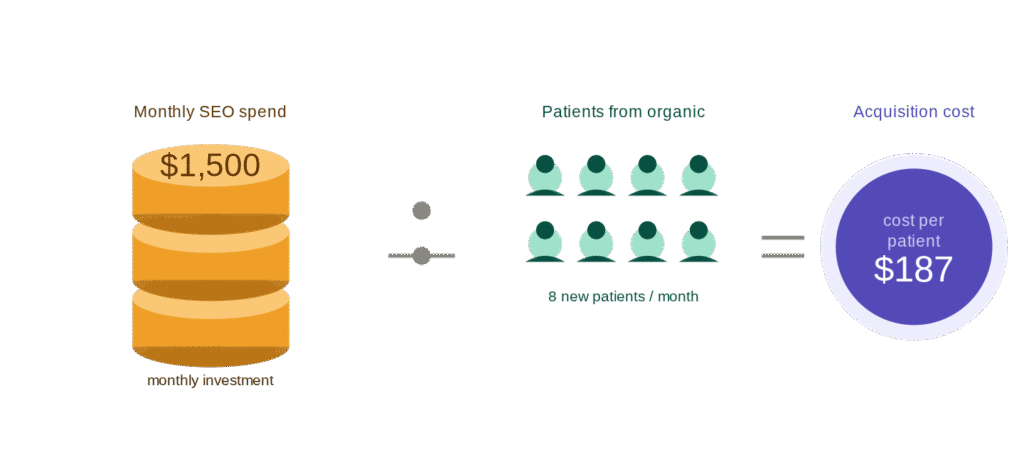
The number that actually determines whether your SEO for dentists investment makes sense is patient acquisition cost (PAC): how much you spend in total marketing effort to bring one new, booked patient through the door.
Understanding PAC through the lens of SEO requires connecting two figures: what you pay for dental SEO services each month, and how many new patients you generate. From there, the calculation is straightforward.
If your monthly SEO retainer is $1,500 and organic search delivers eight new patients in a given month, your PAC through that channel is $187.50 per patient. When you understand that number alongside patient lifetime value, you can evaluate almost any marketing investment rationally.
What Makes Dental SEO Different from General Local SEO
Because dental websites are classified by Google as YMYL (Your Money or Your Life) content, there are heightened expectations for expertise and quality. Agencies that specialize in dental SEO services must understand healthcare advertising laws, patient confidentiality regulations, and HIPAA-compliant content practices that simply do not apply to most local businesses.
This is one of the primary reasons dentist SEO costs more than SEO for a plumber or a restaurant. The content must be clinically accurate, the trust signals more rigorous, and the E-E-A-T requirements considerably more demanding.
The Compounding Nature of Organic Patient Acquisition
Organic leads tend to be more informed and more committed. They have researched your practice, read your reviews, and are further along in their decision process. These patients are more likely to accept treatment plans and become long-term patients. That behavioral difference has a direct financial consequence. A patient who found you via a paid ad clicked impulsively.
A patient who found you through an organic search has already pre-sold themselves. Their first-year treatment acceptance rate and their likelihood to return for recall appointments are both meaningfully higher, which raises their effective lifetime value compared to a PPC-acquired patient at the same nominal cost.
What Dental SEO Actually Costs in 2026
The range of pricing in the dental SEO market is genuinely wide, and that range reflects a meaningful difference in service scope, market competition, and expected outcomes. Understanding what sits inside each price band prevents the most common mistake practice owners make: comparing two retainer quotes at different price points without understanding that they are buying fundamentally different things.
The pricing landscape in 2026 has consolidated into recognizable tiers. Essential packages covering keyword research, basic on-page optimization, Google Business Profile management, and monthly reporting typically run $500 to $750 per month. Comprehensive approaches, including advanced local SEO, content marketing, reputation management, citation building, and conversion optimization, run $900 to $2,000 per month.
Full-service programs, including advanced technical SEO, custom content strategies, extensive link building, and dedicated account management, typically run $2,000 to $5,000 or more per month.
SEO for Dentists Pricing by Practice Type
| Practice Type | Recommended Monthly Investment | Primary Focus |
| New practice, low-competition market | $750 – $1,200 | Google Business Profile, local citations, and foundational on-page SEO |
| Established general practice, mid-size city | $1,200 – $2,500 | Content marketing, review management, and local map pack |
| Cosmetic or implant-focused practice | $2,500 – $5,000 | High-value keyword targeting, link building, service-specific landing pages |
| Multi-location or DSO | $5,000 – $10,000+ | Multi-location local SEO, centralized brand control, competitive domination |
For most dental practices looking to grow, the monthly investment falls between $1,000 and $3,000. Competitive markets like New York, Los Angeles, and California command premium pricing, while local SEO audits in these markets typically cost $1,500 to $3,000 for a comprehensive engagement.
What Drives the Cost Up
Several factors push dental practice SEO investment above the baseline range. The competitiveness of your local market is the single biggest driver: a practice in a suburban town competes against a handful of local practices, while a practice in a dense metropolitan area may face dozens of well-funded competitors and Dental Service Organization (DSO) chains with centralized marketing budgets.
The services you want to rank for also matter significantly. Long-tail keywords with lower competition, such as “pediatric dentist that accepts Medicaid in [small town]” or “sedation dentistry for anxious patients,” require less aggressive and less expensive strategies to rank, while broad high-value terms require substantially more investment.
The Real Patient Acquisition Cost Calculation
Calculating what organic search actually costs you per new patient requires moving beyond the retainer figure. The formula is simple but depends on honest tracking.
Patient Acquisition Cost (SEO) = Monthly SEO Investment / New Patients Attributed to Organic Search
To attribute new patients accurately, practices need call tracking software (such as CallRail), Google Analytics 4 with source attribution configured, and a consistent front-desk question: “How did you hear about us?” Cross-referencing those three data points gives you a reliable organic patient count each month.
A Worked Example: Mid-Size General Practice
A small family practice in Bergen County, New Jersey, with a monthly SEO investment of $1,500, focused on ranking for terms like “family dentist [town name]” and “dentist accepting new patients near me.”
With an average patient lifetime value of $4,800, the practice needed to acquire only one new patient every three months to break even. After six months of SEO for dentists, the practice averaged four to six new patients monthly from organic search, representing an annual ROI of approximately 700%.
That is not an outlier result. It represents a reasonable baseline expectation for a properly executed dental practice SEO campaign in a competitive but not hyper-competitive market.
Patient Lifetime Value: The Number That Changes Everything
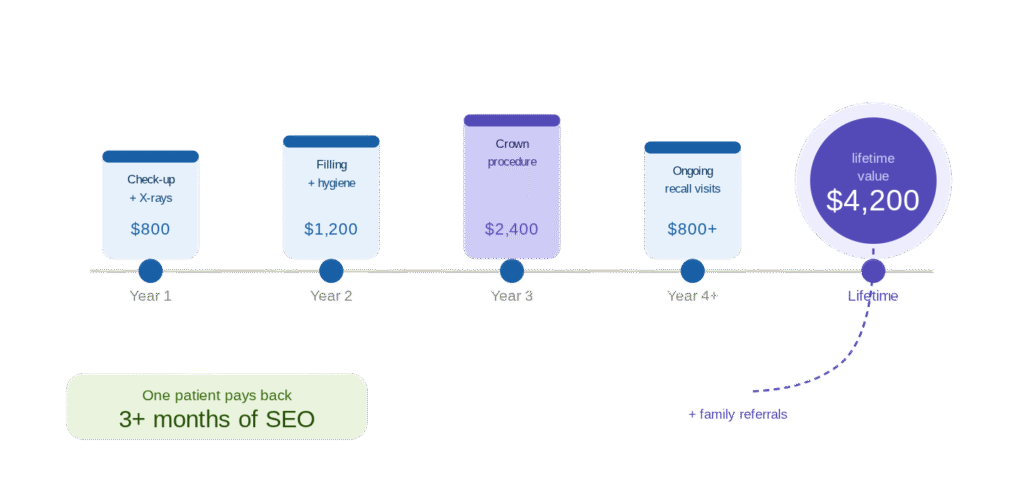
Before any PAC calculation can be evaluated properly, you need a credible estimate of your patient’s lifetime value (LTV). The range across practice types is wide. Most dental patients generate $2,000 to $5,000 in lifetime value, though this varies significantly based on demographics and practice type.
A survey of nearly 13,000 practices found gross production per patient averages around $4,200, but specialized marketing targeting implants, cosmetic, or full-arch cases can dramatically increase profitability.
For high-value service practices, the figures are considerably higher. A cosmetic dentistry practice in Midtown Manhattan investing $4,500 per month in SEO competes for terms like “Invisalign NYC” and “veneers Manhattan.”
With high-value cosmetic cases averaging $12,000 or more per patient and lifetime values exceeding $20,000, the practice needs fewer than one patient per quarter from SEO to justify the investment. Their actual results: 8 to 12 new cosmetic consultations monthly from organic search, with approximately 60% converting to treatment.
SEO vs. PPC: An Honest Cost Comparison for Dental Practices
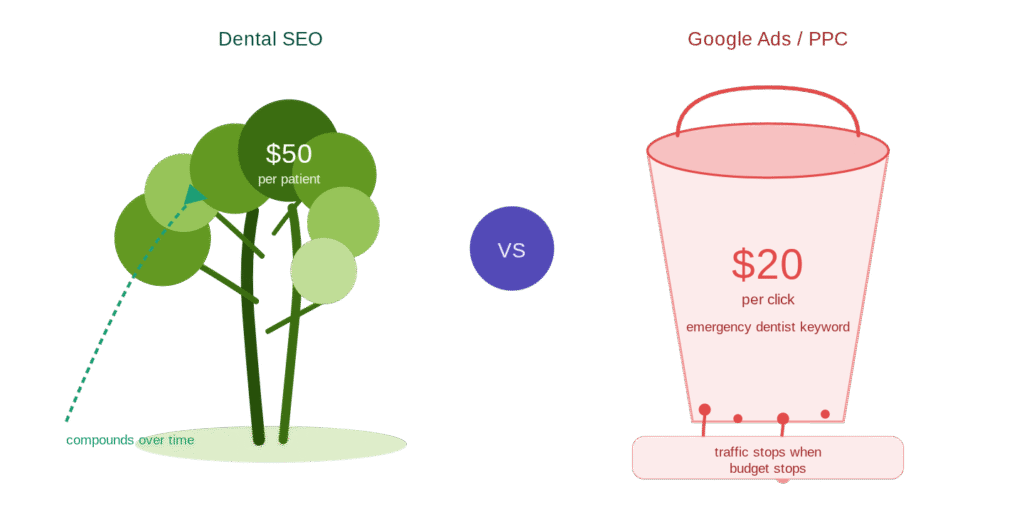
The most common question practice owners ask when evaluating dental SEO services is whether they would get more patients faster by spending the same budget on Google Ads. The answer is more nuanced than either channel’s advocates typically admit.
Dental keywords are among the most expensive in Google Ads. “Dental implants” can cost $8 to $15 or more per click, and “emergency dentist” is often $10 to $20 in most markets. In major metropolitan areas, these costs can double. More importantly, each of those clicks carries no residual value. The moment the budget stops, the traffic stops.
According to Search Engine Journal, 70% of users are more likely to click on organic search results than on paid ads, reflecting a higher baseline level of trust in organic results. For a healthcare service like dentistry, where trust and credibility are foundational to patient conversion, that click-through behavior translates directly into booking rates.
Direct Comparison: SEO vs. PPC for Dental Patient Acquisition
| Factor | Dental SEO | Dental PPC |
| Time to first results | 3 to 6 months | Immediate |
| Average monthly cost | $1,000 – $3,000 | $2,000 – $8,000 (including ad spend) |
| Cost per click | $0 (organic) | $10 – $50+ for dental keywords |
| Cost per lead (mature campaign) | $50 – $150 | $100 – $350 |
| Asset built over time | Yes, compounding | No, stops with spend |
| Patient quality | Higher commitment, more researched | Variable, often more impulse-driven |
| Typical ROI (12+ months) | 3x – 10x | 2x – 4x |
Local Service Ads, an alternative pay-per-lead model, often cost $40 to $90 per qualified call and appear prominently above traditional ads. These can be effective for new practices needing quick patient flow, but they require continuous budget allocation with no lasting benefit once spending stops.
The strongest practice growth strategies use both channels sequentially. PPC fills the schedule while SEO for dentists builds the organic foundation. Once organic rankings mature, PPC spend can be reduced or focused only on high-value keywords like implants or Invisalign.
What a Dental SEO Agency Should Actually Deliver
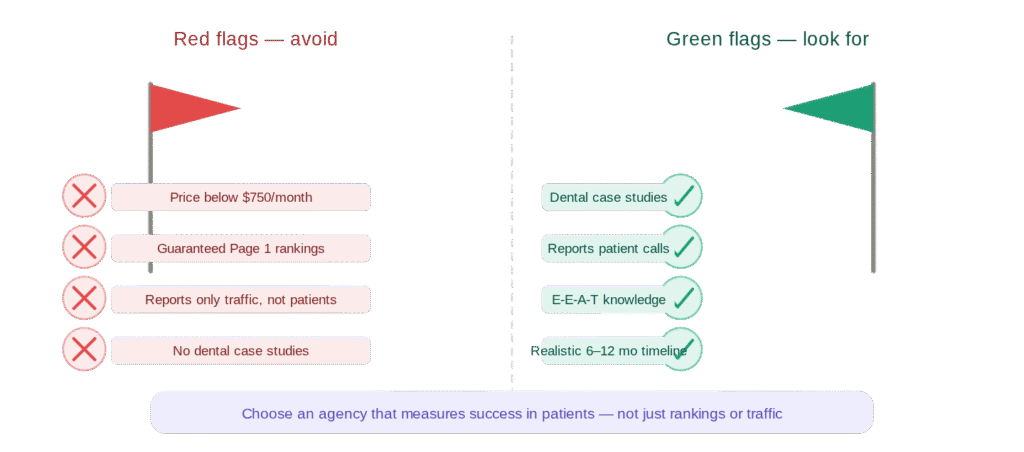
Not all dental SEO services are created equal, and the gap between a generalist agency applying templated tactics and a specialist with genuine dental market experience shows up quickly in results. When evaluating a dental SEO agency, the deliverables should be specific, measurable, and clinically compliant.
Specialized agencies that operate across healthcare and dental verticals, such as Rankfast, tend to build compliance review into their content calendar as a standard step rather than a post-publication audit, which avoids the costly content rewrites that arise when clinical accuracy is treated as an afterthought.
Core Components of a Credible Dental SEO Program
A legitimate dental SEO program in 2026 should include technical SEO covering site speed, mobile performance, and schema markup (specifically LocalBusiness, Dentist, FAQPage, and Review schema), on-page optimization of all service pages with keyword mapping, local SEO including Google Business Profile optimization and citation building across healthcare directories, content marketing with clinically reviewed blog content targeting patient questions, and monthly reporting tied to patient acquisition metrics, not just rankings.
Red Flags When Evaluating Dental SEO Services
Several red flags should give practice owners pause. No reputable SEO agency can guarantee a specific ranking, as Google’s algorithm is complex and constantly changing. Pricing below $750 per month is another major red flag: comprehensive SEO for dental websites requires significant resources, and extremely low prices often indicate an agency cutting corners or using methods that could harm your website.
Agencies that report on traffic and impressions without connecting those numbers to phone calls and booked appointments are measuring the wrong things entirely.
How Long Before Dental SEO Pays for Itself
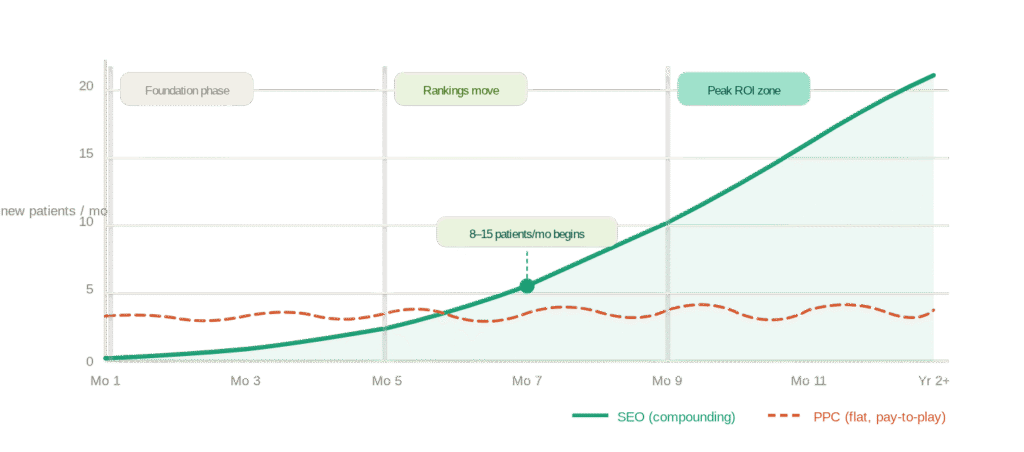
One of the most common reasons practice owners abandon dental practice SEO before it delivers results is misaligned expectations around the timeline. SEO for dentists is not a switch. It is an investment that compounds.
Research shows only about 5.7% of new pages rank in Google’s top 10 within a year, which is why consistent effort over time is essential. Most practices begin seeing meaningful improvements in months three to six, with significant results typically appearing between months six and twelve.
The timeline varies based on three factors: your starting position (an established website with some existing authority responds faster than a brand-new domain), your local market competition, and the monthly investment level. A $750 per month program in a low-competition market can outperform a $3,000 program in Manhattan simply because the competitive landscape is different.
In a mid-sized city, a well-run dental SEO campaign should aim for 8 to 15 new patients per month, specifically from organic search. If your average case value is high, even 5 patients per month can provide a substantial dental SEO ROI.
The Role of Reviews and Google Business Profile in Dental SEO
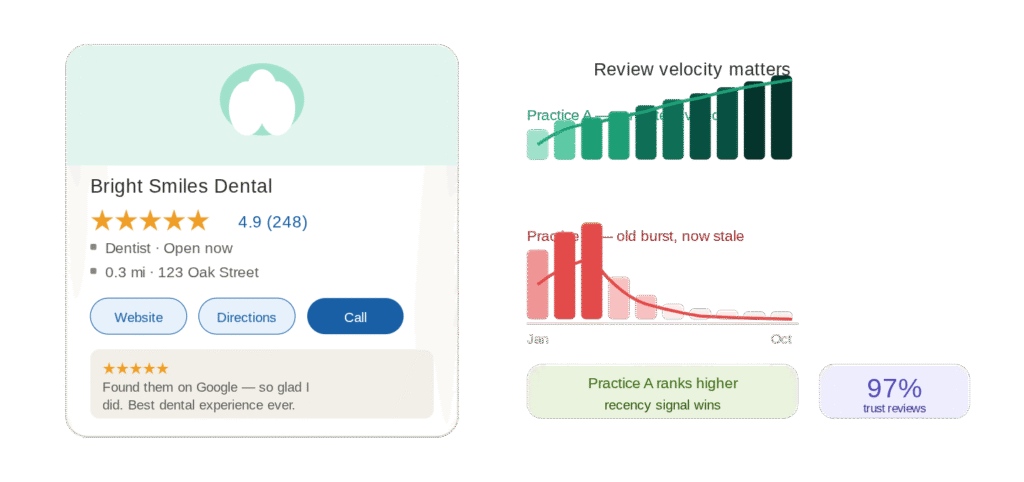
Rankings on Google Maps (the Local Pack) are driven by a different set of signals than traditional organic rankings, and for dentists, the Local Pack is often the highest-converting placement on the page. Most patients searching for a nearby dentist click directly on a map listing rather than scrolling to organic results below.
According to BrightLocal’s 2026 Local Consumer Review Survey, 97% of consumers still rely on reviews to guide their purchase decisions. Reviews have become an essential piece of evidence that a business is active and reliable, and are now a factor in visibility within traditional Google search and AI tools like ChatGPT.
According to BrightLocal’s Local Consumer Review Survey 2024, 36% of consumers use at least two different review sites before deciding to use a local business. For a dental practice, this means your Google Business Profile reviews are necessary but not sufficient. Healthgrades, Zocdoc, and practice-specific directories each capture a portion of patients researching their options before booking.
Review velocity, meaning the rate at which new reviews arrive, is a ranking signal in the local algorithm. A practice with 200 reviews received evenly over four years outperforms a practice with 250 reviews received mostly in year one, because the recency signal matters. Consistent review generation should be a formal process, not an occasional ask.
Conclusion
The case for dental SEO in 2026 is not about rankings. It is about the math. When the average dental patient generates between $2,000 and $5,000 in lifetime value, and a well-executed SEO campaign can bring 8 to 15 of those patients through the door each month at a cost of $50 to $150 per acquisition, the return is not marginal. It is transformational for a practice’s long-term growth trajectory.
If you are ready to evaluate what SEO for dentists could realistically deliver for your practice, start by benchmarking your current patient acquisition cost across all channels. The gap between what you are spending and what you could be spending, per patient, is usually the most compelling case for making the shift.
Frequently Asked Questions
How long does it take for dental SEO to start generating new patients?
Most practices begin seeing meaningful ranking improvements between months three and six, with significant patient volume from organic search typically appearing between months six and twelve. The timeline depends on your starting authority, local competition level, and monthly investment. New domains in competitive markets should budget for a full 12-month runway before evaluating dental SEO ROI.
What is the patient acquisition cost through dental SEO compared to PPC?
In mature SEO campaigns, patient acquisition cost through organic search typically runs $50 to $150 per patient. PPC dental keywords can cost $10 to $20 or more per click, meaning a single booked patient through paid advertising often costs $150 to $400 or more once click-to-booking conversion rates are applied. SEO’s cost-per-patient advantage compounds over time as rankings stabilize and the monthly retainer stays fixed while patient volume grows.
Is dental SEO worth it for a new practice?
Yes, but new practices should combine it with PPC initially. SEO takes time to build, and a new practice needs patience before organic rankings mature. Launching targeted PPC for immediate volume while building SEO foundations is the recommended sequential approach. New practices benefit from a PPC-heavy approach to establish presence; once stabilized, shifting toward SEO reduces dependency on ongoing ad spend.
What should I look for in a dental SEO agency?
Look for agencies with verifiable case studies from dental clients, transparent monthly reporting tied to patient acquisition metrics (not just rankings or traffic), experience with YMYL and E-E-A-T content standards, and clear knowledge of healthcare advertising compliance. A great agency acts as a partner dedicated to your practice’s growth, provides data-driven reports on campaign progress, and can supply references from existing dental clients.
How many new patients should I expect from dental SEO each month?
In a mid-sized city, a well-run campaign should aim for 8 to 15 new patients per month, specifically from organic search. If your average case value is high, even 5 patients per month can provide substantial ROI. Expectations should be benchmarked to your local market, investment level, and the services you want to rank for. General dentistry keywords drive volume; implant and cosmetic keywords drive higher-value patients.