Most marketing budgets treat paid search and SEO as separate line items managed by separate teams with separate KPIs. One team optimises for Quality Score. The other tracks the domain authority. Neither regularly shares data. The result is two channels that should amplify each other instead of quietly competing for the same clicks, often paying for traffic the organic listing was already capturing for free.
The numbers make this a problem worth fixing. Global search ad spend is projected to reach $351.5 billion in 2025. At the same time, organic search accounts for 53.3% of all trackable website traffic but delivers only a fraction of the visibility on AI-powered SERPs, where paid placements still hold ground.
This guide is for marketing directors, growth leads, and business owners evaluating search engine marketing services in 2026. It covers what integrated SEM looks like at a channel level, what the data says about paid versus organic performance, and how the two work together to lower acquisition costs while building lasting search equity.
KEY TAKEAWAYS
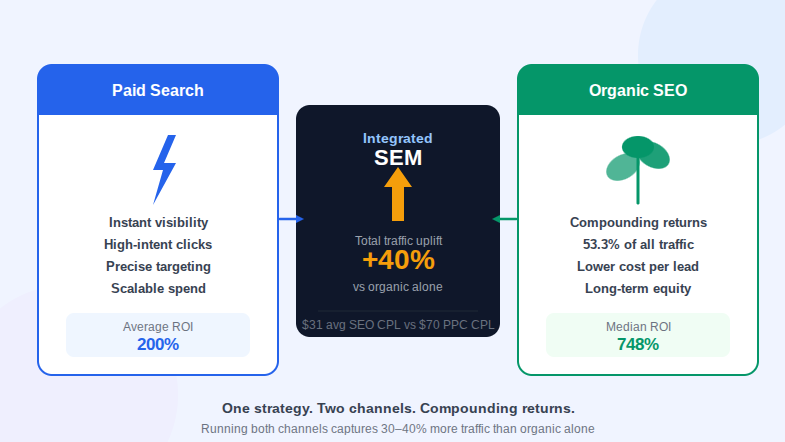
- Organic search generates 53.3% of all website traffic, while paid search accounts for 15%, but paid captures 65% of high-intent clicks, making both channels structurally necessary.
- SEO delivers a median ROI of 748% over a long-term horizon; PPC delivers an average 200% ROI with immediate results.
- Running paid and organic together for the same keywords can increase total incremental traffic by 30% to 40% compared to organic alone, per controlled Search Engine Journal case data.
- AI Overviews now appear in 31% of search results, and only 5% of those SERPs also show PPC ads, meaning brands that rely on paid alone are losing visibility in a growing share of results.
- CPC increased for 87% of industries in 2025; brands that use organic rankings to reduce paid dependency on high-performing keywords protect their margin as auction costs rise.
What Search Engine Marketing Services Actually Cover in 2026
The term ‘search engine marketing’ has shifted in meaning over the past decade. Understanding its current scope is the starting point for evaluating any SEM agency or provider.
Historically, SEM was the umbrella term covering all activity on a search engine results page, both paid and organic. Today, most practitioners use SEM to refer specifically to paid search advertising, while SEO stands on its own. But this semantic split has created a structural problem: businesses now tend to procure paid and organic services separately, often from separate vendors, with no shared strategy layer.
A complete SEM services engagement in 2026 should cover both channels under one strategic framework, regardless of how delivery is staffed. The core components are:
Paid Search Management (PPC / Google Ads)
This includes campaign architecture, keyword bidding, ad copy, audience targeting, conversion tracking, and optimisation of campaign types, including Search, Shopping, Performance Max, and Demand Gen. Google Ads holds a 69.04% share of the global PPC market, making it the mandatory starting point for any paid search strategy. Microsoft Ads (Bing) is a secondary layer, with a consistently lower average CPC of $1.54 versus Google’s $5.26 average across industries.
Search Engine Optimisation (SEO)
SEO covers technical site health, on-page content optimisation, authority building through links, and increasingly, optimisation for AI-generated features like Google’s AI Overviews. The global SEO services market is estimated at $83.98 billion in 2026 and is projected to reach $148.86 billion by 2030. A trajectory that reflects sustained investment confidence despite rapid changes in SERP behaviour.
Integrated Strategy and Attribution
This is the layer most providers omit. It includes shared keyword mapping across paid and organic, cross-channel attribution reporting, and coordinated content and bidding decisions based on where each channel is more efficient. Without this layer, paid and organic teams operate in silos and frequently duplicate spend.
The Case for Paid Search: Speed, Intent, and Measurable Returns
Paid search produces results on a timeline that organic cannot match, and for commercial intent queries, it captures a disproportionate share of high-value clicks.
The average cost-per-lead for paid search on Google Ads across all industries is $70.11. That figure varies substantially by vertical (legal CPCs average $9.21 per click while real estate sits at $1.55), which is why industry-specific benchmarking matters before setting any paid search budget.
Where Paid Search Wins on the SERP
Paid search ads occupy the top of the results page, before organic content. The top three paid positions collectively capture 46% of all clicks. For branded queries and product-specific searches with strong purchase intent, paid search provides a level of SERP control that organic optimisation cannot guarantee in the short term.
The AI Overviews Wrinkle for Paid
A critical 2026 development: AI Overviews now appear in approximately 31% of search results; only 5% of SERPs featuring AI Overviews also display PPC ads. This means paid search is excluded from a growing portion of commercial query results pages, reinforcing why organic visibility in AI features is no longer optional for brands with a long-term search strategy.
Why Organic Search Remains the Highest-ROI Channel
The long-term performance case for SEO is stronger in 2026 than it was five years ago, even accounting for the disruption caused by AI-generated search features and zero-click growth.
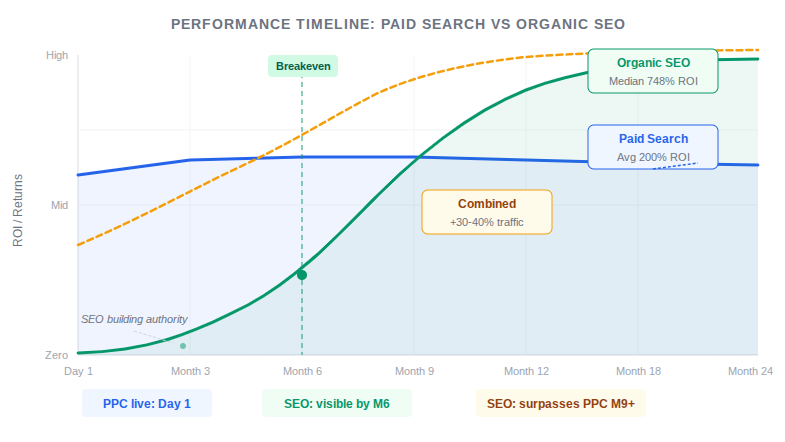
SEO delivers a median ROI of 748%, with organisations realising approximately $22 in returns for every $1 invested over a three-year horizon. This compares to PPC’s average 200% ROI, a significant gap that reflects the compounding nature of organic authority versus the linear returns of paid spend.
Traffic Volume and Lead Quality
Organic search drives 53.3% of all trackable website traffic compared to 15% from paid search. More important than volume, SEO-generated leads close at a 14.6% rate, compared to 1.7% for outbound channels. For B2B businesses in particular, organic search generates 44.6% of all revenue, the single largest channel contribution.
Cost per Lead Advantage
The average cost-per-lead from SEO is approximately $31 per conversion, compared to the $198 industry average across all marketing channels. For businesses with a 12 to 24-month growth horizon, this cost differential is the central argument for investing in SEO alongside paid search rather than instead of it.
The Zero-Click Reality
One structural challenge for organic in 2026: 58.5% of all Google searches end without a click to any external site. This zero-click rate (driven by featured snippets, Knowledge Panels, and AI Overviews) means that raw ranking position no longer guarantees traffic volume. Optimising for AI Overview inclusion and featured snippet capture is now a core deliverable of any serious SEO engagement.
The Integration Advantage: How Paid and Organic Reinforce Each Other
The most significant performance gains in search marketing come not from optimising each channel independently, but from building them around a shared keyword and data architecture.
When a brand’s paid search campaigns went offline while organic remained active, total site traffic fell, and organic did not absorb the full load. When paid search was restored, combined traffic from both channels exceeded the pre-test organic-only baseline by 30% to 40%. The study concluded that SEM and SEO together produce incremental traffic that neither channel achieves alone, including a reinforcement-of-trust effect when a brand occupies both ad and organic positions simultaneously.
Data Sharing Between Channels
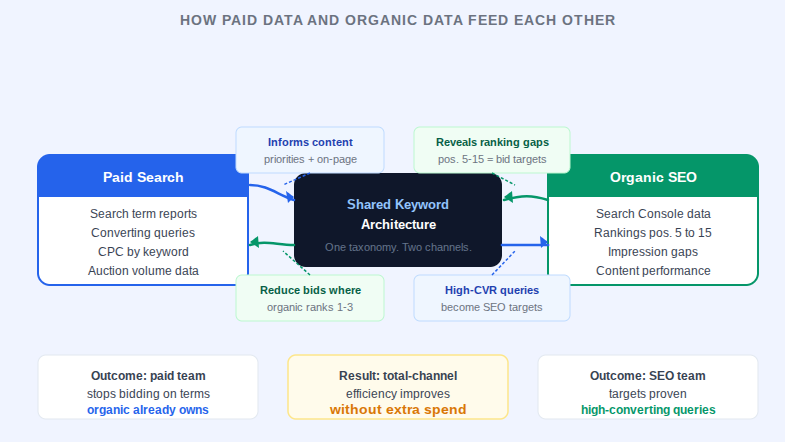
Paid search data is a real-time signal generator. Google Ads search term reports reveal which exact queries are converting, at what cost, and at what volume. This data (when passed to the SEO team) can directly inform content priorities, on-page optimisation targets, and internal linking decisions. Conversely, Google Search Console organic impression data shows which keywords rank between positions 5 and 15, where incremental investment could push them to positions 1 to 3, potentially reducing the need to bid on those terms at all.
Budget Reallocation Based on Organic Position
One of the clearest integration wins involves shifting paid budget away from keywords where organic rankings already sit in positions 1 to 3. Filtering for organic terms ranking in positions 4 and below identifies where paid spend is duplicating organic traffic rather than extending it. Reallocating that budget to non-branded, high-intent keywords where organic has no presence typically improves total-channel efficiency without increasing overall spend.
Keyword Strategy Across Both Channels
A unified keyword framework is the operational foundation of integrated SEM services. The goal is complete funnel coverage, with each channel assigned to the queries it serves most efficiently.
| Query Type | User Intent | Recommended Channel | Rationale |
|---|---|---|---|
| Brand name + service | Navigational / High intent | Paid (brand protection) + Organic | Competitors may bid on your brand; dual presence closes the gap |
| Competitor brand terms | Commercial | Paid only | Organic ranking on competitor names is slow and uncertain; paid is direct |
| Category / service keywords | Commercial investigation | Both — paid while organic matures | High-value; paid captures immediate demand while SEO builds durable ranking |
| Informational / ‘how to’ queries | Awareness / Research | Organic (content) primarily | High search volume, low conversion rate; paid spend is rarely efficient here |
| Long-tail transactional queries | Purchase-ready | Paid (immediate) + Organic (content) | Low competition, high CVR; both channels can convert efficiently |
| Local + service intent queries | Transactional | Paid (Local Campaigns / LSA) + Local SEO | 76% of local searches lead to a business visit within 24 hours (Google) |
Managing Keyword Cannibalization
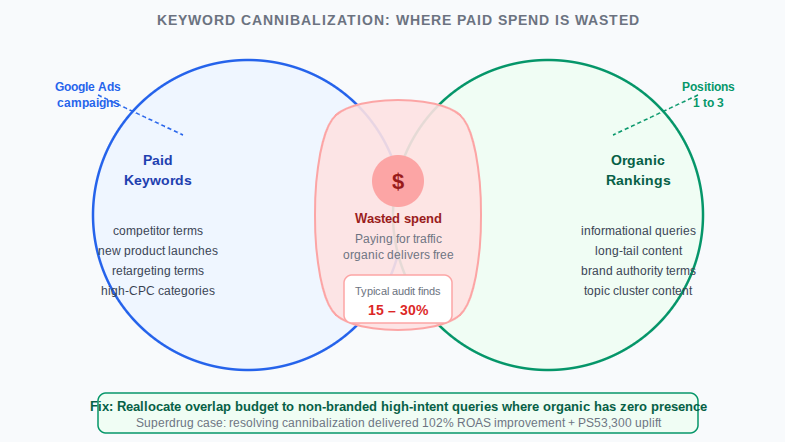
Keyword cannibalization is one of the most common inefficiencies in businesses running both channels. Resolving cannibalization through automated keyword-level bidding decisions resulted in a 102% improvement in total ROAS for Superdrug, alongside a PS53,300 incremental revenue uplift from a unified search strategy.
The fix requires shared reporting across both channels, ideally pulling from Google Ads and Search Console simultaneously, to see where paid spend is buying traffic that organic was already delivering.
Agencies operating across multiple search verticals, like Rankfast, often build a shared keyword taxonomy into the onboarding process for new clients, mapping organic positions against active bid terms before a single campaign goes live. The audit typically reveals 15% to 30% of active paid spend targeting queries where organic already holds a top-three position.
AI Overviews and Their Implications for Search Strategy in 2026
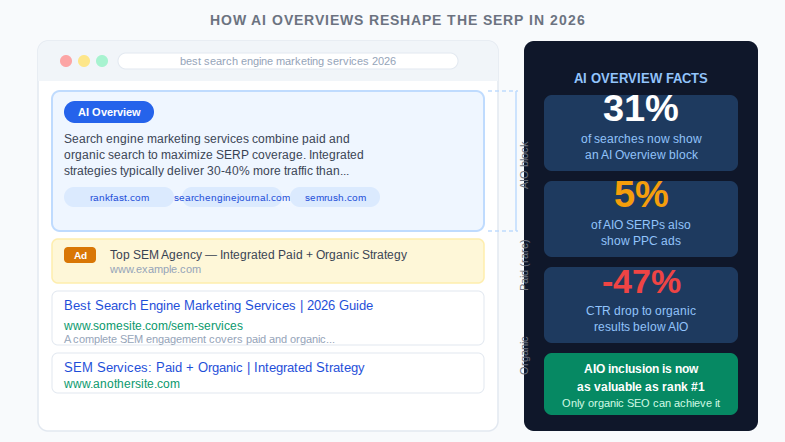
Google’s AI Overviews have fundamentally changed how SERP real estate is distributed, and any search engine marketing company operating without an AI Overview strategy is leaving measurable visibility on the table.
AI Overviews, launched in May 2024 and expanded aggressively through 2025, now appear in approximately 31% of search results.
Queries that trigger AI Overviews see CTR drops of up to 47% to organic results below the AIO block. The implication is not that SEO becomes less important; it is that appearing inside the AI Overview block becomes as valuable as ranking position one.
What AI Overviews Mean for Paid Search
As noted earlier, only 5% of SERPs featuring AI Overviews co-display PPC ads. This is a structural change in SERP composition that paid-only strategies cannot overcome by increasing bids. The practical response is to invest in AIO-optimised content, which is an organic SEO activity, not a paid one.
Optimising Content for AI Overview Inclusion
Content that earns AI Overview citations shares specific structural traits: direct, concise answers in the first 40 to 80 words of a section; use of structured lists and comparison tables; strong E-E-A-T signals through author expertise and cited data sources; and topical authority built through comprehensive coverage of a subject cluster.
These are the same signals that have historically driven featured snippet wins — the difference in 2026 is that AIO inclusion can drive brand impressions even when the user never clicks through to the site.
Comparing SEM Service Models: What to Evaluate When Choosing a Provider
Choosing between a specialist PPC agency, an SEO agency, or a full-service search engine marketing company involves trade-offs across capability depth, integration quality, and reporting transparency.
| Provider Type | Paid Depth | SEO Depth | Integration Layer | Best Suited For |
|---|---|---|---|---|
| Standalone PPC Agency | High | None / Limited | None | Businesses with existing in-house SEO |
| Standalone SEO Agency | None / Limited | High | None | Businesses prioritising long-term organic growth |
| Full-Service SEM Company | High | High | Structured | Businesses wanting unified strategy and one reporting layer |
| In-House Team | Variable | Variable | Possible if structured | Larger organisations with budget for specialist hires |
Questions to Ask Any SEM Provider
Before engaging a search engine marketing company, the following questions separate providers with genuine integration capability from those who run paid and organic as parallel silos:
- How do you share keyword-level data between the paid and organic teams?
- What is your process for identifying and resolving paid/organic keyword cannibalization?
- How do you adjust paid bids when organic positions change for the same keywords?
- What does your attribution reporting cover, and does it reconcile across Google Ads, Search Console, and GA4?
- How do you factor AI Overview inclusion into content deliverables?
Measuring Integrated SEM Performance: Metrics That Matter
Integrated search measurement requires a reporting framework that captures the contribution of both channels to the same conversion events, without attributing shared wins to a single channel.
Cross-Channel KPIs to Track
The following metrics should be standard in any integrated SEM reporting dashboard:
- Total search traffic share: Combined paid + organic visits as a percentage of all site traffic, tracked weekly to identify shifts caused by algorithm changes, SERP layout changes, or campaign pauses.
- Cost per acquisition by channel: Separate CPA for paid search (based on ad spend + conversions) and for organic (based on SEO investment + conversions), compared monthly to track efficiency trends.
- Impression share by keyword cluster: Using Search Console for organic impressions and Google Ads for paid impression share, to identify gaps where neither channel is capturing significant visibility.
- Revenue attribution by channel: GA4’s data-driven attribution model distributes conversion credit across all touchpoints in the journey, allowing accurate comparison of paid versus organic contribution to revenue.
- Cannibalization rate: Percentage of active paid keywords where organic rankings sit in positions 1 to 3, reviewed monthly to identify reallocation opportunities.
Benchmarks for Calibrating Expectations
Realistic timelines matter for any integrated SEM engagement. Paid search delivers visibility within days of campaign activation. SEO results typically become measurable within 7 to 9 months, with most B2B SaaS companies reaching SEO investment breakeven at the 7-month mark. Combining both channels from the outset means the business generates measurable search revenue from day one via paid, while the organic channel builds toward a lower-cost-per-lead baseline over the medium term.
Building a Search Strategy That Compounds
The businesses generating the strongest search ROI in 2026 are not the ones spending the most on Google Ads or publishing the most SEO content. They are the ones that have built a shared architecture between the two — where paid data informs organic decisions, organic rankings reduce paid dependency, and both channels contribute to a SERP presence that is harder for competitors to displace.
If your current search investment runs paid and organic as separate cost centers with separate reporting, the starting point is a cross-channel keyword audit. Identify where you are paying for traffic you already own organically, reallocate that budget to queries where organic has no presence, and align both teams around a single attribution view.
That audit alone typically delivers measurable efficiency improvements within the first 90 days — before a single additional dollar of spend is added. Contact a search strategist at Rankfast to get started.
Frequently Asked Questions
What is the difference between a PPC agency and an SEO agency?
A PPC agency manages paid advertising campaigns, primarily Google Ads, focusing on bid strategy, ad copy, audience targeting, and conversion rate. An SEO agency focuses on organic rankings through content, technical site health, and authority building. The meaningful distinction in 2026 is that PPC produces immediate, scalable results tied directly to budget, while SEO builds compounding returns over months. Both are needed at different weights depending on the business stage and the competitive environment.
How much do search engine marketing services cost?
For paid search, small to mid-sized businesses typically spend $1,000 to $10,000 per month on Google Ads budget, plus $100 to $5,000 per month in agency management fees. For SEO, average monthly agency fees run approximately $3,000 per month in 2026, per Search Engine Journal benchmarks. Integrated SEM retainers combining both channels vary widely by scope, but most mid-market engagements fall between $3,000 and $15,000 per month in total service fees, excluding ad spend.
Should I run Google Ads and SEO at the same time?
Yes, for most businesses. Running both simultaneously allows paid search to capture immediate demand while SEO builds organic authority. Research shows that when both channels are active for the same keywords, total traffic increases by 30% to 40% compared to organic alone — a result driven partly by the trust reinforcement that comes from occupying both ad and organic positions on the same SERP. The key is coordinating keyword targeting to minimise budget waste from cannibalization.
How long does SEO take to show results compared to PPC?
Paid search delivers traffic from the day a campaign goes live, making it the right channel for immediate lead generation. SEO typically produces measurable ranking improvements within 3 to 6 months, with meaningful traffic and revenue impact emerging between months 7 and 12, depending on domain authority, competition level, and content investment. B2B SaaS companies in competitive verticals often reach SEO investment breakeven at 7 months, per First Page Sage campaign data. The two channels are complementary across these timelines, not interchangeable.