Financial services firms operate under two simultaneous pressures that most industries do not face: intense organic search competition and strict regulatory constraints on what they can and cannot say online. A bank cannot promise guaranteed returns. A wealth manager cannot imply performance certainty. An insurance provider must include specific disclosures. And all of them must satisfy Google’s most demanding content standard (YMYL, or Your Money or Your Life), which applies elevated scrutiny to any content that could directly affect a person’s financial well-being.
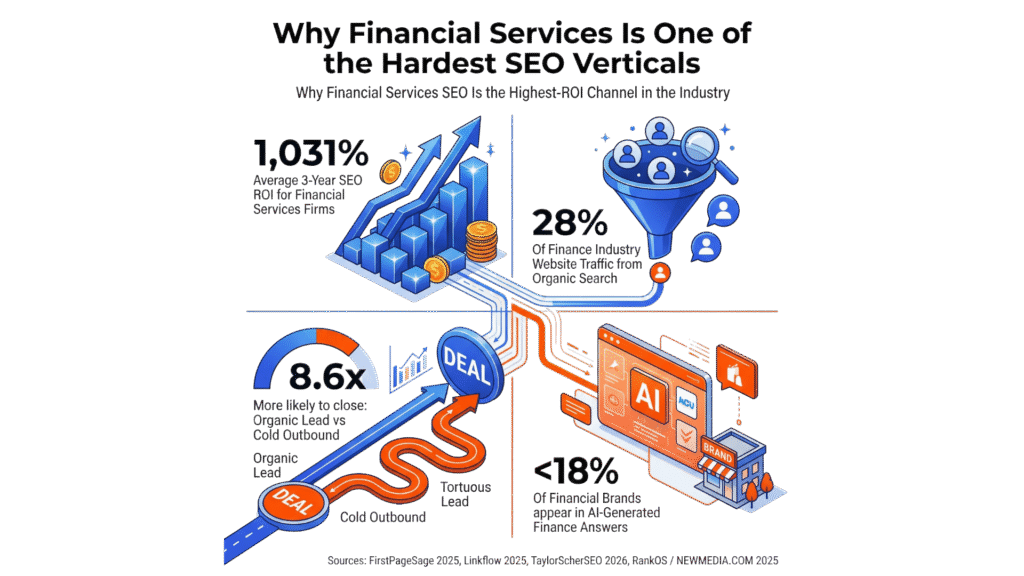
Against that backdrop, a financial services SEO agency delivers the highest three-year return of almost any industry: 1,031% average ROI, based on campaign data across banks, investment managers, fintech companies, and insurers. Organic search accounts for 28% of all finance industry website traffic. An organic lead in financial services is 8.6 times more likely to close than a cold outbound lead, because the prospect arrived with intent, searching for a specific solution, finding your firm as the answer.
This guide explains what genuine finance SEO services require, why a specialist agency is almost always necessary in this sector, and how to evaluate whether an agency has the compliance knowledge and technical depth to actually deliver.
Why Financial Services Is One of the Hardest SEO Verticals
Google’s YMYL classification places financial services content in a category of content that can materially affect a person’s financial decisions, health, or safety. This classification activates a higher standard of algorithmic scrutiny and human quality review. Content that passes in other industries (general advice, loosely sourced claims, anonymous authorship) will not pass in financial services.
The consequences of getting this wrong are not just poor rankings. In regulated markets, non-compliant financial content can attract regulatory attention from bodies such as the SEC, FINRA, the FCA in the UK, or ASIC in Australia.
At the same time, the competitive landscape is brutal. SERPs for high-value financial terms (best mortgage rates, wealth management firms, business bank account comparison) are dominated by institutions with domain authority scores built over decades. A newcomer or mid-market firm targeting these terms directly, without a sophisticated content strategy and genuine authority signals, will not rank.
What a specialist financial services SEO agency brings is the ability to find and execute the content strategy that builds authority incrementally, targeting accessible entry points first and working up the keyword difficulty curve as domain authority grows.
The Compliance-Visibility Tension
The fundamental challenge of finance SEO services is that the tactics that help content rank (strong claims, specific outcomes, persuasive language) are precisely the tactics that compliance departments, regulators, and Google’s quality evaluators flag.

Financial SEO consultant resolves this tension through content architecture: building ranking authority with compliant, genuinely informative content that satisfies Google’s E-E-A-T requirements without triggering regulatory exposure.
The YMYL and E-E-A-T Framework: What Financial Content Must Actually Satisfy
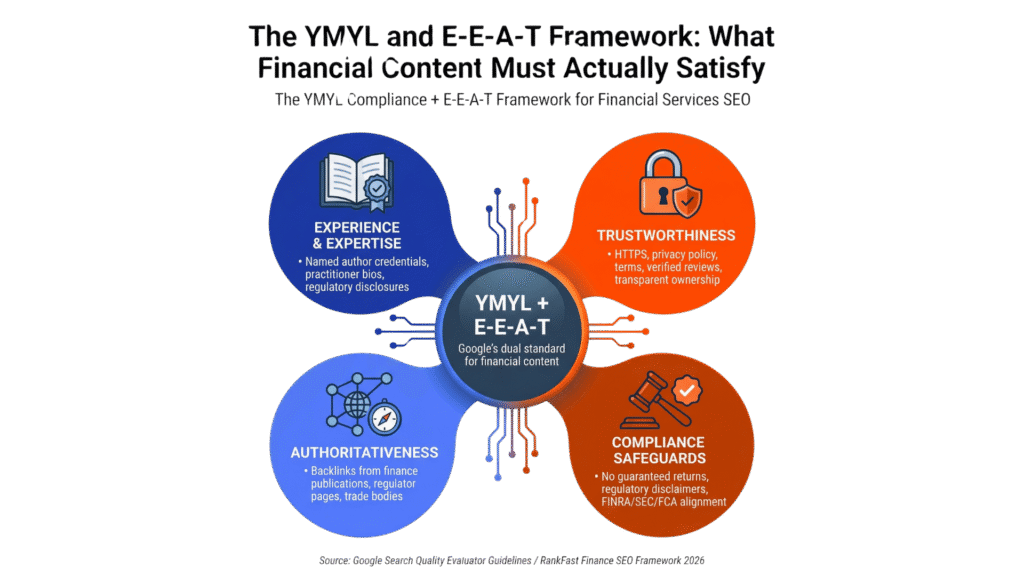
E-E-A-T (Experience, Expertise, Authoritativeness, and Trustworthiness) is Google’s quality framework for evaluating content that could affect users’ lives. For financial services, every dimension carries specific technical requirements.
Experience and Expertise
Financial content must demonstrate that it was produced by someone with genuine knowledge of the subject matter. In practice, this means named authors with verifiable credentials: a chartered financial planner writing about retirement planning, a licensed mortgage broker explaining refinancing options, a qualified accountant discussing tax strategy.
Anonymous content, or content attributed only to a brand name, consistently underperforms in financial services YMYL evaluation because it lacks the credential signals that quality raters look for. Every high-stakes page on a financial services website should carry a named, credentialed author and a bio that clearly establishes their qualifications.
Authoritativeness
Authority in finance SEO services is built through external validation. The links and mentions that carry authority weight in this sector come from specific source types:
- industry regulators and trade bodies (FCA, FINRA, FPC, industry associations)
- financial news publications (Bloomberg, Reuters, FT, the Wall Street Journal for US firms)
- academic and research institutions, and authoritative comparison platforms (MoneySuperMarket, NerdWallet, Bankrate)
Generic link building from unrelated websites does not move the needle in financial services. Domain-authority accumulation needs to be targeted at the specific sources that signal credibility to Google’s quality systems in this vertical.
Trustworthiness and Compliance Safeguards
Trustworthiness signals in financial services include technical site security (HTTPS, correct SSL implementation), a visible and current privacy policy, transparent ownership and regulatory registration details, clear risk disclosures on any content involving investment products, and the absence of prohibited language. Phrases that imply guaranteed returns, risk-free outcomes, or specific performance claims are regulatory red flags in most jurisdictions and Google quality signals in all of them.
A financial services SEO agency must have a compliance review process that checks every piece of content before publication. Agencies without this process regularly produce content that passes their own SEO review but fails legal review, and the resulting need to unpublish or heavily revise content wastes both the agency’s work and the firm’s budget.
The 5 Pillars of a Financial Services SEO Agency That Drives Qualified Leads
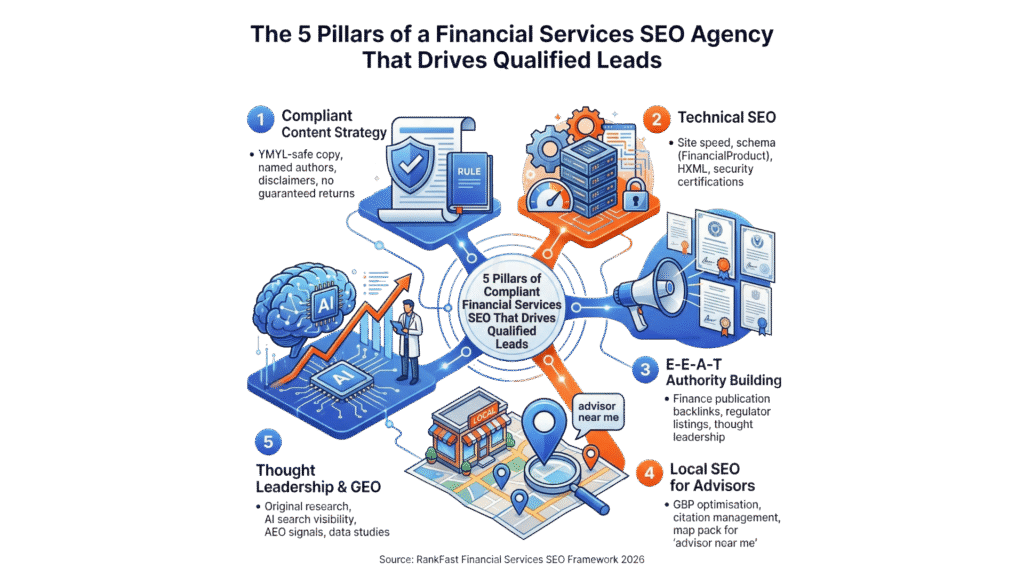
A financial services SEO programme that produces compounding lead generation requires five systems operating simultaneously. Here is what each involves.
Pillar 1: Compliant Content Strategy
The content strategy for a financial services firm cannot be built around the highest-volume keywords in the sector. Terms like guaranteed investment returns, risk-free trading, or best returns in [timeframe] are both unprovable and potentially in violation of regulatory advertising standards. The keyword strategy must begin with compliance screening: identifying the high-intent queries in your sector that can be addressed with genuinely educational, appropriately disclaimed content.
This requires a financial services SEO agency that understands the difference between compliant educational content (how to assess investment risk, what to look for in a wealth manager) and promotional content that must satisfy different regulatory standards. The compliance-first content approach is not a constraint on SEO effectiveness. Done correctly, it produces the exact type of authoritative, well-researched content that Google’s quality systems reward.
Pillar 2: Technical SEO for financial site architecture
Financial services websites frequently carry technical SEO issues that are specific to their architecture: large paginated documentation or product catalogue sections that consume crawl budget, compliance-required disclaimers that duplicate across hundreds of pages and create thin-content signals, login-gated content that creates indexation gaps, and multi-region sites with complex hreflang and currency localization.
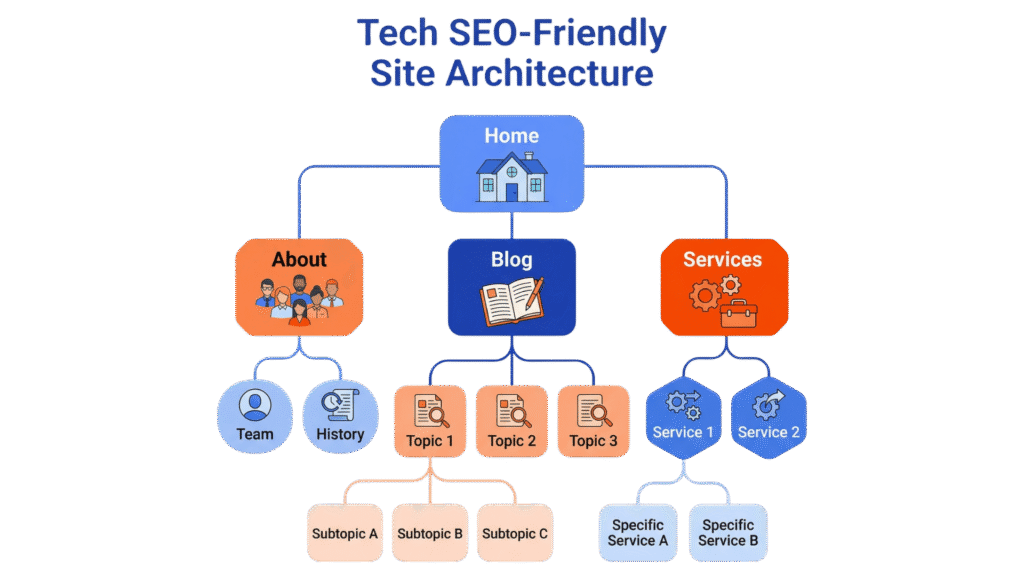
FinancialProduct schema markup (structured data that makes financial product information machine-readable for both Google and AI assistants) is consistently under-implemented on financial services sites despite being a meaningful differentiator. A financial SEO consultant without experience in financial site architecture will miss most of these issues during a standard technical audit.
Pillar 3: E-E-A-T authority building
Building E-E-A-T authority for a financial services firm means a systematic programme of earned coverage in the specific publications and platforms that signal credibility in this sector.
This includes:
- securing listings and contributions on regulatory body platforms and trade association websites
- placing thought leadership in financial news publications and professional journals
- building presence on authoritative comparison platforms (Bankrate, NerdWallet, MoneySuperMarket)
- accumulating consistent positive reviews on platforms used by financial services consumers (Trustpilot, Google, industry-specific review platforms)
A franchise of financial advisors using BrightLocal’s citation management achieved top-3 map pack positions for “financial advisor near me” queries across 85% of their branches within six weeks by standardising NAP data alone. Citation consistency is one of the lowest-effort, highest-return technical interventions available to multi-location financial services firms.
Pillar 4: Local SEO for advisors and regional institutions
For financial advisors, community banks, regional credit unions, accountants, and insurance brokers, local SEO is as important as national organic rankings. The query “financial advisor near me” is high-intent and high-conversion; the prospect has already decided they need an advisor and is now choosing who to contact.
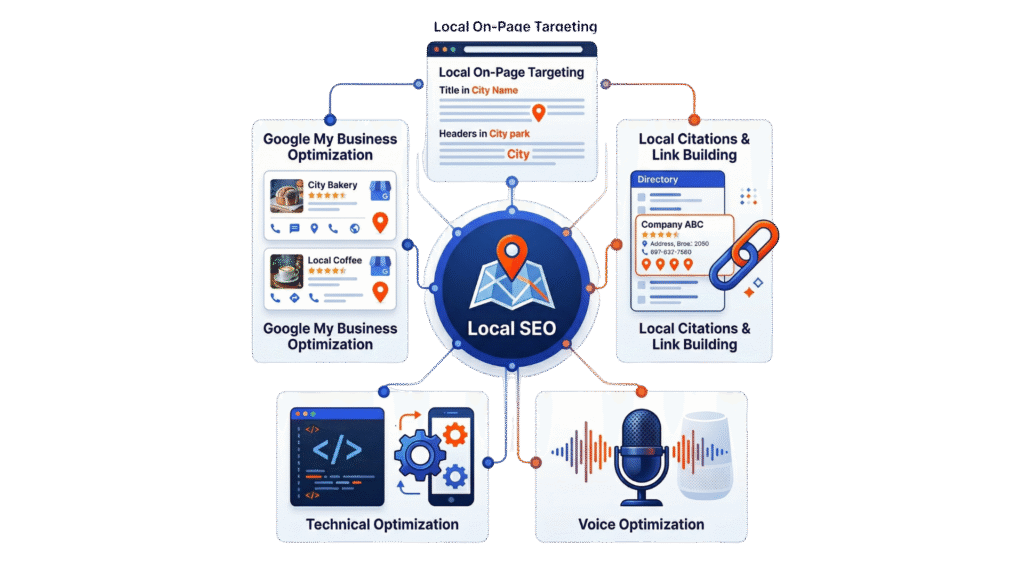
Google Business Profile optimization, consistent citation management, and a review generation strategy that produces fresh, recent feedback all determine whether your firm appears in the map pack for these queries or is invisible to the majority of local searchers.
Pillar 5: Thought leadership and AI search visibility
Original research is the most powerful authority-building content type available to financial services firms. Proprietary data (market surveys, portfolio analysis trends, consumer financial behavior research) earns the kind of inbound links from financial publications that no outreach campaign can reliably replicate.
Financial services websites that produce original research achieve 29.7% organic traffic increases versus 9.3% for those without it. And in 2026, this content is doubly valuable: it builds traditional SEO authority, and it generates the AI citation signals that determine whether a firm appears in AI-generated financial recommendations.
Fewer than 18% of financial services and insurance brands currently appear in AI-generated answers for financial queries, making early AI visibility investment a genuine competitive advantage for firms that act now.
The ROI Case: Why Financial Services Justify the Investment
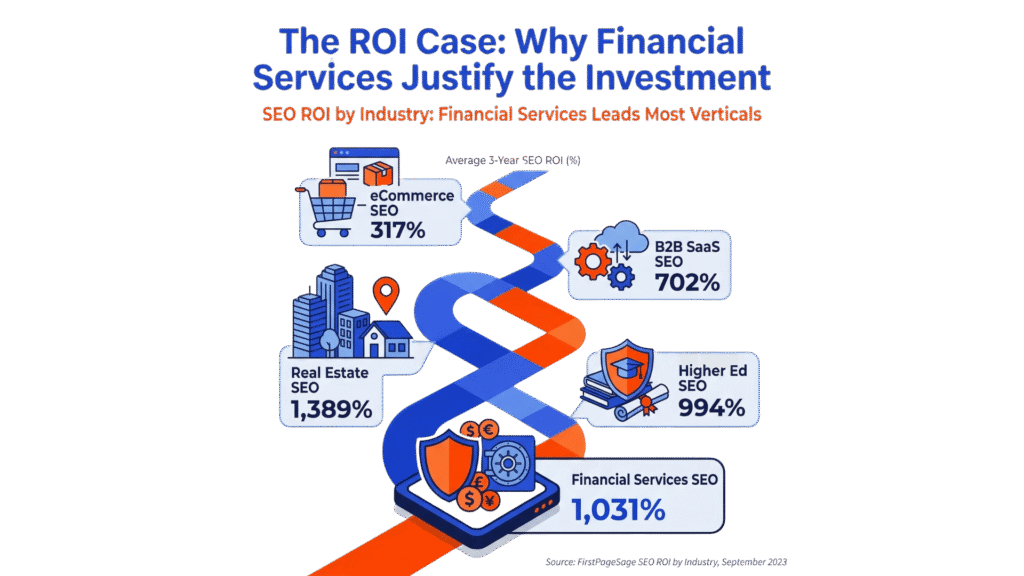
The 1,031% average three-year ROI for financial services SEO is not an anomaly. It reflects the high customer lifetime values inherent in the sector. A wealth management firm that acquires a single new client through organic search at $500,000 AUM, generating $5,000–10,000 in annual management fees, sustained for a decade or more, has recovered a year of SEO investment from that one lead. The economics of high-LTV financial services clients make even conservative organic lead generation volumes produce outsized financial returns.
| Firm Type | Typical Monthly SEO Investment | Target ROI at 12 Months |
| Local financial advisor / IFA | $1,000–$2,500 | 3x–5x (2–5 new clients/mo from organic) |
| Regional bank/credit union | $2,500–$6,000 | 4x–6x (product signups + footfall) |
| Fintech / digital lender | $4,000–$10,000 | 5x–10x (scalable organic user acquisition) |
| Wealth/investment manager | $3,000–$8,000 | 8x–15x (high AUM client LTV over 10+ years) |
The Cost of Invisibility: Organic searches drive 28% of finance industry website traffic, and the cost of not appearing for prospects in financial services is enormous. A firm invisible in organic search for its primary service terms is surrendering those leads to competitors every day, at no cost to those competitors and with no way to recapture the lost opportunity.
How to Select a Financial Services SEO Agency
Most SEO agencies will take a financial services client. Far fewer are qualified to serve one. The selection criteria that matter in this sector are specific.
| What a Specialist SEO Agency for Financial Services Does | What a Generic Fintech SEO Agency Misses |
| Has an internal compliance review process for all financial content | Publishes first, reviews compliance after, or never |
| Understands FINRA, SEC, FCA, or ASIC advertising standards for their market | Unaware of jurisdiction-specific financial advertising rules |
| Targets financial-sector authority sources: FT, Bloomberg, trade bodies | Pursues generic link-building from unrelated domains |
| Reports on qualified lead volume and pipeline impact, not just traffic | The monthly report shows sessions and keyword rankings only |
| Has case studies from banks, advisors, fintechs, or insurers specifically | Finance case studies are repurposed from other industries |
| Implements FinancialProduct schema and financial-specific structured data | Applies the generic LocalBusiness schema or no schema at all |
The fastest qualification test is a direct question: Can you walk me through how you would approach a content brief for a wealth management service page, including the compliance review process? A specialist agency will describe a workflow that involves compliance-safe language, appropriate regulatory disclosures, named author credentials, and a review step before publication. A generic fintech SEO agency will describe keyword optimization and word count targets.
Conclusion
If your financial services firm is not generating the organic leads your expertise and reputation deserve, the answer is almost always a combination of YMYL compliance gaps, technical underperformance, or authority signals that have not been systematically built. Competitors appearing above you in search results are not necessarily better firms. They are better-optimized ones.
RankFast works with financial services firms, fintechs, and investment managers to build SEO programmes that satisfy Google’s compliance requirements, meet E-E-A-T standards, and produce measurable qualified lead growth without the regulatory exposure that comes from working with agencies that do not understand this sector.
Talk to our team about what a compliance-first financial services SEO strategy looks like for your firm and your growth targets.
Frequently Asked Questions
How long does financial services SEO take to generate leads?
Initial ranking movement for targeted, lower-competition terms typically begins in months 3 to 5. Leads attributable to organic search become measurable at months 5 to 8. Competitive rankings for higher-value terms build over 12 to 24 months as domain authority accumulates. The long lead times reflect both the competitive intensity of the sector and the YMYL content quality bar, which makes ranking faster but less durable than in lower-scrutiny industries.
Does a financial services firm need a specialist banking SEO agency, or will a general agency work?
For most financial services firms, a specialist banking SEO agency is necessary. A general agency that produces non-compliant content can expose a firm to regulatory risk, trigger algorithmic penalties for YMYL quality failures, and build links from sources that carry no authority weight in financial services. The 40+ agencies eliminated from Linkflow’s 2025 financial SEO ranking review for lacking basic compliance knowledge illustrate how common the gap is. The investment in finding a qualified specialist pays back immediately in avoided errors and accelerated results.
What does financial services SEO cost?
Monthly investment varies widely by firm type and scope. Local financial advisors and small regional institutions typically invest $1,000 to $3,000 per month for a targeted campaign covering local SEO, GBP management, and compliant content. Fintech and digital finance companies with broader keyword targets typically invest $4,000 to $10,000 per month. Enterprise banking and investment management programmes requiring national or international reach can require $10,000 to $30,000+ per month. The investment level should be calibrated against the lifetime value of clients acquired, not the cost of a single transaction.