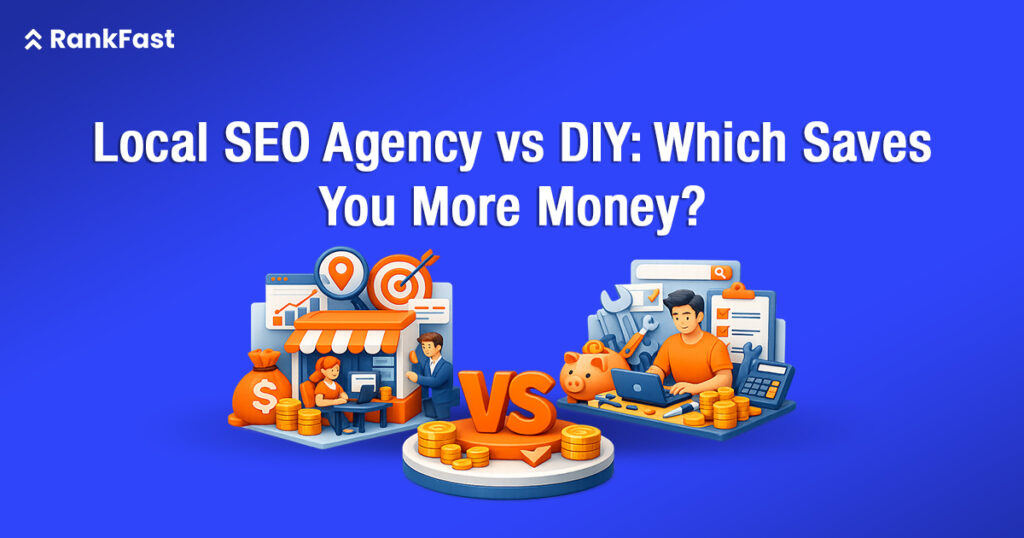
You’re paying rent, managing staff, handling customer service, and trying to grow your business. The last thing you want is to spend money on something that doesn’t deliver. So when it comes to a local SEO agency, the question isn’t just “should I invest in it?”; it’s “should I pay someone else to do it, or handle it myself?”
This isn’t a simple answer. Both paths have real costs, real risks, and real upside. The right choice depends on where your business is, how competitive your local market is, and critically, how you value your own time. This guide breaks down both options honestly so you can make the decision that actually saves you more money in the long run.
Key Takeaways: Local SEO Agency vs DIY
- DIY local SEO costs more than most expect; tools plus time add up to ~$1,350–$1,400/month in real terms
- DIY works best in low-competition markets for owners who can commit 10–15 hours/month consistently
- Hiring an agency removes the time burden and speeds up results; worth it for competitive markets, multi-location businesses, or high-value clients
- The hybrid model (you handle maintenance, agency handles strategy and technical) often delivers the best ROI, especially early on
- Consistency beats strategy. The businesses winning local search have been showing up reliably for 12–36 months
- The worst mistake isn’t picking the wrong approach
Why Local SEO Agency Even Matters in 2026
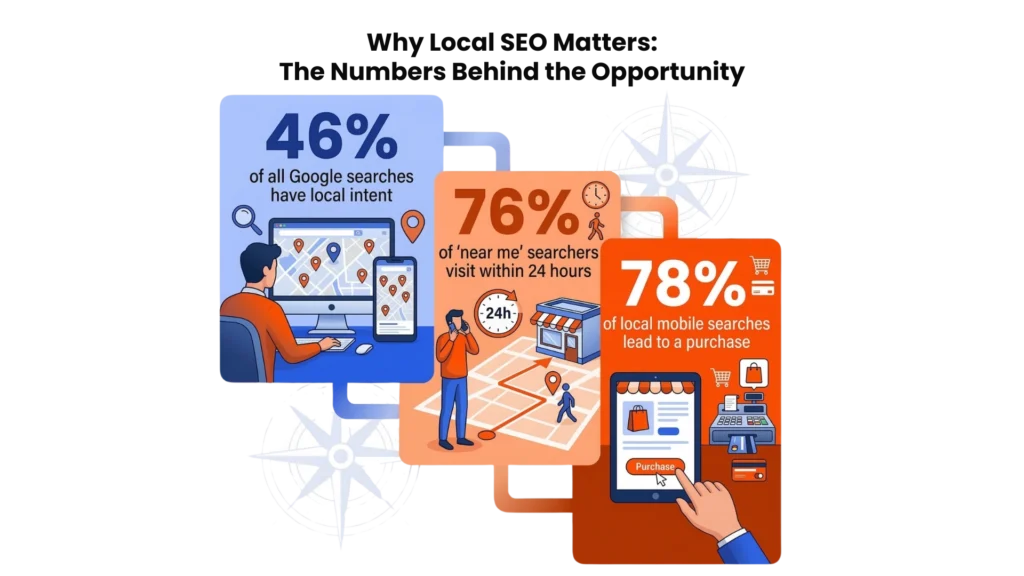
Before comparing your options, it helps to understand what’s at stake. Local SEO is how your business shows up when someone nearby searches for what you sell. That includes Google’s local pack (the map results at the top of search pages), organic results for location-based queries, and your Google Business Profile. Getting that visibility right has a direct line to revenue.
Consider the numbers: 46% of all Google searches carry local intent, and 98% of consumers now use the internet to research nearby businesses (up from 90% just a few years ago). More telling is what happens after someone searches locally: 76% of people who conduct a “near me” search on mobile visit a business within 24 hours, and 78% of local mobile searches result in an offline purchase.
Those aren’t browser sessions. Those are buyers. If your business isn’t showing up prominently in local search, you’re handing customers to whoever is ranking above you. That context matters when you’re evaluating whether to spend time or money (or both) on local SEO.
What DIY Local SEO Actually Costs You
DIY local SEO is often framed as “free.” That’s misleading. It’s not free, it’s just structured differently. Instead of a monthly invoice, you’re paying with two things: your time and your learning curve.
The real dollar cost of doing it yourself
The tools you need to run local SEO properly aren’t free. A functional DIY tech stack for a small local business looks something like this:
- Google Business Profile: Free
- Google Search Console: Free
- Rank tracking and citation management (BrightLocal or Whitespark), approximately $40–$80/month
- Keyword research and competitor analysis (Semrush or SE Ranking)’ approximately $100–$130/month
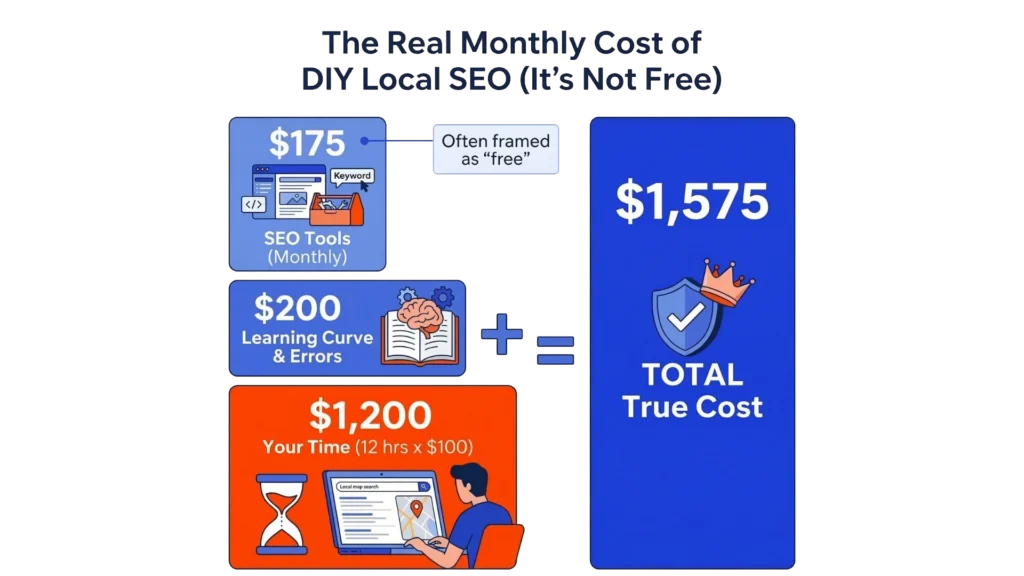
So the software alone runs you roughly $150–$200/month to do the job properly. You can get by on less, but you’ll have significant blind spots, particularly around citation accuracy, competitor tracking, and technical site health.
That still sounds affordable. Here’s where it gets more complex.
Your time has a dollar value
Managing local SEO yourself takes approximately 10–15 hours per month when done properly, according to industry estimates for small business owners running their own SEO. That includes updating your Google Business Profile, managing and responding to reviews, publishing local content, monitoring rankings, building citations, and fixing technical issues.
Now put a value on those hours. If your time is worth $100/hour as a business owner (a conservative estimate for most founders and operators), 12 hours a month equals $1,200 in opportunity cost. Add your $150–$200 in tools, and the real monthly cost of DIY is somewhere between $1,350 and $1,400.
That’s before accounting for mistakes.
The hidden cost: the learning curve
Local SEO isn’t complicated when you understand it. Getting to that point takes time. Google’s local algorithm considers approximately 149 different ranking factors according to Whitespark, covering everything from review velocity and NAP consistency to proximity signals and engagement metrics.
Errors made during the learning phase (inconsistent business listings, improper category selection on Google Business Profile, missing schema markup) can actively suppress your rankings for months. That’s not just wasted effort. It’s lost revenue during the window when you should be building visibility.
What DIY makes sense for
Not everything needs to be outsourced. Several local SEO tasks are genuinely straightforward once you’ve done them once:
- Claiming and filling out your Google Business Profile
- Responding to reviews regularly
- Publishing GBP posts (photos, updates, offers)
- Ensuring your NAP (name, address, phone) is consistent across your main directory listings
One digital marketing manager at an eCommerce brand, quoted in a Semrush study on local SEO, reported saving roughly $500/month by handling GBP optimization in-house. It’s relatively straightforward once you understand what consistency means across platforms.
DIY works best for basic, repeatable maintenance. It struggles with competitive strategy, technical fixes, and link building.
What Hiring a Local SEO Agency Actually Costs You
Agency pricing has a wide range, and that range reflects genuine differences in what you’re getting.
How local SEO agencies price their services
Monthly retainers are the dominant model: 87% of agencies use this approach, which makes sense since SEO is an ongoing discipline, not a one-time fix.
Here’s where pricing typically lands based on the scope of work:
- Automated local SEO (directory listings only): $84–$499/year
- Small-scale campaigns (one location, basic optimization): $399–$899/month
- Comprehensive campaigns (full-service, multi-location): $899–$1,999/month
- Competitive markets with larger agencies: $2,500–$5,000+/month
According to WebFX’s 2025/2026 survey of over 250 businesses, 52% of businesses pay between $501–$3,000 per month for agency-managed local SEO. Most small businesses seeking meaningful results should budget at least $1,500/month, though single-location businesses in lower-competition markets can achieve solid execution in the $500–$1,000 range.
Hourly rates average $128 for local SEO specialists, with US agencies typically charging between $85 and $200/hour, depending on expertise and market.
What a local SEO agency actually does for that money
A reputable agency handles the full stack: Google Business Profile optimization, citation building and cleanup, local link acquisition, review management, technical site audits, local content strategy, and performance reporting. They bring tools and institutional knowledge across multiple clients, which means they’ve seen what works in your industry and what doesn’t.
The time arbitrage is the clearest value proposition. The 10–15 hours per month you’d spend managing this yourself get absorbed by their team. You get that time back to run your business.
The more significant value, though, is expertise compression. A good local SEO consultant has seen patterns across dozens of businesses. They know which citation sources actually matter in your industry, what GBP categories perform best for your business type, and how to recover from a Google algorithm update without starting from scratch.
The risks of hiring an agency
Not every agency delivers on these promises. A few honest warnings:
Be skeptical of agencies offering comprehensive local SEO for under $500/month. Skilled SEO specialists earn upwards of $70,000 annually, according to Glassdoor, so services priced suspiciously low typically rely on automated tools or black-hat tactics that can damage your rankings rather than improve them.
Watch out for agencies that guarantee specific ranking results. No legitimate SEO company can guarantee Google rankings; the algorithm isn’t theirs to control. Promises of “guaranteed page one results” are a red flag, not a selling point.
Also, ask specifically what’s included. Some agencies bundle content creation, link building, and technical work. Others charge these as add-ons. Get clarity before signing.
The True Cost Comparison: Running the Numbers
Let’s make this concrete with a side-by-side comparison for a single-location local business.
DIY Local SEO Services Cost Breakdown:
| Item | Monthly | Annual |
| SEO tools (rank tracking, citation management) | $150 | $1,800 |
| Time investment (12 hrs × $100/hr) | $1,200 | $14,400 |
| Learning curve/errors (estimated) | $200 | $2,400 |
| Total | ~$1,550 | ~$18,600 |
Agency Local SEO Services Cost Breakdown:
| Tier | Monthly | Annual |
| Small-scale agency (competitive market) | $800 | $9,600 |
| Mid-tier agency (comprehensive) | $1,500 | $18,000 |
| Premium agency (multi-location / high competition) | $3,500 | $42,000 |
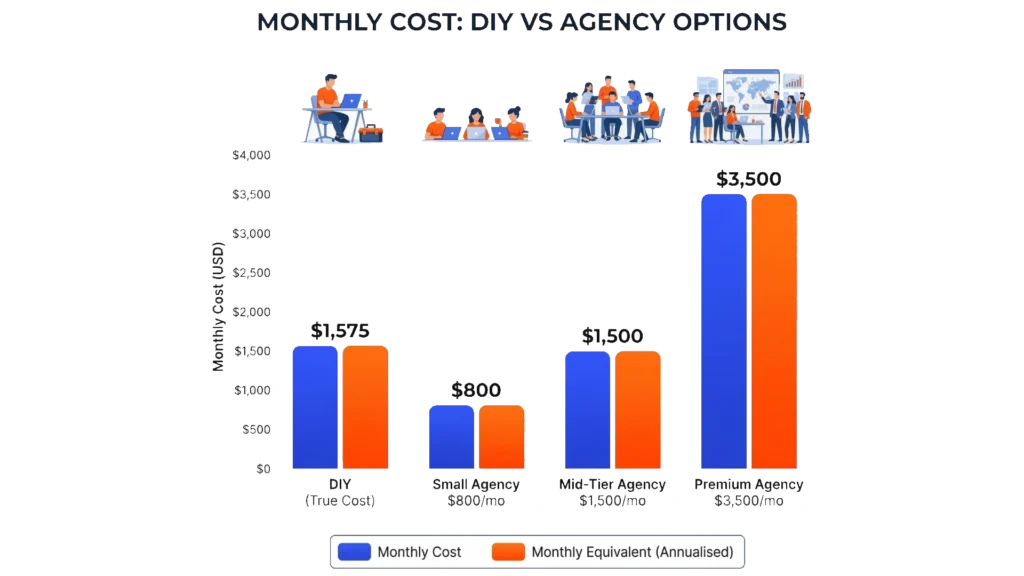
On paper, a small-scale agency retainer at $800/month looks nearly identical in total cost to DIY once you factor in time. But there’s a crucial difference: the agency’s $800 buys professional execution, while your $1,550 buys your own time and learning curve.
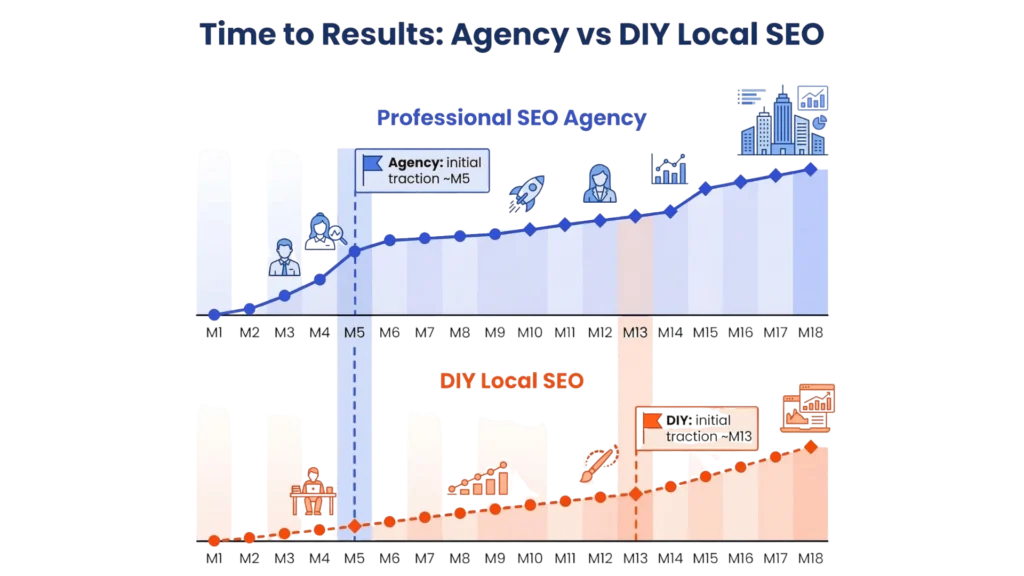
Fig 4. Time to local visibility: agency vs DIY. Agency campaigns typically reach initial traction 8–10 months ahead of DIY in competitive markets. Source: RankFast Campaign Data
The math shifts further when you factor in results timelines. DIY SEO in a competitive market can take 12–18 months to produce meaningful ranking gains. A well-run agency campaign in the same market typically delivers initial traction in 4–6 months, based on industry campaign data. Every month, the results compound faster.
What the ROI Data Says
The reason both options can be worth it is that local SEO, when done correctly, delivers returns that significantly outpace the investment.
40% of local SEO campaigns achieve 500%+ ROI, according to Finances Online data. More broadly, businesses on average see a return of approximately 2.5 times their local SEO investment. 96% of businesses report satisfaction with their local SEO ROI, per WebFX’s survey data.
The revenue mechanics are clear: 28% of local searches result in a purchase within 24 hours, and SEO leads convert at 14.6% compared to 1.7% for outbound channels like cold outreach or paid ads. If you’re a plumber, dentist, lawyer, or any service business where a single new customer is worth hundreds or thousands of dollars, the economics become very clear very quickly.
The key variable is execution quality. A well-run DIY approach in a low-competition market can absolutely deliver strong ROI. A poorly run agency relationship with weak deliverables and no accountability can burn budget with nothing to show for it.
The Hybrid Approach: Often the Smartest Play
You don’t have to choose completely between agency and DIY. Many businesses get the best return by splitting responsibilities thoughtfully.
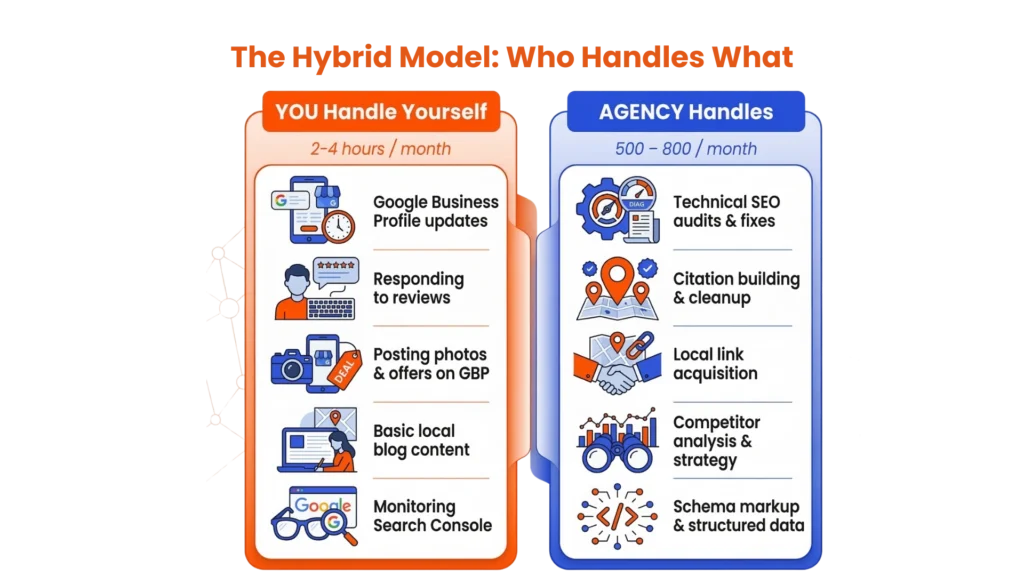
This hybrid reduces agency costs; you might pay $500–$800/month for a narrower scope of work while keeping your time investment to a manageable 2–4 hours per month on the basics.
One Georgetown dental practice profiled in a 2025 local SEO tools study took a similar approach: they hired an agency for strategy and technical execution at $2,400/month, handled their own review responses and GBP updates, and achieved a 100% ROI within the first year with 40 new leads per month.
When Each Option Makes Sense
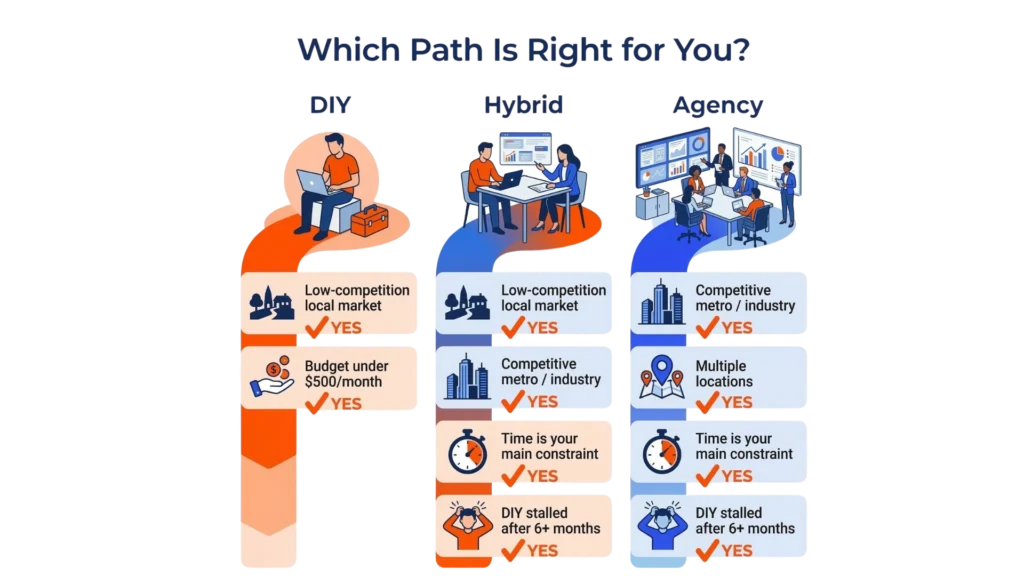
Hire a local SEO agency when
- Your market is competitive. If you’re a personal injury attorney in Chicago or a cosmetic dentist in Manhattan, you’re competing against firms spending thousands per month on SEO. Matching that level of execution with DIY is a full-time job you can’t give up.
- You operate multiple locations. Each location needs its own GBP, citation profile, and often its own landing page strategy. Managing this at scale without professional tools becomes a job unto itself.
- Your time is worth more elsewhere. If closing one new client is worth $5,000 to your business, spending 12 hours per month on local SEO rather than business development is a poor trade, even if the SEO itself goes well.
- You’ve tried DIY and stalled. If you’ve been managing local SEO for 6+ months without meaningful ranking movement, the issue is usually either technical or strategic. An agency audit will surface this faster than continued trial and error.
DIY local SEO makes sense when
- You’re in a low-competition market. A financial advisor in a small Midwest town with minimal local competitors can rank well with consistent GBP management and basic on-page optimization.
- Your budget is genuinely constrained. If $500–$800/month isn’t currently feasible, a DIY approach with a solid tool stack beats doing nothing. Start with GBP, citation consistency, and review management.
- You’re willing to invest learning time upfront. The learning curve is real but finite. Commit 20–30 hours to understanding local SEO fundamentals, and you can build a functional DIY system. After that, maintenance drops to a few hours per month.
Conclusion
The choice between a local SEO agency and doing it yourself isn’t really about which one costs less on paper. It’s about which one generates more net return given your market, your bandwidth, and your time’s opportunity cost.
Our local SEO team works with businesses across competitive markets to identify what’s suppressing their local visibility and build a plan that delivers measurable results. If you want a clear-eyed look at what’s possible for your market, our SEO audit is the right starting point.
Frequently Asked Questions
Can I do local SEO myself without any technical background?
Yes, with caveats. Google Business Profile management, review responses, citation consistency, and local content creation are all accessible to non-technical business owners. More complex tasks (technical site audits, schema markup, site speed optimization, and local link building) typically require professional tools or expertise to execute correctly. A hybrid approach (DIY the basics, outsource the technical work) is often the most realistic path.
How long does it take to see results from local SEO?
Initial results (ranking movement, increased Google Business Profile visibility) typically appear within 3–6 months of consistent effort. In competitive markets, meaningful ranking gains for primary keywords can take 6–12 months. Results from a professional agency campaign generally come faster than DIY because technical issues are resolved quickly and strategy is informed by prior experience.
What's the ROI of local SEO compared to paid ads?
SEO generally outperforms paid ads on a cost-per-lead basis over time. SEO leads close at 14.6% compared to 1.7% for outbound channels. Unlike paid ads, which stop producing results when you stop paying, SEO rankings compound over time. The tradeoff is that paid ads produce results immediately, while SEO takes months to build. Many businesses run both in parallel, using paid ads for immediate leads while building long-term SEO visibility.
What should I look for when hiring a local SEO agency?
Look for case studies from businesses similar to yours in size and industry. Ask what specific deliverables are included each month: content, link building, citations, reporting. Verify that they use white-hat tactics only (avoid any agency that can't clearly explain their link-building approach). Ask how they measure success and what metrics they report on. And be cautious of any agency that guarantees specific rankings.
Is a local SEO consultant different from an agency?
A local SEO consultant typically works as an individual rather than as part of a team. They often charge less than agencies: freelancers typically charge $100–$1,500/month compared to $500–$3,000+ for agencies, but have more limited bandwidth and may not cover all specializations (technical SEO, content, link building, reporting) within a single engagement. Agencies bring more resources; consultants bring more direct access to senior expertise. Agencies also charge about 30% more than freelancers on average, per Backlinko research.