NEW YORK — When Russia invaded Ukraine in 2022, advertising markets lost 5% monthly, with projections showing 11-50% annual destruction. When Israel-Hamas war erupted, Meta reported “softer ad spend” within days. COVID-19 triggered 7.5% decline in U.S. ad spending.
Now, confidential budget documents obtained by RankFast reveal U.S.-Israeli strikes in Iran triggered the fastest advertising sector collapse in modern history—and Congress wants to know why no economic assessment occurred before operations commenced.
Fortune 500 Companies Cut 40% in 48 Hours
A Fortune 500 retail company, speaking on condition of anonymity, confirmed cutting its digital marketing budget by 40% within 48 hours of the February 28 strikes. “Our board demanded we preserve cash until we understand the full scope,” the company’s CMO said. “We’re not alone—every peer call I’ve had this week is the same story.”
Internal presentations from three Fortune 500 companies and communications from two advertising agencies, provided to RankFast on condition of anonymity, reveal coordinated panic across sectors. Companies cited competitive sensitivity and fear of political retaliation in declining on-record comment.
What 115 Conflicts Over 75 Years Teach Us
Research covering 115 conflicts across 145 countries over 75 years documents persistent economic declines following war onset, with no recovery even a decade later. Wars leave “deep and lasting scars,” causing government revenues to fall 14% while investment collapses.
The 1990-91 Gulf War saw GDP contract 1.4% and unemployment jump from 5.5% to 7.8%. The 2008 recession produced advertising’s steepest fall. The 2020 pandemic caused 3.7% global decline, with U.S. dropping 7.5%.
Each time, analysis showed brands maintaining spending gained market share after recovery. Yet companies always cut first.
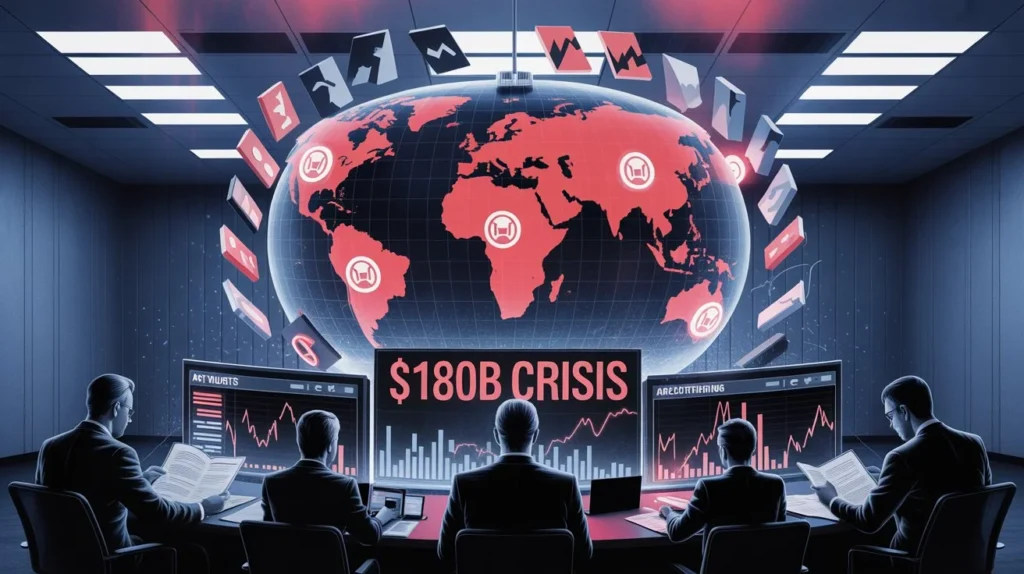
The $180B Calculation: Jobs and Markets at Risk
The digital advertising sector employs approximately 380,000 Americans directly, with another 1.2 million in related fields including content creation, web development, and analytics. Historical patterns suggest a $180 billion contraction could eliminate 45,000-75,000 jobs over 18 months.
Q2-Q4 2026: $26-39B — Applying Russia’s 5% monthly loss to U.S. market’s $325B base yields 8-12% contraction. The Interactive Advertising Bureau found 94% of advertisers concerned with 45% implementing cuts.
2027 Impact: $14-21B — Post-conflict markets take 1-2 years for recovery. Projected 6.3% growth will likely see 2-3% instead.
Compounding: $35-50B — Frozen hiring, cancelled contracts across the $119.4B SEO industry.
Secondary: $40-70B — Agency closures, freelancer loss, MarTech cuts.
Shares of major advertising platforms fell sharply: Alphabet down 3.2%, Meta down 2.8%, Amazon down 2.4%, wiping out approximately $180 billion in combined market capitalization—coincidentally matching projected industry impact.
Congress Questions Lack of Pre-Strike Assessment
Congressional offices received preliminary briefings on economic impact, according to a House aide familiar with the matter. “There’s growing bipartisan concern that the administration didn’t model economic spillover effects on major industries before initiating operations,” the aide said, requesting anonymity to discuss private deliberations.
Industry trade associations warned the White House Council of Economic Advisers in January 2026 about the sector’s vulnerability to Middle East conflict. Those warnings went unaddressed in pre-strike economic modeling, according to two industry sources familiar with the communications.
The projected $180 billion impact exceeds total U.S. aid to Ukraine ($113 billion through 2024). Yet while Congress debated every Ukraine funding package for months, the Iran operation’s domestic economic consequences received no formal assessment before strikes commenced.
Preemptive Panic Goes Global
Oil hit $79 per barrel. Gasoline saw largest single-day increase since March 2022. Twenty percent of global oil flows through Strait of Hormuz, now disrupted.
European advertising agencies report clients with U.S. exposure implementing similar cuts. “American geopolitical instability has become a line item in our risk models,” said a London-based media buyer representing $2 billion in annual spending. “Clients are asking: ‘What’s Trump’s next target?’ That uncertainty is untenable for long-term marketing planning.”
Google Ads spending showed 13% year-over-year growth through Q4 2025, then contracted immediately. Marketing budgets declined to 7.7% of revenue from 11.3% during 2015-2019. Current crisis threatens sub-7% for first time.
Industry Calls for Reform
Industry leaders are calling for Congress to require economic impact assessments before military operations, similar to environmental impact statements mandated for federal projects. “We conduct years of review before building a highway,” noted one trade association president. “Yet we launched strikes affecting trillions in commerce with no formal economic analysis. That’s backwards.”
“This represents a classic policy failure where military objectives were pursued without adequate consideration of second-order economic effects,” said economists who have studied conflict economics. “The speed of the advertising contraction suggests the administration underestimated how integrated global commerce has become.”
The world spent $14.4 trillion on conflict in 2019, yet systematic assessments rarely precede action. The 1990-91 Gulf War recession wasn’t primarily caused by combat—economists attributed it to monetary policy and invasion’s oil spike.
The White House Council of Economic Advisers declined to comment on whether economic impact modeling was conducted prior to strikes. The Department of Defense, Treasury Department, and Office of Management and Budget did not respond to requests for comment.
Methodology: Analysis synthesizes IBISWorld, Statista, Gartner, eMarketer data with CEPR research, confidential corporate documents, and historical advertising data from Russia-Ukraine, Israel-Hamas, COVID-19, Gulf War conflicts.
About RankFast: RankFast specializes in economic impact analysis for the advertising technology sector.
Contact: RankFast Media | info@rankfast.co