This is one of the most important digital marketing decisions a business owner makes. Get it right and you build a lead pipeline that either delivers fast results, compounds over time, or ideally both. Get it wrong and you spend months waiting for results that never arrive, or you burn budget on clicks with nothing to show for it once the ads stop.
The honest answer is that PPC and SEO are not rivals. They are different tools for different jobs. But most businesses starting out or scaling up cannot invest heavily in both at once, so the sequencing decision matters.
This guide gives you everything you need to make that decision with confidence: a full breakdown of what each channel delivers, a detailed ROI and cost comparison, industry-specific guidance, the synergy case for running both, and a practical framework for choosing where to start.
What a PPC Agency Does (and What It Cannot Do)
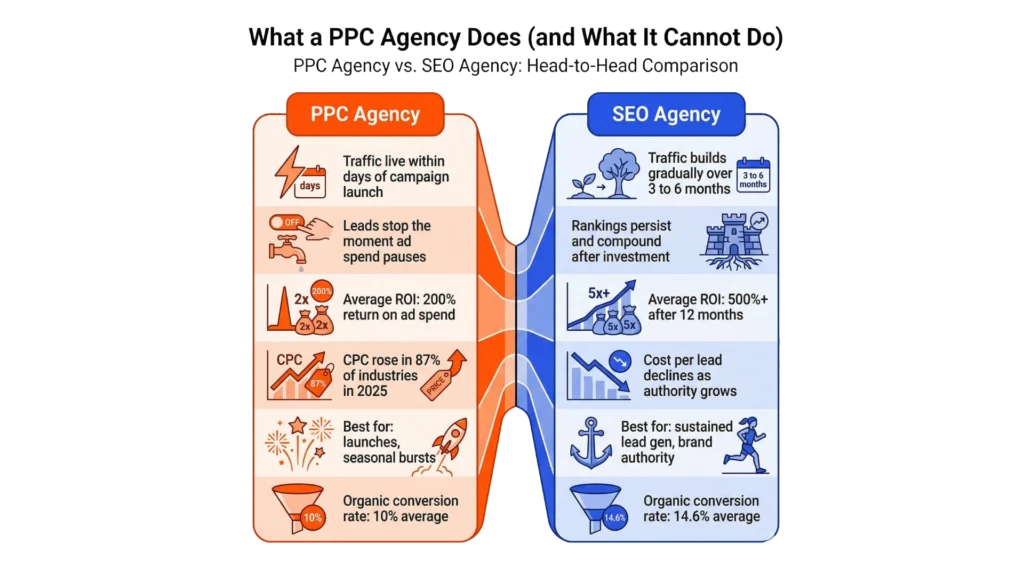
A PPC (pay-per-click) agency manages paid advertising campaigns, primarily on Google Ads and Microsoft Ads, though many also manage Meta, LinkedIn, and programmatic display campaigns.
The core mechanism is straightforward: you bid on keywords, pay for each click, and ads appear at the top of search results instantly. The agency’s job is to make those clicks as profitable as possible.
What a PPC agency handles day to day
- Campaign architecture and keyword research: identifying the highest-value keywords to bid on within your budget
- Ad copywriting and creative: writing the headlines and descriptions that drive clicks from the right audience
- Bid strategy and budget management: allocating spend across campaigns to maximize return on ad spend (ROAS)
- Landing page recommendations: identifying where the conversion rate can be improved after the click
- A/B testing: continuously testing ad variations to find the top performers
- Conversion tracking and reporting: measuring exactly which ads generate leads and revenue
The strengths of PPC
- Immediate visibility: campaigns can be live within 24 to 72 hours of setup
- Precise targeting: by keyword, location, device, time of day, and audience segment
- Predictable spend: you set the budget ceiling and it will not be exceeded
- Measurable return: every click, lead, and sale is attributable to a specific ad
- Fast market testing: you can test whether a product or offer converts before investing in long-term SEO
The limitations of PPC
PPC has a structural weakness that no amount of good management can fix: it is rented visibility.
- Traffic stops immediately the moment your budget is paused or exhausted
- No compounding effect: spending $10,000 this month does not make next month cheaper or more efficient
- Rising costs: Google cost-per-click increased in 87% of industries in 2025, and that trend is expected to continue as more businesses shift budget to paid channels
- Banner blindness: 42% of users distrust paid search ads and 94% deliberately skip them when they see the Ad label
- Budget dependency: small to medium-sized businesses already spend 7 times more on PPC than on SEO, often over-indexing on a diminishing-return channel
PPC is rented visibility. You pay for every impression and click, and the moment you stop paying, you disappear from search results entirely. SEO is owned visibility. The rankings you build are yours. You cannot lose them by pausing a campaign. That distinction has enormous long-term financial implications.
What an SEO Agency Does (and Why It Takes Time)
An SEO (search engine optimization) agency improves your website’s visibility in organic, unpaid search results. The goal is to appear in the top positions of Google for the searches your potential customers are making, without paying per click.

The mechanism is different from PPC in a fundamental way: SEO builds a compounding asset. Every piece of content that ranks, every link that is earned, and every technical improvement made adds to an accumulating foundation that makes future rankings easier and more durable.
What search engine marketing services handles
- Technical SEO: site speed, Core Web Vitals, mobile performance, crawlability, schema markup, and indexation
- Keyword strategy: identifying the search terms your ICP uses at every stage of the buying journey
- Content creation: building the service pages, landing pages, and blog content that target those keywords
- Link building: earning backlinks from authoritative external sites to build domain authority
- Local SEO: Google Business Profile management, citation building, and map pack optimization for location-based businesses
- Conversion optimization: improving the pages that rank so more visitors take action
- Reporting and analytics: connecting organic search performance to leads, sales, and revenue
The strengths of SEO
- Compounding ROI: rankings earned today continue generating leads months and years later without incremental cost
- Higher conversion rates: organic search converts at 14.6% on average, compared to 10% for paid search
- Greater trust: users inherently trust organic results more than ads, especially for high-consideration purchases
- Declining cost per lead: as domain authority builds, new content ranks faster and the cost per acquired lead drops over time
- Sustainable competitive moat: strong organic rankings take competitors months or years to dislodge, creating durable lead generation
Why SEO takes 3 to 6 months
The most common frustration with SEO investment is the timeline. It is worth understanding exactly why the delay exists.
- Google needs to crawl and index new pages, which can take days to weeks
- New content needs to accumulate engagement signals (clicks, dwell time, return visits) before Google assigns it significant ranking authority
- Domain authority builds incrementally as inbound links accumulate over time
- Technical improvements take time to be recognized and reflected in rankings after Google re-crawls affected pages
The patience required in months one through five is real. But so is the return from month six onwards. This is not a flaw in the channel. It is the mechanism behind its compounding advantage.
The ROI and Cost Comparison: PPC Vs SEO
Return on investment
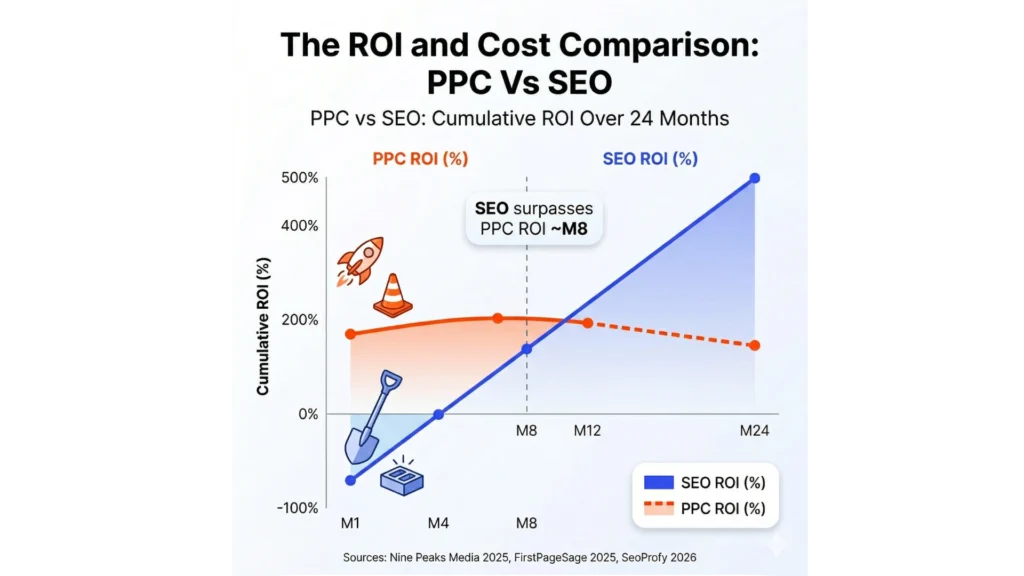
The 24-month ROI trajectory is where the case for long-term SEO investment becomes clear. PPC delivers a positive return quickly, averaging around 200% ROI (a $2 return for every $1 spent on ads and management combined). That number is solid. But it tends to erode as click costs rise and competition intensifies.
SEO starts in negative territory. The first few months represent investment, not return. But by month 8, most well-run SEO campaigns surpass PPC on cumulative ROI. By month 12, SEO campaigns commonly reach 500% to 1,300% ROI. The channel continues compounding, with 70% of marketers reporting that SEO generates more long-term sales than PPC.
Cost per lead by channel
When you look at cost per lead rather than total ROI, the comparison becomes even more stark over time. Average Google Ads cost-per-click now sits at $5.26 across all industries, but legal, financial services, and insurance keywords routinely exceed $50 per click. In these sectors, PPC is often unsustainable as a primary acquisition channel at any realistic conversion rate.
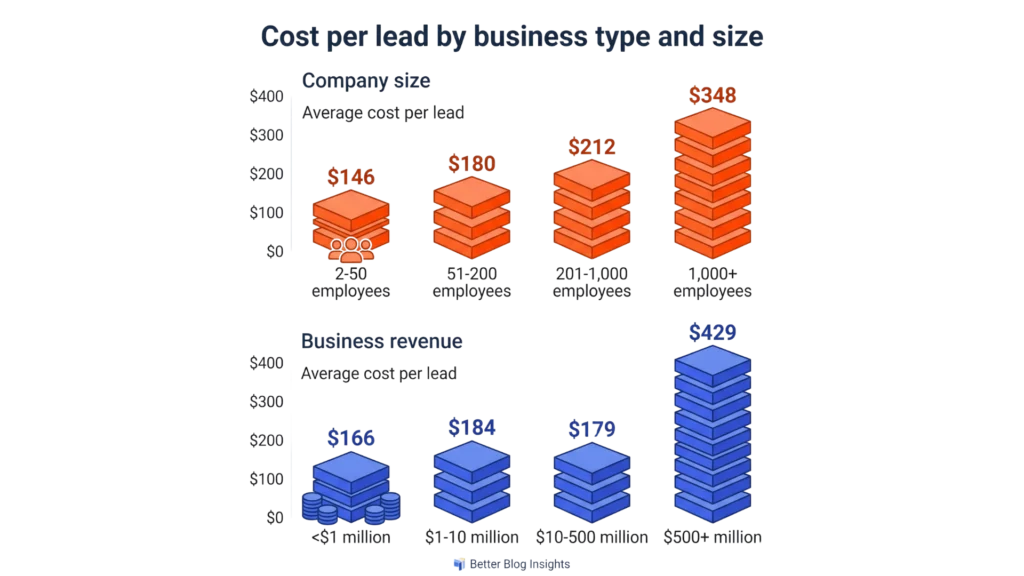
SEO cost per lead, by contrast, is highest in the early months (because you are spending on agency fees with no rankings yet) and progressively declines as authority builds. Lack of SEO can increase your overall ad spend requirements by up to 400%, because every keyword you rank for organically is a keyword you no longer need to bid on.
The reason for organic’s consistent conversion advantage is trust. Users know that organic results have earned their position through relevance and authority, not by paying for placement. That implied third-party endorsement translates directly into higher willingness to engage and convert.
| Metric | PPC (Paid Search) | SEO (Organic Search) |
| Time to first leads | Days | 3 to 6 months |
| Average ROI | ~200% | 500%+ at 12 months |
| Conversion rate | ~10% | ~14.6% |
| Cost trend over time | Rising (CPC inflation) | Declining (authority compounds) |
| Traffic if you stop | Stops immediately | Continues (rankings hold) |
| Trust level with users | Lower (ad label visible) | Higher (organic endorsement) |
| Best measurement metric | ROAS, CPA | Organic leads, traffic, MQL volume |
When to Hire a PPC Agency First
There are specific, well-defined situations where PPC is the right starting point. If any of the following apply to your business, beginning with a PPC agency is likely the correct decision.
Situations where PPC comes first
- You are launching a brand-new business with no organic presence, no domain authority, and no time to wait 3 to 6 months for rankings
- You have a product launch with a fixed date. An event, seasonal window, or go-live deadline that cannot accommodate an SEO timeline
- You are in a seasonal business. If 60% of your revenue comes in a 3-month window (as is the case for moving companies, tax advisors, holiday retailers, and many others), you need to be visible during that window, regardless of where your organic presence is
- You need to validate a new offer or market. PPC is the fastest way to test whether a product converts before investing in long-term content strategy around it
- Your sales cycle is short and transactional. For businesses where a customer searches and buys within hours, the immediate visibility of PPC aligns well with the customer journey
- You have a meaningful budget but a small team. PPC is more immediately manageable with limited internal resources than a full SEO programme
Many businesses use PPC as a bridge: paying for immediate visibility while SEO builds in the background. Once organic rankings mature (typically months 6 to 12), paid spend on those overlapping keywords can be gradually reduced without losing lead volume. This is the most capital-efficient way to manage the transition between channels.
When to Hire an SEO Agency First
Search engine marketing services are the stronger starting point in a different but equally well-defined set of circumstances. These are situations where the compounding nature of the channel, the higher conversion rate, or the unsustainability of paid acquisition makes organic search the primary priority.
Situations where SEO comes first
- You have an established business with existing traffic. If you already have website visitors, domain history, and some existing rankings, SEO can build on those foundations quickly
- Your customer lifetime value is high. When a single new client is worth thousands of pounds or dollars over months or years (professional services, B2B, financial services, legal), a 6-month investment horizon is entirely justified
- Your industry has a high cost-per-click. Legal, financial services, insurance, and real estate keywords routinely cost $20 to $100+ per click. At any realistic conversion rate, PPC is simply too expensive to scale as a primary channel
- You want long-term brand authority. Consistent first-page presence for your core keywords builds brand recognition and trust that paid ads cannot replicate, regardless of spend
- You have been over-relying on paid ads. If all your leads currently come through PPC and you have no organic presence, you have no resilience against cost increases, policy changes, or algorithm shifts
- You are targeting informational and educational queries. Buyers who research before they buy (B2B, healthcare, financial products) typically engage first with educational organic content, making SEO the natural first touchpoint in the funnel
The Decision Framework: Google Ads Agency vs SEO Agency
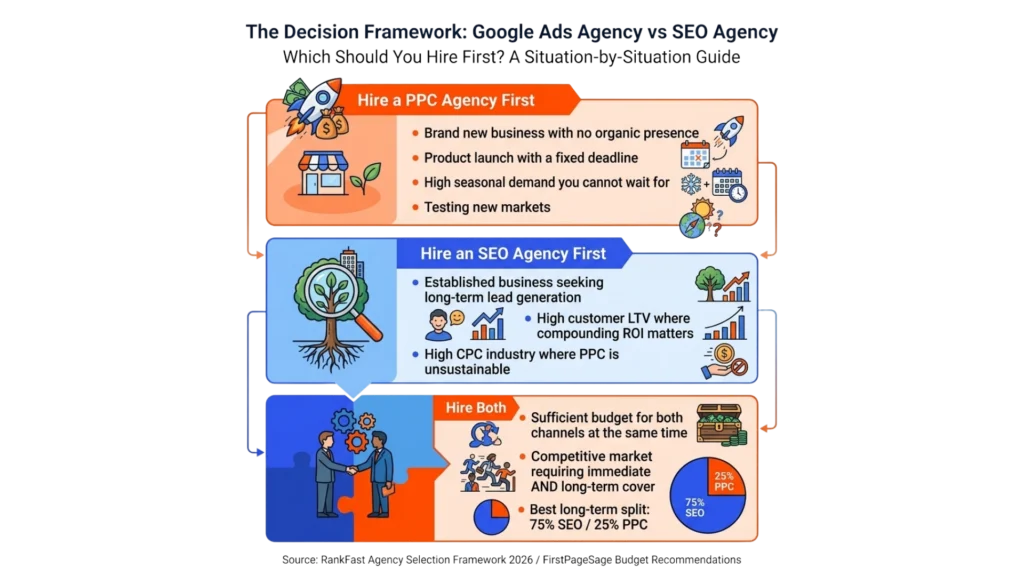
Use this framework to map your current situation to the right starting point.
| Your Situation | Best Starting Point |
| Brand-new business, no domain authority | Start with PPC; run basic SEO in parallel if budget allows |
| Established business, undiscoverable in organic search | Prioritize SEO; the organic deficit is the core problem |
| Seasonal business with a fixed peak window | PPC for the immediate season; SEO for the following year |
| High-CPC industry (legal, finance, insurance) | SEO first; paid acquisition is unsustainable at scale |
| High customer LTV, B2B, or professional services | SEO first for compounding qualified lead generation |
| E-commerce with both evergreen and seasonal demand | Both: SEO for evergreen, PPC for promotions and launches |
| Budget under $2,000/month total | Choose one; split budgets too thin to produce results in either channel |
| Budget $2,000 to $5,000/month | Start with the channel that fits your timeline; add the second within 6 months |
| Budget above $5,000/month | Run both: approximately 70% SEO, 30% PPC while organic builds |
After 15 years of campaign data across thousands of clients, FirstPageSage recommends a long-term ratio of approximately 75% SEO and 25% PPC as the optimal sustained allocation. The rationale: PPC handles time-sensitive demand and testing. SEO builds the owned channel that progressively reduces dependence on paid spend.
Paid Search vs SEO: Why Running Both Together Is the Most Effective Strategy
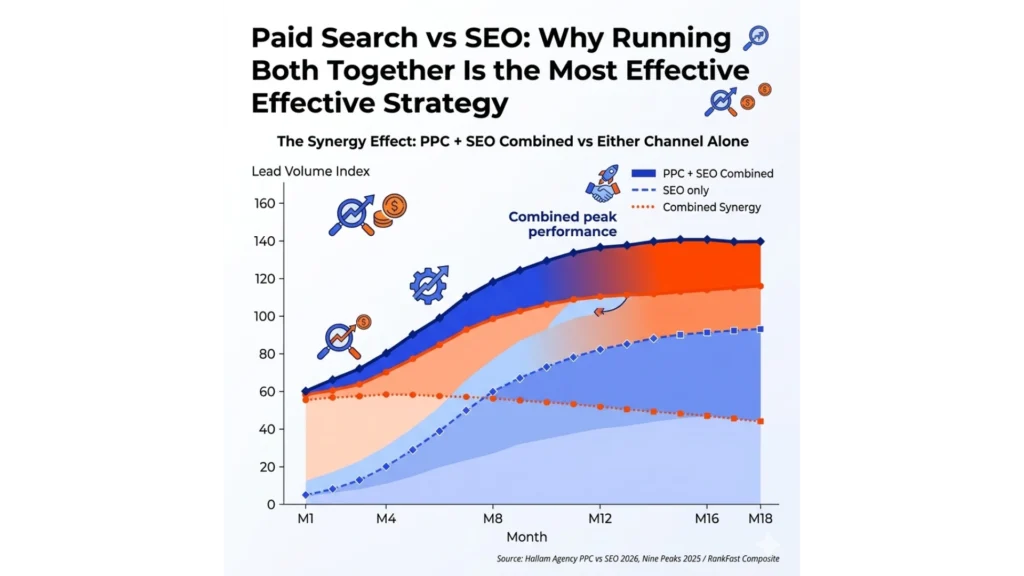
When budget allows, the highest-performing approach is not choosing between PPC and SEO. It is running both in a way that makes each channel stronger.
The synergy between paid and organic search is well-documented and operates across several reinforcing mechanisms.
How PPC makes SEO more effective
- PPC reveals which keywords actually convert. Before investing months of SEO effort in a keyword, paid campaigns show you quickly whether it generates real leads, not just traffic
- Ad testing informs organic content. The headlines and copy that perform best in PPC ads are the same messages that should lead your organic landing pages and meta descriptions
- Paid data fills the research gap. In the first 3 to 5 months of an SEO campaign, when organic data is limited, PPC provides a conversion signal that guides keyword prioritization and content direction
How SEO makes PPC more effective
- Organic rankings reduce the keywords you need to bid on. Every search term you rank for organically is one you can reduce or eliminate from paid campaigns, cutting CPC spend on your highest-volume queries
- Brand familiarity from SEO content increases paid CTR. Users who have already encountered your brand through organic content are significantly more likely to click your ads when they appear
- SEO improves Quality Score. Google’s Quality Score for paid ads is partially influenced by your landing page quality and site authority. Stronger SEO foundations mean lower CPCs and better ad positioning
- Organic content reduces bounce rates on paid landing pages. Users who arrive from PPC and explore your organic content have higher engagement, lower CPA, and higher conversion rates
Double visibility for high-intent queries
When your business appears in both the paid results and the organic results for the same high-intent query, click-through rates increase substantially. Research shows that appearing in both paid and organic positions for a single query increases total clicks by 25% to 50% compared to appearing in only one. The reason is dual: users trust the brand more when they see it occupying multiple positions, and different users click different result types.
PPC vs SEO: How to Evaluate an Agency in Either Channel
The wrong digital advertising agency in either channel will consume budget without producing results.
Evaluating a PPC agency
- Ask for case studies with ROAS and CPA data, not just impressions and click volumes. The business metric that matters is cost per acquired customer, not cost per click
- Check whether they are a Google Partner. This certification indicates a minimum level of spend managed and exam-verified expertise, though it is a floor, not a ceiling
- Ask about their landing page process. Great ad campaigns fail on weak landing pages. An agency that manages only the ad side without addressing landing page conversion is solving half the problem
- Understand their reporting cadence. Weekly optimization reporting with clear CPA and ROAS data is the minimum standard. Monthly-only reporting is usually insufficient for responsive campaign management
- Ask how they handle budget adjustments. A good PPC agency has a clear process for pausing underperforming campaigns, scaling budget to winners, and protecting against wasted spend
Evaluating an SEO agency
- Test their own rankings first. Search for ‘SEO agency [city]’ or ‘digital marketing agency [city]’. If they cannot rank for their own service keywords, they cannot rank yours
- Ask for case studies with lead volume data, not just keyword rankings or traffic growth. The metric that matters is new qualified leads from organic search
- Ask what they do in the first 60 days. The correct answer is a technical and content audit, competitor gap analysis, and a prioritized roadmap. Starting with content without auditing first is backwards
- Understand their link-building approach. Links from irrelevant or low-quality sites cause more harm than good. Ask specifically how they build authority and from what types of sources
- Ask how they report on business outcomes. Rankings and traffic are health indicators. Leads, conversions, and revenue impact are the business metrics. Any agency that only reports the former is not measuring the right things
In both PPC and SEO, any digital advertising agency that guarantees specific outcomes before conducting an audit is either over-promising or under-scoping. A credible PPC agency will estimate achievable ROAS ranges based on your industry and budget. A credible SEO agency will give you a realistic timeline based on your current domain authority and the competitive intensity of your market. Guarantees without evidence are a sales tactic, not a service standard.
Not Sure Which Channel Fits Your Business Right Now?
The right answer is in your data. Your current organic position, customer lifetime value, industry CPC landscape, and growth timeline all indicate a clear starting point.
RankFast works with businesses across both SEO and paid search to build acquisition strategies grounded in what the numbers actually support. We can audit your current search visibility and lead generation mix, and give you a clear picture of which channel to prioritize, what realistic results look like, and how to integrate both over time for compounding returns.
Frequently Asked Questions
Can you run PPC and SEO at the same time?
Yes, and for most businesses with enough budget, running both is the optimal strategy. PPC provides immediate leads while SEO builds. PPC keyword and conversion data directly inform the SEO content strategy. As organic rankings mature, paid spend on overlapping keywords can be reduced without losing visibility or leads. The two channels are more complementary than they are competitive.
What is a good monthly budget for a PPC agency?
PPC management fees typically range from $1,500 to $10,000 per month, depending on account size and complexity, separate from the actual ad spend budget. Most small to medium-sized businesses run ad spend of $1,000 to $10,000 per month.
How do I know which agency I hired is actually performing?
For a PPC agency: the primary performance metrics are cost per acquisition (CPA), return on ad spend (ROAS), and lead volume from paid campaigns. A good agency reports on these weekly or bi-weekly and connects ad spend directly to revenue impact. For search engine marketing services, the primary metrics are organic lead volume, organic traffic to high-intent pages, keyword rankings for commercial terms, and the share of total leads coming from organic search over time. Both agencies should be connecting their work to business outcomes, not just channel metrics.