Most businesses know they need SEO. Fewer know exactly what they are paying for when they hire an agency or sign a retainer.
The phrase “SEO services” gets used to describe everything from a one-time website audit to a full-scale monthly program involving technical fixes, content production, link building, and reporting. The difference in what is included in SEO services matters enormously for the results you get.
This guide breaks down every component of professional SEO services, what each one does, what gets delivered on a monthly basis, how pricing works, and what to expect at each investment level.
Why Professional SEO Services Produce Results DIY Cannot Match

Organic search drives 53.3% of all website traffic globally. That single statistic makes SEO the largest traffic source for most websites, ahead of paid search, social media, direct, and referral combined.
The quality of that traffic matters as much as the volume. SEO-generated leads close at 14.6%, compared to 1.7% for outbound methods like cold email and print advertising. A visitor who found your business through organic search arrived with intent. They were searching for what you offer.
When executed as a long-term strategy, SEO delivers up to 700% ROI. The median SEO ROI in 2026 reaches 748%, with organizations realizing $22 in returns for every $1 invested.
The global SEO services market is valued at $83.98 billion in 2026 and projected to reach $148.86 billion by 2030. The investment in professional SEO is growing precisely because the returns justify it across every industry and business size.
The Key Difference Between Basic and Professional SEO
Basic SEO typically covers keyword research and some on-page optimization. Professional SEO services cover the full spectrum: technical foundations, content architecture, link authority, local presence, and monthly reporting tied to business outcomes. According to FirstPageSage (2026), thought-leadership SEO campaigns that include strategy, content, and authority building achieve peak results in year two or three.
The 6 Core Components of Professional SEO Services

Professional SEO services are built around six interconnected disciplines. Removing any one of them weakens the others. Here is the SEO services list and why it matters.
1. Technical SEO
Technical SEO addresses the infrastructure that determines whether Google can find, crawl, and rank your pages. It is the foundation that all other SEO work builds on.
- Site speed and Core Web Vitals: Pages loading in under 3 seconds convert at dramatically higher rates. Google uses Core Web Vitals as a ranking signal. Most websites have fixable performance issues suppressing rankings.
- Mobile optimization: Over 62% of global web traffic comes from mobile devices. Google uses mobile-first indexing, meaning mobile performance determines rankings.
- Crawlability and indexation: Ensuring Google can access and index every important page, while blocking pages that should not be indexed such as staging environments and duplicate content.
- Schema markup: Structured data that makes your pages machine-readable for both search engines and AI assistants, enabling rich results like star ratings, FAQs, and product information in search listings.
- HTTPS and site security: A confirmed Google ranking factor. Sites without valid SSL certificates receive ranking penalties and browser warnings that reduce trust and conversions.
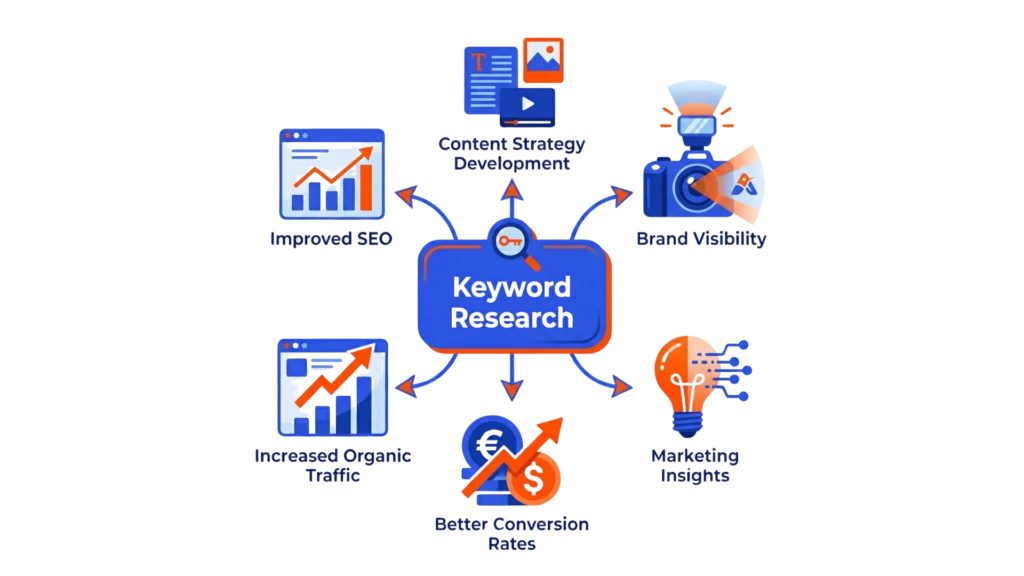
2. Keyword Research and Strategy
Keyword research identifies the exact search terms your target customers use at every stage of their decision-making journey. Professional keyword research maps search intent across three layers:
- Informational intent: Queries from people researching a topic. These build brand awareness and E-E-A-T authority.
- Commercial intent: Queries from people comparing options. These target prospects are being evaluated and narrowed down.
- Transactional intent: Queries from people ready to act. These drive direct leads, bookings, and sales.
A professional SEO agency also runs competitor gap analysis, identifying keywords where competitors rank but you do not. These represent recoverable traffic opportunities with clear roadmaps to capture them.
3. On-Page Optimization
On-page SEO covers every element within a page that Google uses to understand what it is about and who it should be shown to.
- Title tags and meta descriptions: Pages with keywords in their URL have a 45% higher CTR. Well-crafted meta descriptions increase click-through rates significantly.
- Heading structure: H1 through H4 tags that signal content hierarchy to both users and search engines.
- Internal linking: Connecting related pages to distribute authority across the site and guide users deeper into relevant content.
- Image optimization: Alt text, file size compression, and descriptive file names that make images accessible to search engines and screen readers.
- E-E-A-T signals: Author bios, credentials, publication dates, citations, and transparent ownership information that build Google’s trust in your content.
4. Content Strategy and Creation
Content is the mechanism through which your website ranks for keywords, answers customer questions, and builds topical authority. Around 70% of marketers rely on content marketing as their main acquisition and branding channel.
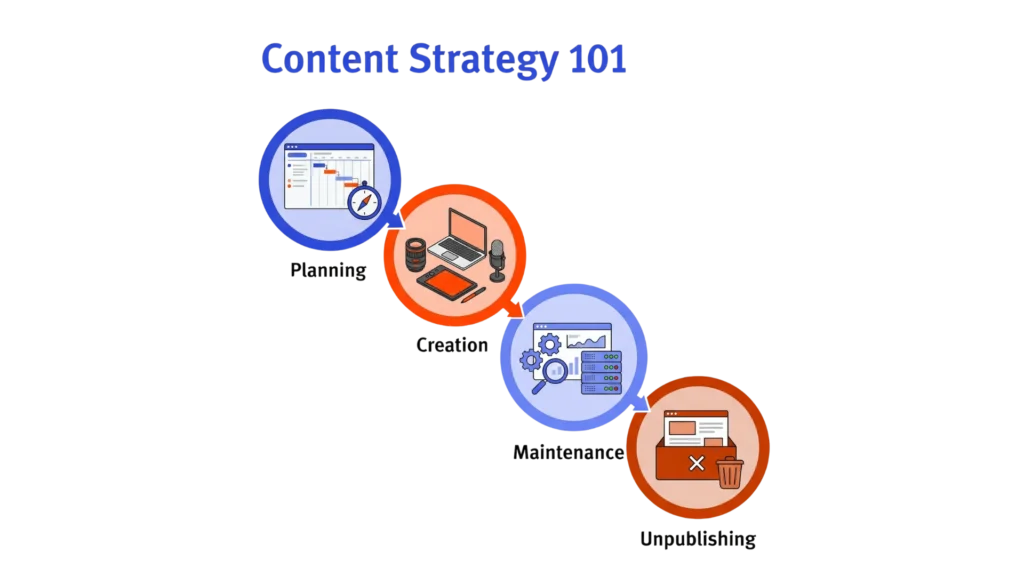
- Topic cluster architecture: Building interconnected hubs of content around your core services, with pillar pages supported by detailed subtopic articles.
- Service and landing pages: Dedicated pages for each service, location, and audience type, each targeting specific high-intent keywords.
- Blog content: Websites with active blogs earn 97% more inbound links on average than those without fresh content.
- FAQ content: Structured answers to common customer questions that capture featured snippets, People Also Ask boxes, and AI Overview inclusions.
5. Link Building and Authority
Links from other websites to yours are one of Google’s strongest ranking signals. Nearly 80% of SEO professionals name link building as a key part of their strategy.
- Digital PR: Creating newsworthy content, original research, and data studies that journalists and bloggers link to naturally.
- Guest content: Contributing expert articles to industry publications in exchange for contextual backlinks.
- Local citations: Building consistent Name, Address, Phone listings across directories relevant to your industry and location.
- HARO and expert sourcing: Responding to journalist queries to earn mentions and links from authoritative news publications.
Quality beats volume here. Google’s systems actively devalue links from irrelevant or low-authority sources. A handful of links from genuinely authoritative sites outperforms hundreds of low-quality directory links.
6. Reporting and Performance Tracking
Professional SEO services include monthly reporting that connects rankings and traffic directly to business outcomes.
- Keyword ranking movement: Position changes for target keywords month over month, with trend data and competitor comparison.
- Organic traffic: Sessions, users, and page-level breakdown showing which content is driving visits.
- Conversion tracking: Leads, form submissions, calls, and bookings attributed to organic search. This is the metric that connects SEO to revenue.
- Technical health monitoring: Alerts for new crawl errors, indexation issues, or Core Web Vitals regressions.
- Content performance: Which pages are gaining or losing traffic, with recommendations for optimization.
What Happens Each Month in a Professional SEO Retainer
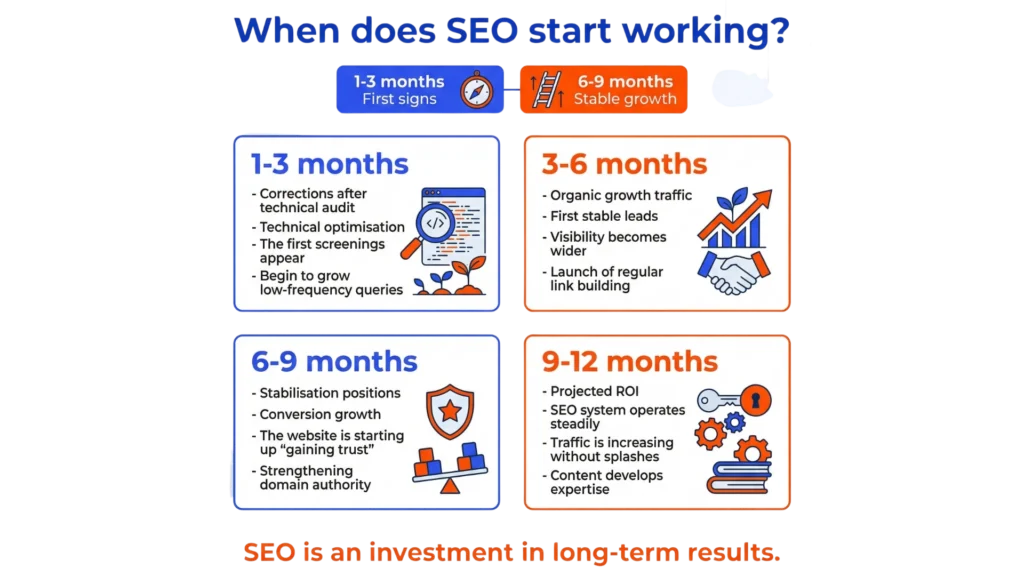
One of the most common questions about SEO services is what actually happens each month. Here is the realistic timeline.
Month 1: Deep Audit and Strategy
- Comprehensive technical audit covering site speed, indexation, crawl errors, and Core Web Vitals
- Keyword research and competitor gap analysis for your specific market
- Google Business Profile and local citation audit for location-based businesses
- Content audit of existing pages with recommendations for consolidation or improvement
- Delivery of a prioritized SEO roadmap with projected timelines
Months 2 to 3: Foundation Building
- Technical fixes deployed: speed improvements, schema markup, redirects, indexation corrections
- Core service and location pages built or optimized with target keywords
- Internal linking structure established across the site
- Citation cleanup and Google Business Profile optimization
- Initial content is published to the blog or resource section
Months 4 to 6: Growth Phase
- Consistent content publishing on the agreed schedule, typically 2 to 6 pieces per month
- Link-building program in active outreach, earning backlinks from relevant sources
- Ranking movement becomes visible, particularly for lower-competition and long-tail queries
- Google Business Profile posts, Q&A, and review strategy are active
- Monthly reporting with ranking, traffic, and conversion data
Month 6 and Beyond: Compounding Returns
- Domain authority accumulates, making new content rank faster and for more competitive terms
- Cost per acquired lead declines as organic traffic scales without proportional cost increases
- Content assets mature: pages built in months 2 to 4 reach their peak ranking potential
- Peak results typically arrive in year 2 or 3, when the compounding effect of authority, content, and links reaches critical mass
Professional SEO Services Pricing: What Each Level Delivers
SEO pricing varies based on the scope of work, the competitiveness of your market, and whether you are a single location or a multi-site operation.
| Tier | Monthly Investment | What Is Included |
| Foundational | $500 – $1,500 | GBP management, citation cleanup, basic technical fixes, keyword tracking, and monthly reporting. Suitable for low-competition local businesses. |
| Growth | $1,500 – $3,500 | Full technical SEO, service page build-out, content program (2 to 4 pieces/month), link building, conversion tracking, and detailed monthly reporting. |
| Competitive | $3,500 – $8,000 | All growth tier work plus aggressive link building, digital PR, programmatic content strategy, multi-location optimization, and revenue attribution reporting. |
| Enterprise | $8,000+ | Dedicated strategy team, international SEO, full content production, digital PR campaigns, AI search visibility (GEO), and executive reporting tied to the pipeline. |
Average hourly rates for SEO services fall between $100 and $150. The investment should be calibrated against the lifetime value of customers acquired, not the cost of a single transaction.
SEO Agency vs Freelancer vs DIY: Which Fits Your Business
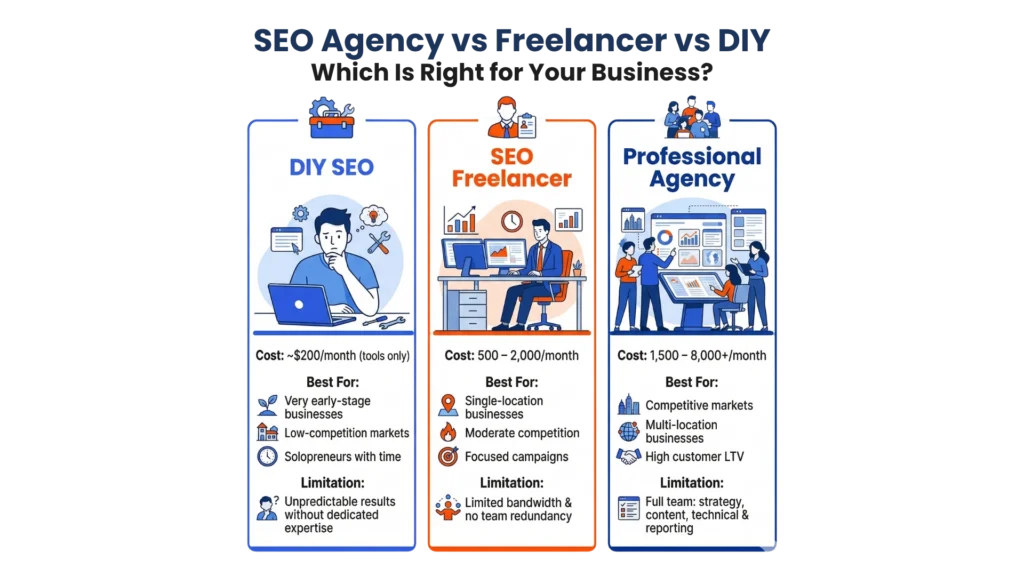
The right delivery model depends on your business stage, budget, and competitive environment.
DIY SEO
Viable for early-stage businesses or solopreneurs with significant time available and lower-competition local markets. The cost is primarily tools, around $100 to $200 per month for keyword research and rank-tracking software. The practical limitation is time and depth. SEO covers technical, content, and authority disciplines simultaneously. Doing each well while running a business is achievable only at a limited scale.
SEO Freelancer
A solid option for single-location businesses in moderate-competition markets. Freelancers typically charge $500 to $2,000 per month and provide more personalized attention than a large agency. The main limitation is bandwidth. A single specialist can only manage a finite number of tasks at once. There is also no redundancy if they become unavailable.
Professional SEO Agency
The appropriate model for competitive markets, multi-location businesses, or any sector where the customer lifetime value justifies a meaningful marketing investment. Agencies provide a full specialist team: a strategist, technical SEO specialist, content writers, link builders, and a reporting analyst. The work happens concurrently rather than sequentially, which compresses timelines and produces better results.
| When a Freelancer Works Well | When a Professional Agency Is Necessary |
| Single location, low to moderate competition | Multi-location or competitive local market |
| Budget under $1,500 per month | Budget $1,500 per month and above |
| One primary service to optimize | Multiple services, locations, or audience types |
| Long timeline acceptable | Growth targets require faster traction |
| Limited ongoing content needs | Regular content publication required |
What to Look for in a Professional SEO Service Provider
- They audit before they propose: Any credible SEO agency reviews your current site, rankings, and competitive landscape before recommending a strategy. Proposals issued without an audit are built on assumptions.
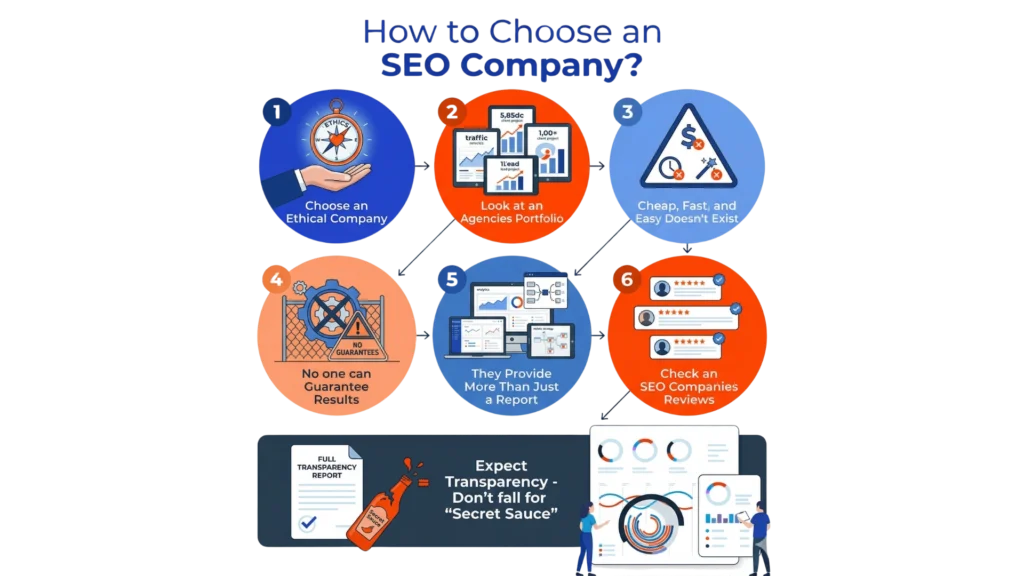
- They report on business outcomes: Monthly reports should include lead volume and conversion data, not just keyword rankings and organic sessions.
- They can rank their own site: Search for “SEO agency [city]” or “SEO services [city].” An agency that cannot rank for its own service keywords has a credibility problem.
- They explain their link-building approach clearly: Ask specifically where their backlinks come from. Vague answers often signal low-quality link farms or purchased links.
- They set realistic timelines: Positive ROI from SEO campaigns is typically achieved within 6 to 12 months. Agencies promising first-page rankings within 30 days are using risky tactics.
- They include E-E-A-T in their content approach: In 2026, Google’s quality systems require evidence of experience, expertise, authoritativeness, and trustworthiness. Agencies that do not mention E-E-A-T are not operating to current standards.
One Question That Reveals Everything
Ask any prospective SEO agency: “What will you do in the first 60 days?” The correct answer includes a technical audit, keyword strategy, competitor gap analysis, and a prioritized implementation roadmap. An agency that immediately describes blog topics and content calendars without reviewing your site first is optimizing in the wrong direction.
Conclusion
Most businesses are leaving organic leads on the table because their SEO program is missing one or more of the six components covered above. A technical foundation without content produces nothing to rank. Content without links does not build authority. Authority without technical health does not convert.
RankFast builds professional SEO programs that cover all six disciplines, with reporting that connects organic search directly to leads and revenue. We start with an honest audit of where you are, build a roadmap based on your market and goals, and deliver measurable results within a defined timeline.
Frequently Asked Questions
How long before professional SEO services show results?
Initial technical improvements can produce ranking movement within 4 to 8 weeks. Meaningful organic lead volume from new content becomes attributable by month 4 to 6. Positive ROI is achieved within 6 to 12 months for well-executed programs. Peak results arrive in year 2 or 3.
What is the difference between SEO services and digital marketing services?
Digital marketing services are a broad term covering paid advertising, social media management, email marketing, and content marketing. SEO services specifically refer to improving organic search visibility. When evaluating providers, confirm which specific SEO deliverables are included in the scope.
Are professional SEO services worth it for small businesses?
For most small businesses, professional SEO services produce a better long-term return than paid advertising for the same budget. 74% of small businesses invest in SEO, with average monthly services costing $497 at the entry level.
How do I know if my SEO agency is doing a good job?
Track three metrics: organic lead volume month over month, organic traffic to high-intent service pages, and keyword ranking positions for your primary commercial terms. A good agency provides this data in its monthly report and connects it to business outcomes.